
Update 26 October 2026
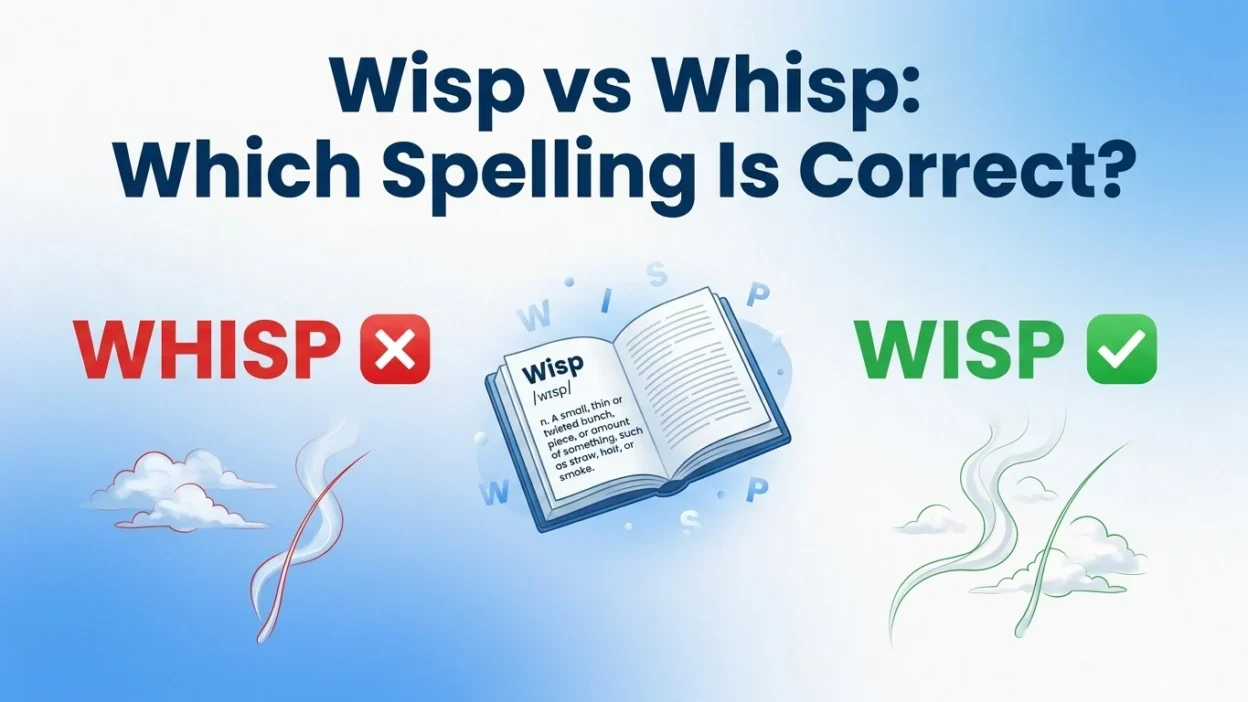
Have you ever wondered whether to write wisp or whisp? These two spellings look similar, so it is easy to confuse them. However, wisp is the standard and correct spelling in modern English, while whisp is generally considered a nonstandard or incorrect spelling when used with the same meaning. A wisp refers to a small, thin amount of something, such as smoke, hair, cloud, or grass.
Understanding the difference between wisp and whisp helps you improve your spelling and communicate more clearly. For example, you might describe a thin trail of smoke as “a wisp of smoke” or a small lock of hair as “a wisp of hair.” In both cases, wisp is the appropriate choice. Although whisp may appear in occasional informal writing, older texts, or as a variant spelling, it is not the usual form in contemporary standard English. This guide explains their meanings, correct usage, examples, and common mistakes so you can confidently choose the right word.
Quick Answer: Wisp vs Whisp
Wisp is the standard English spelling for a small, thin amount of something, such as smoke, hair, cloud, or straw. Whisp is generally a nonstandard variant or misspelling when used with the same meaning. In everyday writing, schoolwork, and professional communication, choose wisp.
Why Do People Confuse Wisp and Whisp?
People often confuse wisp and whisp because the words look and sound similar. Adding an “h” after the “w” may seem natural because English contains many words with the “wh” combination, including whisper, whistle, and whale.
However, spelling patterns do not always follow the same rules. The standard noun for a small, thin strand or amount is wisp, without an “h.”
Another reason for the confusion is that people may encounter unusual spellings in older writing, informal messages, or online content. Nevertheless, for modern standard English, wisp is the safest and most widely accepted choice.
What Does Wisp Mean?
Wisp is a noun that describes a small, thin, delicate, or scattered amount of something. It is commonly used for things that appear light, narrow, or difficult to hold together.
Common Meanings of Wisp
- A small amount of smoke: A wisp of smoke drifted from the chimney.
- A thin strand of hair: A wisp of hair fell across her forehead.
- A small piece or strand of something: A wisp of straw lay on the ground.
- A thin, light cloud: A wisp of cloud floated across the sky.
The word often creates a gentle or delicate image. For example, “a wisp of mist” suggests a thin, light layer of mist rather than a thick fog.
Is Wisp a Noun or a Verb?
Wisp is primarily used as a noun in modern English. It also appears in the expression “wisp of,” which identifies a small amount or strand of something.
For example:
- A wisp of smoke rose into the air.
- She tucked a wisp of hair behind her ear.
- A wisp of fog covered the hillside.
What Does Whisp Mean?
Whisp is sometimes found as a variant spelling of wisp, but it is not the standard spelling most English learners should use. In ordinary modern English writing, it is generally treated as a misspelling of wisp.
If you see whisp in a text, check the context. It might be a spelling error, an unusual historical form, or a name used in a specific context. Do not assume it is the correct everyday spelling simply because it appears online or in an older source.
For school assignments, essays, emails, and professional documents, use wisp when you mean a small, thin amount of something.
Wisp vs Whisp: Comparison Table
| Feature | Wisp | Whisp |
|---|---|---|
| Standard spelling | Yes | Generally no |
| Common meaning | A small, thin amount or strand | Usually intended to mean wisp |
| Typical usage | Modern standard English | Nonstandard or unusual usage |
| Example | A wisp of smoke rose upward. | Usually corrected to “a wisp of smoke” |
| Best choice for formal writing | Yes | No, unless it is a specific name or quoted form |
When Should You Use Wisp or Whisp?
When to Use Wisp
Use wisp when describing something thin, light, delicate, or present in a small amount. It is suitable for everyday conversations, creative writing, academic assignments, and professional communication.
Examples:
- A wisp of steam rose from the hot tea.
- A wisp of hair escaped from her braid.
- Wisps of cloud appeared above the mountains.
When to Avoid Whisp
Avoid whisp when you intend to use the ordinary English word for a thin strand or small amount. In most cases, replace it with wisp.
Incorrect: A whisp of smoke came through the window.
Correct: A wisp of smoke came through the window.
However, if Whisp is a proper name, a brand name, or a spelling preserved in a direct quotation, keep the original form when appropriate.
12 Examples of Wisp in Sentences
These examples show how to use wisp naturally in different contexts.
- A wisp of smoke rose from the campfire.
- She brushed a wisp of hair away from her eyes.
- A wisp of cloud drifted across the blue sky.
- The cold morning air carried a wisp of mist over the lake.
- A wisp of steam escaped from the kettle.
- He noticed a wisp of straw near the barn door.
- A wisp of dust floated through the sunlight.
- Only a wisp of fog remained after sunrise.
- The artist painted a delicate wisp of smoke above the candle.
- A wisp of ribbon fluttered in the breeze.
- Wisps of white cloud appeared over the distant hills.
- She tied back the loose wisps of hair around her face.
Examples Showing the Spelling Difference
- Nonstandard: A whisp of smoke rose from the fire.
- Standard: A wisp of smoke rose from the fire.
- Nonstandard: He removed a whisp of hair from his jacket.
- Standard: He removed a wisp of hair from his jacket.
These examples demonstrate the usual correction when both forms are intended to carry the same meaning.
Common Mistakes with Wisp and Whisp
Here are some errors to watch for when writing these words.
- Adding an unnecessary “h”: Writing whisp instead of wisp in ordinary sentences.
- Assuming similar words have similar spelling patterns: The spelling of whisper does not mean that wisp needs an “h.”
- Using the wrong word for the context: A wisp describes a small amount or strand, not every large or thick object.
- Copying an unusual spelling without checking it: A word appearing online does not automatically make it standard English.
- Changing a proper name unnecessarily: If Whisp is intentionally used as a name, preserve its spelling in that context.
To avoid these mistakes, remember both the spelling and the meaning of wisp.
Memory Trick: How to Remember Wisp
Use this simple memory trick:
WISP has no “H”—a wisp is a thin, wispy little thing.
Think of a thin strand of hair or a tiny trail of smoke. Both are delicate and light, just like the word wisp.
You can also connect wisp with wispy, an adjective meaning thin, delicate, or resembling a wisp.
Example: The morning mist looked wispy above the field.
Remembering the related word wispy can help you recall the correct spelling.
American vs British English: Wisp or Whisp
There is no usual American-versus-British spelling difference between these forms. Wisp is the standard spelling in both American and British English.
| English variety | Standard spelling | Nonstandard form |
|---|---|---|
| American English | Wisp | Whisp |
| British English | Wisp | Whisp |
Therefore, you do not need to change the spelling when switching between American and British English. Use wisp in both varieties when referring to a small, thin amount or strand.
Similar Words to Wisp
Several English words describe things that are small, thin, light, or delicate. However, each word has its own meaning.
- Wispy: Thin, delicate, or resembling a wisp. Example: wispy clouds.
- Strand: A thin piece of hair, thread, or another material. Example: a strand of hair.
- Sliver: A very thin or narrow piece of something. Example: a sliver of wood.
- Fleck: A tiny spot or particle. Example: a fleck of dust.
- Trace: A very small amount of something. Example: a trace of smoke.
- Tendril: A thin, curling part of a climbing plant. Example: a tendril of ivy.
- Filament: A very thin threadlike structure. Example: a filament of light.
Although these words are related in some contexts, they are not always interchangeable. For example, strand commonly refers to a single length of hair or thread, while wisp often suggests something light, delicate, or scattered.
Final Verdict: Wisp or Whisp?
Wisp is the correct standard spelling when you mean a small, thin amount of something, such as smoke, mist, hair, or cloud. By contrast, whisp is generally considered a nonstandard spelling or a mistake in ordinary modern English.
If you are writing an essay, an email, a school assignment, or a story, choose wisp. Remember that the word has no “h,” even though other English words, such as whisper and whistle, begin with “wh.”
FAQs:
1. Is wisp or whisp correct?
Wisp is the standard spelling in modern English. Whisp is generally nonstandard when used to mean a small, thin amount of something.
2. What does wisp mean?
A wisp is a small, thin, delicate amount or strand of something. Common examples include a wisp of smoke, a wisp of hair, and a wisp of cloud.
3. Is whisp ever a correct word?
Whisp appears as an occasional variant spelling and may also occur as a proper name. However, it is not the standard form for ordinary modern English writing when referring to a small strand or amount.
4. How do you spell wisp of smoke?
The correct spelling is wisp of smoke. For example, “A wisp of smoke rose from the chimney.”
5. Is wispy related to wisp?
Yes. Wispy is an adjective derived from wisp. It describes something thin, delicate, or resembling a wisp, such as wispy hair or wispy clouds.
6. Is wisp spelled the same in American and British English?
Yes. Wisp is the standard spelling in both American and British English. There is no regular regional spelling difference between the two forms.
7. Why do people write whisp instead of wisp?
People may add an “h” because they associate the sound or spelling with words such as whisper and whistle. However, the standard spelling of the noun is wisp.
Remember This
- Wisp = the standard English spelling.
- Whisp = generally nonstandard when used with the same meaning.
- A wisp can describe a small amount of smoke, mist, hair, cloud, or another thin material.
- American and British English both use wisp.
- Memory tip: A wisp is wispy, and neither word needs an “h” after the “w.”
Conclusion
Choosing between wisp and whisp is simple once you remember the standard spelling. Wisp is the correct everyday English word for a small, thin, or delicate amount of something. It commonly appears in phrases such as “a wisp of smoke,” “a wisp of hair,” and “a wisp of cloud.”
Although you may occasionally encounter whisp, it is generally not the preferred spelling in modern standard English. To make your writing clear and accurate, use wisp in schoolwork, professional communication, and everyday writing. Remember the connection between wisp and wispy, and you will find it easier to spell and use the word correctly.