
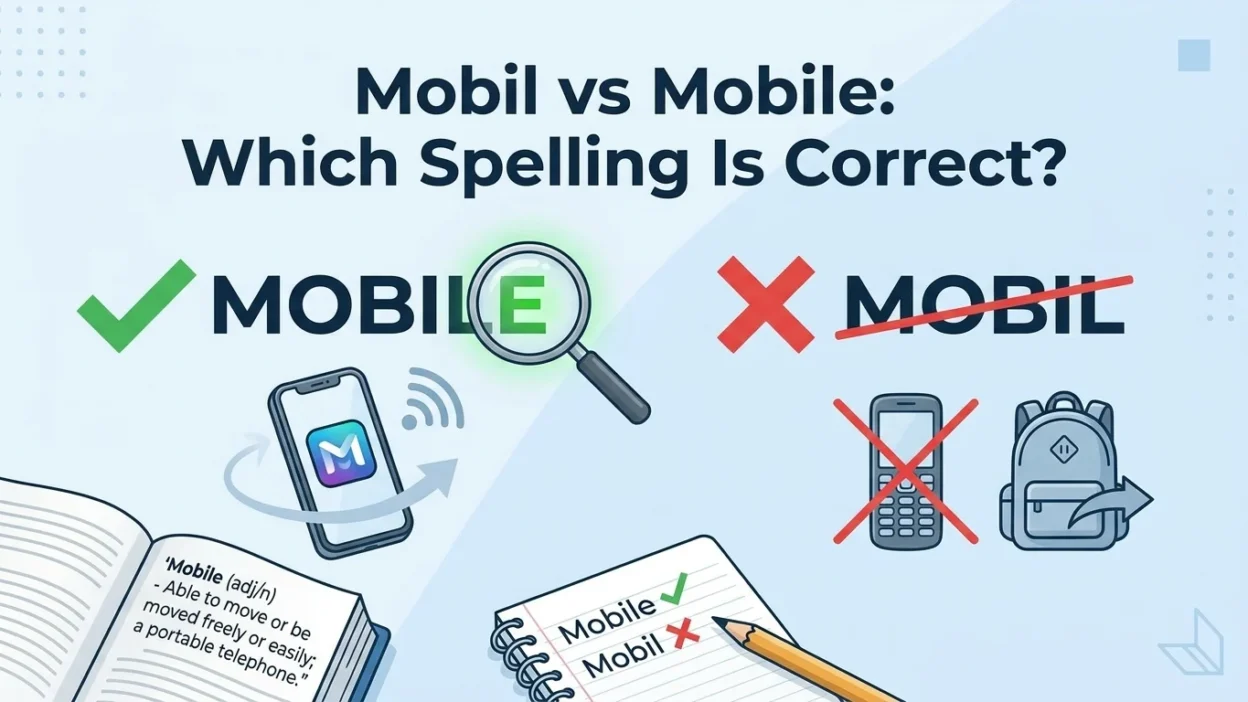
If you are wondering whether mobil or mobile is correct, the answer depends on the context. Mobile is the standard English word when you mean something that can move easily, a mobile phone, or something designed for movement. Mobil is not normally the correct spelling of this word in standard English, although it can appear as a brand name or proper name.
The confusion often happens because the final e in mobile may be weak or silent in pronunciation, depending on the variety of English and the word’s use. As a result, learners may write mobil because it seems to match the spoken form. However, in standard English writing, use mobile when referring to phones, movable objects, or things that can move. Understanding this spelling helps students, ESL learners, writers, and general readers communicate clearly.
Quick Answer
Mobile is the standard English spelling, while mobil is generally incorrect when you mean the common English word. Mobile can mean capable of moving, relating to a mobile phone, or designed for movement. For example, “I bought a new mobile phone.” Use mobile, with the final e.
Why Do People Confuse It?
People often confuse mobil and mobile because the final e in mobile is not strongly pronounced in many contexts.
When spoken, mobile can sound somewhat like:
mobil
This can make mobil seem like a reasonable spelling, especially for English learners who are writing words based on pronunciation.
However, the standard spelling is:
mobile ✅
Not:
mobil ❌
Another reason for confusion is that some languages spell related words without the final e. For example, words related to “mobile” may have forms similar to mobil in other languages.
In standard English, however, the usual word is mobile.
First Word: Mobil
Mobil is generally not the standard English spelling of the common word mobile.
If you mean a portable phone, something that can move, or something related to movement, use mobile.
Incorrect:
I bought a new mobil phone.
Correct:
I bought a new mobile phone.
However, Mobil can appear as part of a proper name or brand name. For example, Mobil is a trademark associated with a fuel and energy brand. In that case, the spelling is intentional and should not be changed.
Therefore, whether Mobil is correct depends on whether it is being used as a specific name or as the ordinary English word.
Second Word: Mobile
Mobile is the standard English word.
As an adjective, mobile means capable of moving or being moved.
The unit is mobile and can be transported easily.
It is also commonly associated with mobile phones:
She uses a mobile phone every day.
As a noun, particularly in British English, mobile can mean a mobile phone:
I left my mobile at home.
The word can also describe something that is not fixed in one location:
The clinic operates from a mobile unit.
Mobil vs Mobile: Comparison Table
| Word | Correct? | Common Use | Example |
|---|---|---|---|
| mobile | ✅ Yes | Movable, portable, or related to mobile phones | I bought a new mobile phone. |
| mobil | ❌ Generally no | Usually not the standard English spelling; may be a proper name | Mobil is a brand name. |
The key point is that mobile is the ordinary English word, while Mobil may be correct when referring to a specific name or brand.
When to Use Each
When to Use “Mobile”
Use mobile when referring to:
- something that can move
- something that is portable
- a mobile phone
- mobile technology
- a mobile application
- a mobile service
- a mobile unit
Examples:
The equipment is mobile.
She bought a new mobile phone.
The hospital has a mobile clinic.
When to Use “Mobil”
Do not normally use mobil as a shortened spelling of mobile in standard English.
However, use Mobil when it is part of an official name or trademark.
For example:
The station sells Mobil fuel.
In this case, Mobil is a proper name rather than an alternative spelling of the adjective mobile.
10+ Examples of Mobile
- I bought a new mobile phone.
- She keeps her mobile in her bag.
- The equipment is lightweight and mobile.
- The company developed a mobile application.
- We need a mobile internet connection.
- The clinic uses a mobile medical unit.
- He works from a mobile office.
- The camera is mounted on a mobile platform.
- Many students use mobile devices for learning.
- The service is available through a mobile app.
- The laboratory has a mobile testing unit.
- The machine is designed to be easily mobile.
These examples show how mobile can describe phones, technology, equipment, services, and things capable of movement.
Common Mistakes
The most common mistake is dropping the final e.
Incorrect:
I lost my mobil phone.
Correct:
I lost my mobile phone.
Another common mistake is assuming that words should always be spelled exactly as they sound. English pronunciation and spelling do not always match perfectly.
Remember that the standard word is:
mobile
with a final e.
It is also important not to confuse the ordinary word mobile with the brand name Mobil. The capitalized form can be correct when it refers to that specific trademark.
Memory Trick
A simple way to remember the spelling is:
Mobile has an E at the end.
Think of:
MOBILE → MOVE
Both words are connected with movement.
You can also remember a familiar phrase:
mobile phone
The word mobile always keeps its final e.
So remember:
MOBILE ✅
MOBIL ❌ for the ordinary English word
If you see Mobil with a capital M, check whether it is being used as a specific brand or name.
American vs British English
Mobile is the standard spelling in both American and British English.
However, the word is commonly used differently when referring to phones.
In British English, mobile or mobile phone is very common:
I forgot my mobile at home.
In American English, cell phone is more common:
I forgot my cell phone at home.
Americans also use mobile frequently as an adjective:
mobile technology
mobile device
mobile application
Therefore, the spelling remains mobile in both varieties, even though everyday phone vocabulary can differ.
Similar Words
Several words are related to mobile, but each has a slightly different meaning.
Portable
Portable means easy to carry or move.
This laptop is small and portable.
Movable
Movable means capable of being moved.
The shelves are movable.
Transportable
Transportable means suitable for being transported from one place to another.
The equipment is easily transportable.
Handheld
Handheld describes something designed to be held in the hand.
The technician uses a handheld device.
Wireless
Wireless refers to communication or connection without physical cables.
The phone has a wireless connection.
Cellular
Cellular is commonly used in American English when referring to mobile phone networks and technology.
The device supports cellular service.
These words are related to mobile, but they are not exact replacements in every sentence.
Final Verdict
Mobile is the standard English spelling when you mean something movable, portable, or related to mobile phones.
Mobil is generally not an alternative spelling of mobile in ordinary English. However, Mobil can be correct as a specific brand name or proper name.
Remember:
MOBILE ✅
MOBIL ❌ as the ordinary English word
The easiest way to remember it is to keep the final e: mobile.
Frequently Asked Questions
Is it mobil or mobile?
Mobile is the standard English spelling of the common word. Mobil is not normally used as an alternative spelling, although it can be a proper name or brand.
Is mobil a correct English word?
Mobil is not normally the standard spelling of the common English word mobile. It can, however, appear as a proper name or trademark.
How do you spell mobile correctly?
The correct spelling is M-O-B-I-L-E: mobile.
Why do people spell mobile as mobil?
The mistake often happens because the final e is not strongly pronounced, making mobile sound similar to mobil in some contexts.
Is mobile phone correct?
Yes. Mobile phone is a standard expression, especially common in British English and many other varieties of English.
Do Americans say mobile or cell phone?
Americans commonly say cell phone when referring to a mobile phone. Mobile phone is more strongly associated with British English and many other varieties.
Is Mobil a brand?
Yes. Mobil can be used as a brand name. In that context, the capitalized spelling Mobil is intentional and should not be treated as a misspelling of mobile.
Is mobile spelled differently in British and American English?
No. Mobile has the same spelling in both American and British English.
Remember This
Mobile = correct ✅
Mobil = generally incorrect as the ordinary English word ❌
Remember:
MOBILE has an E.
Use mobile for:
- mobile phone
- mobile device
- mobile app
- mobile technology
- mobile unit
- mobile equipment
Use Mobil only when it is part of a specific name or trademark.
Conclusion
The difference between mobil vs mobile is mainly a spelling issue, although Mobil can be correct when used as a specific brand or proper name. For the ordinary English word meaning movable, portable, or related to mobile phones, mobile is the correct spelling.
The easiest way to remember the difference is to keep the final e in mobile. Whether you are writing about a mobile phone, mobile technology, or mobile equipment, use mobile in standard English. The spelling is the same in American and British English, although Americans commonly use cell phone instead of mobile phone.