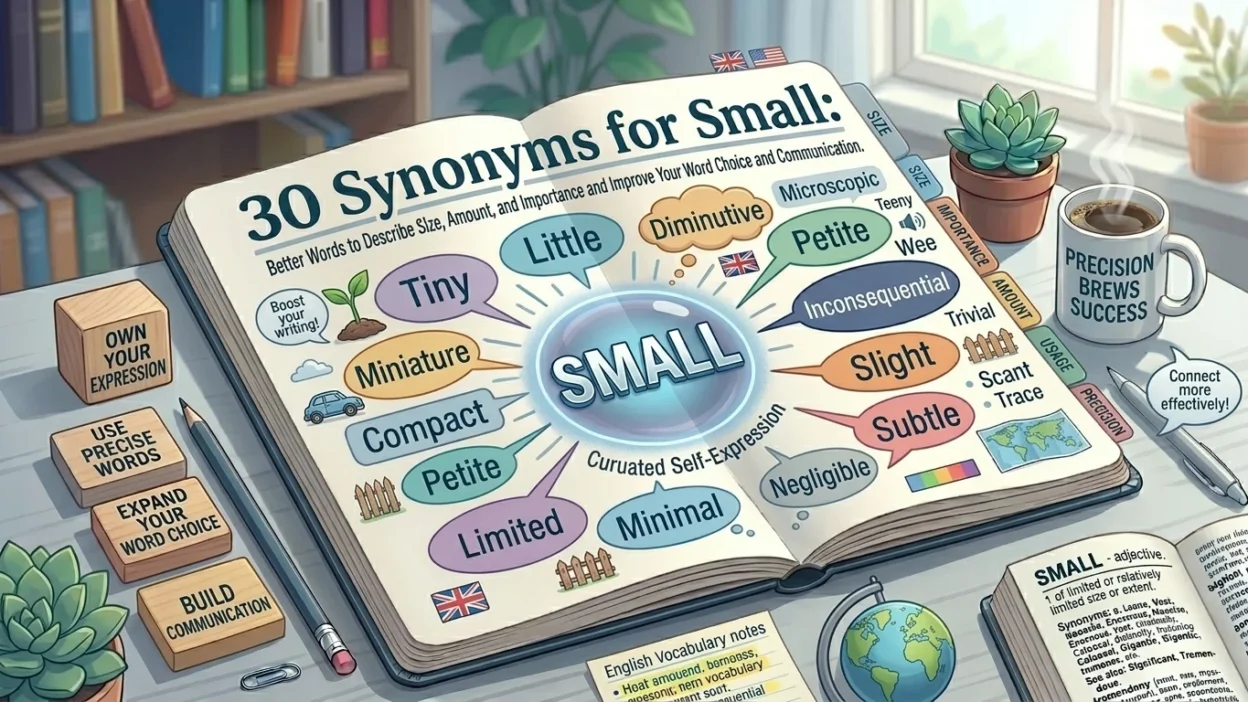
The word small is one of the most common words in English. It is used to describe size, quantity, importance, or even a short amount of time. While “small” is simple and useful, using the same word repeatedly can make your writing feel less creative.
Learning different synonyms for small helps students, ESL learners, writers, and content creators choose more accurate words. Some alternatives describe physical size, while others express limited amounts, minor importance, or gentle qualities.
In this guide, you will learn the meaning of “small,” discover 30 useful alternatives, understand their differences, and learn how to choose the right word for different situations.
What Does “Small” Mean?
The word small means little in size, amount, number, or importance. It can describe objects, people, places, problems, or ideas.
Examples:
- She lives in a small house.
- I made a small mistake.
- He has a small amount of money.
Although “small” works in many situations, choosing a more specific synonym can make your writing clearer and more professional.
30 Synonyms for Small
1. Little
Meaning: Small in size or amount.
Example Sentence: The little puppy was very cute.
Best Usage Context: Everyday conversation.
2. Tiny
Meaning: Extremely small.
Example Sentence: She found a tiny piece of paper.
Best Usage Context: Very small objects.
3. Miniature
Meaning: A smaller copy of something.
Example Sentence: He collects miniature cars.
Best Usage Context: Models and replicas.
4. Petite
Meaning: Small and delicate.
Example Sentence: She has a petite figure.
Best Usage Context: People and appearance.
5. Compact
Meaning: Small but efficiently arranged.
Example Sentence: This compact phone is easy to carry.
Best Usage Context: Products and design.
6. Minor
Meaning: Less important or serious.
Example Sentence: It was only a minor problem.
Best Usage Context: Issues and situations.
7. Slight
Meaning: Small in degree or amount.
Example Sentence: There was a slight change in the plan.
Best Usage Context: Small differences.
8. Limited
Meaning: Small in amount or availability.
Example Sentence: The store has limited supplies.
Best Usage Context: Resources and opportunities.
9. Narrow
Meaning: Small in width.
Example Sentence: They walked through a narrow path.
Best Usage Context: Spaces and measurements.
10. Brief
Meaning: Short in time or length.
Example Sentence: We had a brief conversation.
Best Usage Context: Time and communication.
11. Scant
Meaning: Very small or barely enough.
Example Sentence: The report provided scant information.
Best Usage Context: Formal writing.
12. Modest
Meaning: Not large or excessive.
Example Sentence: They live in a modest home.
Best Usage Context: Lifestyle and amounts.
13. Minimal
Meaning: Very small amount.
Example Sentence: The design uses minimal decoration.
Best Usage Context: Design and quantity.
14. Tiny-scale
Meaning: Very small in size or operation.
Example Sentence: They started a tiny-scale business.
Best Usage Context: Projects and activities.
15. Microscopic
Meaning: Extremely small and difficult to see.
Example Sentence: Scientists studied microscopic organisms.
Best Usage Context: Science and details.
16. Petite
Meaning: Small and attractive in appearance.
Example Sentence: The shop sells petite clothing.
Best Usage Context: Fashion and appearance.
17. Compact-sized
Meaning: Designed to save space.
Example Sentence: The compact-sized apartment is comfortable.
Best Usage Context: Homes and products.
18. Trivial
Meaning: Small and not important.
Example Sentence: They argued over a trivial matter.
Best Usage Context: Minor issues.
19. Insignificant
Meaning: Too small to matter.
Example Sentence: The difference was insignificant.
Best Usage Context: Importance and impact.
20. Negligible
Meaning: So small it can almost be ignored.
Example Sentence: The cost increase was negligible.
Best Usage Context: Numbers and measurements.
21. Minute
Meaning: Extremely small.
Example Sentence: The scientist noticed a minute detail.
Best Usage Context: Formal descriptions.
22. Subtle
Meaning: Small and not obvious.
Example Sentence: She made a subtle change to the design.
Best Usage Context: Details and differences.
23. Few
Meaning: A small number.
Example Sentence: Only a few people attended.
Best Usage Context: Quantity.
24. Scattered
Meaning: Small amounts spread around.
Example Sentence: There were scattered clouds in the sky.
Best Usage Context: Distribution.
25. Light
Meaning: Small in intensity or amount.
Example Sentence: There was light rain in the morning.
Best Usage Context: Weather and feelings.
26. Short
Meaning: Small in length or duration.
Example Sentence: We took a short break.
Best Usage Context: Time and distance.
27. Slightest
Meaning: The smallest possible amount.
Example Sentence: He did not show the slightest fear.
Best Usage Context: Emphasis.
28. Petite-sized
Meaning: Small in physical size.
Example Sentence: The store offers petite-sized clothing.
Best Usage Context: Fashion and products.
29. Moderate
Meaning: Not large, but also not extremely small.
Example Sentence: The company saw moderate growth.
Best Usage Context: Balanced descriptions.
30. Understated
Meaning: Simple and not excessive.
Example Sentence: She prefers an understated style.
Best Usage Context: Design and personality.
Comparison Table: When to Use Different Synonyms for Small
| Synonym | Tone | Best Used For |
|---|---|---|
| Little | Simple | Everyday objects |
| Tiny | Strong | Very small things |
| Compact | Professional | Products and design |
| Minor | Formal | Problems |
| Slight | Neutral | Small differences |
| Limited | Professional | Resources |
| Petite | Descriptive | People and clothing |
| Minimal | Modern | Design and quantity |
| Negligible | Technical | Numbers |
| Brief | General | Time |
How to Choose the Right Synonym for Small
For Physical Size
Use:
- Little
- Tiny
- Miniature
- Compact
- Petite
These describe objects, people, and places.
For Small Amounts
Use:
- Limited
- Minimal
- Few
- Scant
- Negligible
These describe quantities.
For Minor Importance
Use:
- Minor
- Trivial
- Insignificant
- Slight
These describe problems or effects.
For Professional Writing
Use:
- Moderate
- Minimal
- Negligible
- Limited
These sound more formal and precise.
Common Mistakes When Using Synonyms for Small
Using Words Without Understanding Meaning
Example:
“The problem was tiny.”
This may describe size, but “minor” is better for importance.
Better:
“The problem was minor.”
Choosing Strong Words Incorrectly
Example:
“The company had microscopic growth.”
This sounds unusual unless talking about extremely small scientific measurements.
Ignoring Context
A small object and a small problem need different words.
Why Learn Synonyms for Small?
Learning alternatives helps you:
- Improve vocabulary
- Avoid repetition
- Write more clearly
- Describe ideas accurately
- Improve academic and creative writing
A wider vocabulary allows you to communicate with more detail and confidence.
Conclusion
Learning synonyms for small helps you describe size, amount, and importance more accurately. Words like tiny, little, compact, minor, minimal, limited, and negligible allow you to express different meanings instead of repeating the same word.
The best synonym depends on your situation and the message you want to share. By practicing these words, students, ESL learners, writers, and content creators can improve their English skills and create more effective writing.