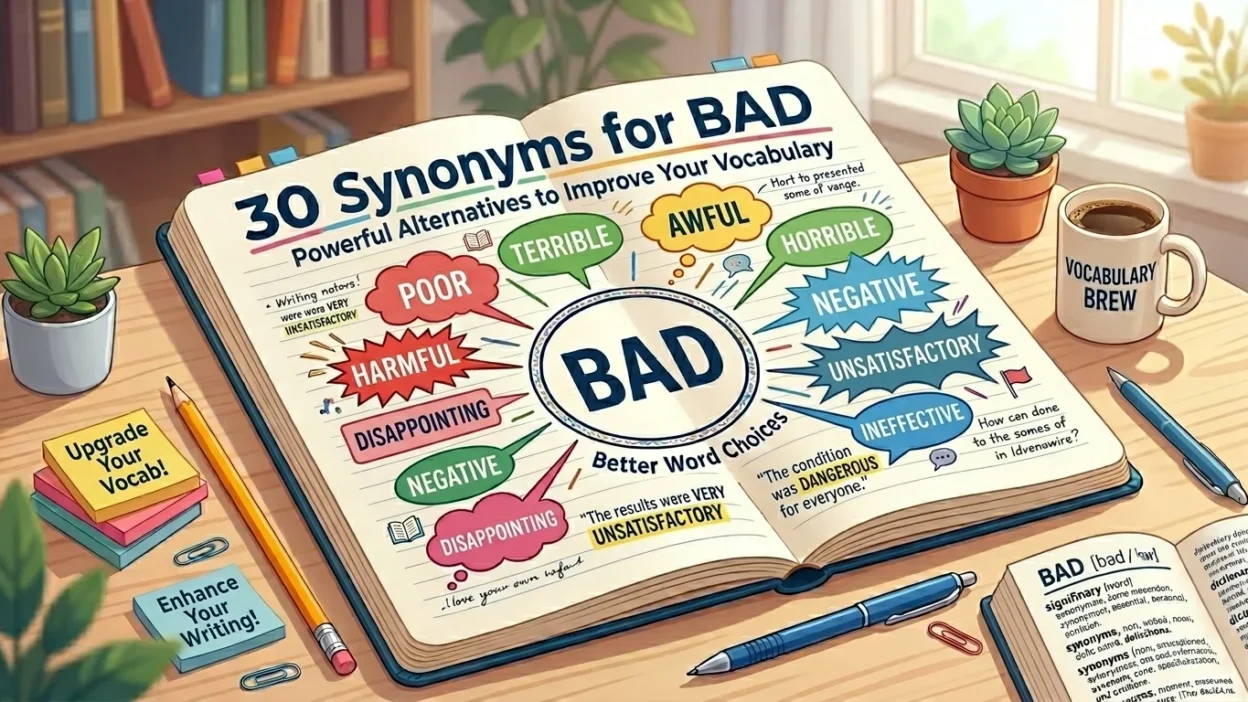
The word bad is one of the most commonly used words in English. People use it to describe poor quality, unpleasant experiences, mistakes, negative emotions, or things they do not like. While it is simple and useful, using the same word repeatedly can make writing sound repetitive and less expressive.
Learning different synonyms for bad helps students, ESL learners, writers, and content creators communicate more clearly. Some alternatives sound stronger, softer, more formal, or more descriptive depending on the situation.
In this guide, you’ll discover the meaning of bad, learn 30 useful alternatives, see examples for each word, and understand when to use them naturally in writing and conversation.
What Does “Bad” Mean?
The word bad describes something negative, poor in quality, unpleasant, harmful, incorrect, or disappointing.
Examples:
- The weather was bad yesterday.
- She had a bad experience at the restaurant.
- His exam result was bad.
Because “bad” has many meanings, choosing a more specific synonym often makes communication stronger.
30 Synonyms for Bad
1. Poor
Meaning: Low quality or not good.
Example: The report showed poor results.
Best Usage Context: General quality.
2. Terrible
Meaning: Extremely bad.
Example: We had terrible traffic.
Best Usage Context: Strong negative situations.
3. Awful
Meaning: Very unpleasant.
Example: The food tasted awful.
Best Usage Context: Casual conversation.
4. Horrible
Meaning: Extremely unpleasant.
Example: It was a horrible experience.
Best Usage Context: Emotional situations.
5. Unpleasant
Meaning: Not enjoyable.
Example: The smell was unpleasant.
Best Usage Context: Polite descriptions.
6. Negative
Meaning: Harmful or unfavorable.
Example: Negative comments affected her confidence.
Best Usage Context: Opinions and outcomes.
7. Inferior
Meaning: Lower quality.
Example: This material feels inferior.
Best Usage Context: Comparisons.
8. Unsatisfactory
Meaning: Not meeting expectations.
Example: The service was unsatisfactory.
Best Usage Context: Formal feedback.
9. Defective
Meaning: Having faults.
Example: The product arrived defective.
Best Usage Context: Products and manufacturing.
10. Faulty
Meaning: Not working correctly.
Example: The machine was faulty.
Best Usage Context: Technical issues.
11. Weak
Meaning: Lacking strength or quality.
Example: His argument was weak.
Best Usage Context: Performance.
12. Inadequate
Meaning: Not enough.
Example: Their preparation was inadequate.
Best Usage Context: Formal writing.
13. Harmful
Meaning: Causing damage.
Example: Smoking is harmful.
Best Usage Context: Health and safety.
14. Damaging
Meaning: Causing negative effects.
Example: Rumors can be damaging.
Best Usage Context: Impact discussions.
15. Severe
Meaning: Very serious.
Example: The storm caused severe damage.
Best Usage Context: Serious conditions.
16. Dreadful
Meaning: Extremely unpleasant.
Example: The hotel service was dreadful.
Best Usage Context: Strong opinions.
17. Unacceptable
Meaning: Not allowed or approved.
Example: That behavior is unacceptable.
Best Usage Context: Rules and standards.
18. Substandard
Meaning: Below normal quality.
Example: The work was substandard.
Best Usage Context: Professional evaluations.
19. Disappointing
Meaning: Not as good as expected.
Example: The movie was disappointing.
Best Usage Context: Reviews.
20. Miserable
Meaning: Very unpleasant emotionally.
Example: He felt miserable all day.
Best Usage Context: Feelings.
21. Unfortunate
Meaning: Causing regret.
Example: It was an unfortunate mistake.
Best Usage Context: Polite language.
22. Unfavorable
Meaning: Not beneficial.
Example: Market conditions were unfavorable.
Best Usage Context: Business and reports.
23. Wrong
Meaning: Incorrect or improper.
Example: That answer is wrong.
Best Usage Context: Accuracy.
24. Corrupt
Meaning: Morally dishonest.
Example: The official was corrupt.
Best Usage Context: Ethics and politics.
25. Toxic
Meaning: Harmful emotionally or physically.
Example: They left a toxic workplace.
Best Usage Context: Relationships and environments.
26. Dangerous
Meaning: Likely to cause harm.
Example: Driving carelessly is dangerous.
Best Usage Context: Safety.
27. Disastrous
Meaning: Extremely damaging.
Example: The launch was disastrous.
Best Usage Context: Major failures.
28. Unhealthy
Meaning: Harmful to well-being.
Example: Eating too much sugar is unhealthy.
Best Usage Context: Health.
29. Offensive
Meaning: Causing upset.
Example: The comment was offensive.
Best Usage Context: Social situations.
30. Ineffective
Meaning: Not producing results.
Example: Their strategy was ineffective.
Best Usage Context: Performance evaluation.
Comparison Table: When to Use Different Synonyms for Bad
| Synonym | Tone | Best Use |
|---|---|---|
| Poor | Neutral | General quality |
| Awful | Casual | Everyday opinions |
| Terrible | Strong | Serious complaints |
| Unsatisfactory | Formal | Reviews |
| Harmful | Serious | Health |
| Toxic | Modern | Relationships |
| Ineffective | Professional | Performance |
| Dangerous | Warning | Safety |
| Disappointing | Balanced | Reviews |
| Faulty | Technical | Products |
How to Choose the Right Synonym
Different synonyms for bad fit different situations.
For Everyday Conversation
Use:
- Poor
- Awful
- Terrible
- Disappointing
These sound natural and easy.
For Formal Writing
Use:
- Unsatisfactory
- Inadequate
- Inferior
- Substandard
These fit reports and academic work.
For Emotional Situations
Use:
- Miserable
- Horrible
- Dreadful
- Toxic
These express stronger feelings.
For Safety and Serious Topics
Use:
- Dangerous
- Harmful
- Severe
- Disastrous
These emphasize risk and consequences.
For Professional Feedback
Use:
- Faulty
- Ineffective
- Unacceptable
- Unfavorable
These work well in workplaces.
Common Mistakes When Using Synonyms for Bad
Using Very Strong Words Too Often
Words like “disastrous” or “horrible” can feel exaggerated.
Ignoring Context
Not every synonym fits every sentence.
Incorrect:
The sandwich was corrupt.
Correct:
The sandwich was awful.
Using Formal Words in Casual Speech
Choose words that match the situation and audience.
Why Learn Synonyms for Bad?
Knowing more alternatives helps you:
- Avoid repeating words
- Improve writing quality
- Express ideas clearly
- Sound more natural in English
- Build confidence in communication
- Create more engaging content
Conclusion
Learning useful synonyms for bad helps you communicate with more accuracy and confidence. While “bad” is simple and effective, alternatives like poor, terrible, harmful, disappointing, ineffective, and disastrous can make your writing stronger and more specific.
The best choice depends on tone, context, and purpose. By practicing these words regularly, students, ESL learners, writers, and content creators can build a richer and more flexible vocabulary.