
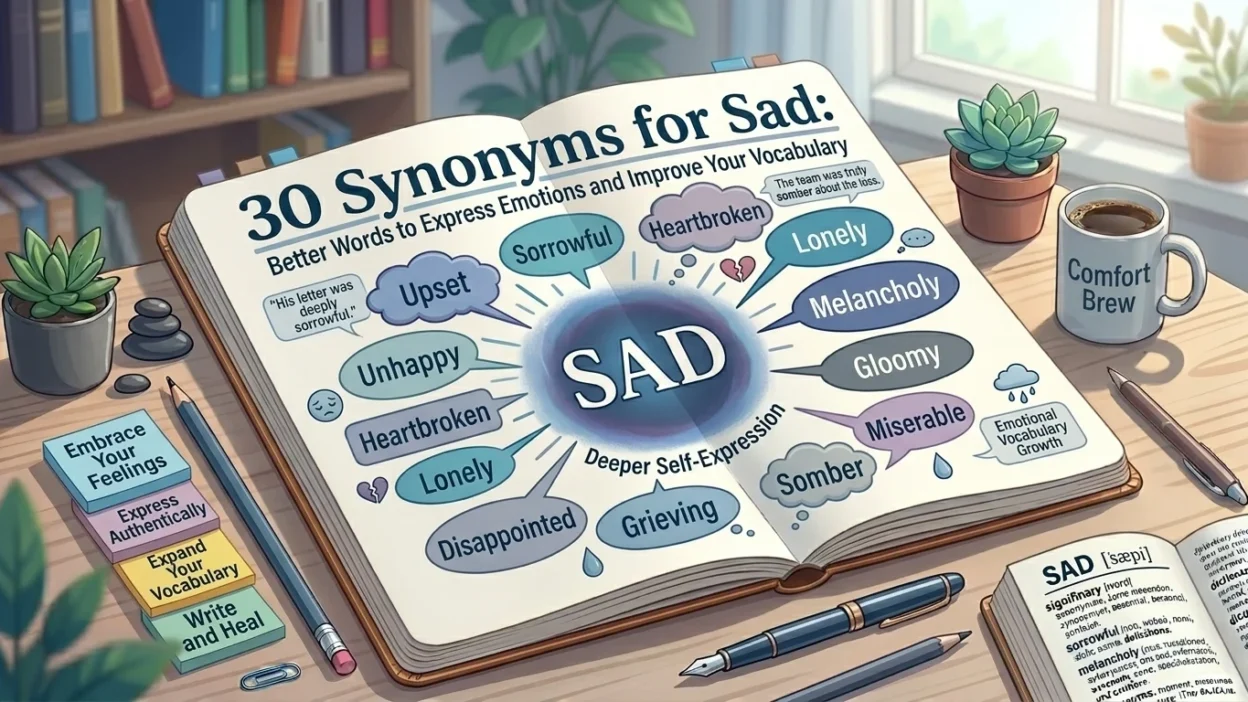
The word sad is one of the most common words used to describe negative emotions. We use it when we feel unhappy, disappointed, lonely, or upset. While “sad” is simple and easy to understand, using the same word repeatedly can make writing feel less expressive.
Learning different synonyms for sad helps students, ESL learners, writers, and content creators describe emotions more accurately. Some words show mild sadness, while others express deep sorrow, grief, or emotional pain.
In this guide, you will learn the meaning of “sad,” discover 30 useful alternatives, understand their differences, and learn how to choose the right word for different situations.
What Does “Sad” Mean?
The word sad describes a feeling of unhappiness, sorrow, disappointment, or emotional pain. It can happen because of a difficult situation, loss, failure, or something unpleasant.
Examples:
- She felt sad after hearing the bad news.
- He was sad about leaving his friends.
- The movie had a sad ending.
Although “sad” is useful, choosing a more specific synonym can make your writing more powerful and emotional.
30 Synonyms for Sad
1. Unhappy
Meaning: Feeling bad or not pleased.
Example Sentence: She was unhappy with the final decision.
Best Usage Context: General sadness.
2. Upset
Meaning: Feeling worried, hurt, or disturbed.
Example Sentence: He was upset after losing his phone.
Best Usage Context: Everyday emotions.
3. Sorrowful
Meaning: Feeling deep sadness.
Example Sentence: She gave a sorrowful goodbye.
Best Usage Context: Emotional situations.
4. Miserable
Meaning: Extremely unhappy.
Example Sentence: He felt miserable after the argument.
Best Usage Context: Strong negative feelings.
5. Depressed
Meaning: Feeling very low or without happiness.
Example Sentence: She felt depressed after many stressful events.
Best Usage Context: Serious emotional states.
6. Disappointed
Meaning: Feeling sad because expectations were not met.
Example Sentence: I was disappointed by the result.
Best Usage Context: Failures and unmet hopes.
7. Heartbroken
Meaning: Feeling extreme sadness or emotional pain.
Example Sentence: She was heartbroken after the breakup.
Best Usage Context: Deep emotional experiences.
8. Lonely
Meaning: Feeling alone or without support.
Example Sentence: He felt lonely after moving to a new city.
Best Usage Context: Isolation and relationships.
9. Gloomy
Meaning: Feeling dark, sad, or without hope.
Example Sentence: The rainy weather made everyone feel gloomy.
Best Usage Context: Mood and atmosphere.
10. Melancholy
Meaning: A quiet and thoughtful sadness.
Example Sentence: The old song created a melancholy feeling.
Best Usage Context: Writing and emotions.
11. Depressed
Meaning: Feeling very unhappy or emotionally low.
Example Sentence: The news left him feeling depressed.
Best Usage Context: Serious situations.
12. Distressed
Meaning: Feeling worried, upset, or troubled.
Example Sentence: She was distressed about the accident.
Best Usage Context: Stressful events.
13. Grieving
Meaning: Feeling sadness after a loss.
Example Sentence: The family was grieving after the loss.
Best Usage Context: Loss and mourning.
14. Regretful
Meaning: Feeling sorry about something.
Example Sentence: He felt regretful about his mistake.
Best Usage Context: Past actions.
15. Downhearted
Meaning: Feeling discouraged or sad.
Example Sentence: She felt downhearted after failing the test.
Best Usage Context: Disappointment.
16. Disheartened
Meaning: Losing confidence or hope.
Example Sentence: The team felt disheartened after the defeat.
Best Usage Context: Failure and setbacks.
17. Hopeless
Meaning: Feeling like nothing will improve.
Example Sentence: He felt hopeless during the difficult time.
Best Usage Context: Very serious emotions.
18. Blue
Meaning: Feeling sad or unhappy.
Example Sentence: She felt blue after saying goodbye.
Best Usage Context: Casual English.
19. Tearful
Meaning: Close to crying.
Example Sentence: She became tearful while watching the movie.
Best Usage Context: Emotional moments.
20. Somber
Meaning: Serious, quiet, and sad.
Example Sentence: The room became somber after the announcement.
Best Usage Context: Formal writing.
21. Wretched
Meaning: Feeling extremely unhappy.
Example Sentence: He felt wretched after the failure.
Best Usage Context: Strong emotions.
22. Regretful
Meaning: Feeling sadness because of a past action.
Example Sentence: She was regretful about her words.
Best Usage Context: Apologies and mistakes.
23. Pained
Meaning: Showing emotional suffering.
Example Sentence: He gave a pained expression.
Best Usage Context: Emotional descriptions.
24. Mournful
Meaning: Showing sadness, especially after loss.
Example Sentence: The song had a mournful sound.
Best Usage Context: Literature and emotions.
25. Dismal
Meaning: Very sad, unpleasant, or depressing.
Example Sentence: The situation looked dismal.
Best Usage Context: Situations and conditions.
26. Troubled
Meaning: Worried or emotionally disturbed.
Example Sentence: She looked troubled by the news.
Best Usage Context: Concerns and problems.
27. Vulnerable
Meaning: Feeling emotionally weak or exposed.
Example Sentence: He felt vulnerable after sharing his feelings.
Best Usage Context: Personal emotions.
28. Forlorn
Meaning: Feeling lonely and abandoned.
Example Sentence: The old house looked lonely and forlorn.
Best Usage Context: Descriptive writing.
29. Pessimistic
Meaning: Expecting negative results.
Example Sentence: He became pessimistic about the future.
Best Usage Context: Attitudes and opinions.
30. Woeful
Meaning: Full of sadness or sorrow.
Example Sentence: She told a woeful story.
Best Usage Context: Formal or literary writing.
Comparison Table: When to Use Different Synonyms for Sad
| Synonym | Tone | Best Used For |
|---|---|---|
| Unhappy | Simple | Everyday sadness |
| Upset | Casual | Problems and emotions |
| Disappointed | Mild | Failed expectations |
| Lonely | Emotional | Isolation |
| Heartbroken | Very strong | Loss and relationships |
| Grieving | Serious | Death or loss |
| Melancholy | Soft | Thoughtful sadness |
| Miserable | Strong | Deep unhappiness |
| Somber | Formal | Serious situations |
| Forlorn | Literary | Descriptive writing |
How to Choose the Right Synonym for Sad
For Everyday Conversations
Use:
- Sad
- Unhappy
- Upset
- Blue
These words sound natural and simple.
For Deep Emotional Pain
Use:
- Heartbroken
- Miserable
- Grieving
- Wretched
These express stronger emotions.
For Professional or Formal Writing
Use:
- Distressed
- Somber
- Disheartened
- Disappointed
These sound more appropriate in reports and essays.
For Creative Writing
Use:
- Melancholy
- Forlorn
- Mournful
- Gloomy
These create stronger emotional images.
Common Mistakes When Using Synonyms for Sad
Choosing Words That Are Too Strong
Example:
“I am heartbroken because my internet stopped.”
This sounds too extreme.
Better:
“I am upset because my internet stopped.”
Using Formal Words in Casual Speech
Words like “mournful” and “somber” may sound unnatural in daily conversations.
Ignoring the Situation
Different types of sadness require different words. A small disappointment and a major loss should not be described the same way.
Why Learn Synonyms for Sad?
Learning alternatives to “sad” helps you:
- Improve vocabulary
- Write better stories and essays
- Express emotions clearly
- Avoid repetition
- Communicate more naturally
A wider vocabulary allows you to describe feelings with accuracy and confidence.
Conclusion
Learning synonyms for sad helps you express emotions in a more meaningful way. While “sad” is a simple and common word, alternatives like unhappy, disappointed, heartbroken, melancholy, grieving, and sorrowful allow you to show different levels of emotion.
The best synonym depends on the situation, tone, and feeling you want to communicate. By practicing these words, students, ESL learners, writers, and content creators can improve their English skills and create more powerful writing.