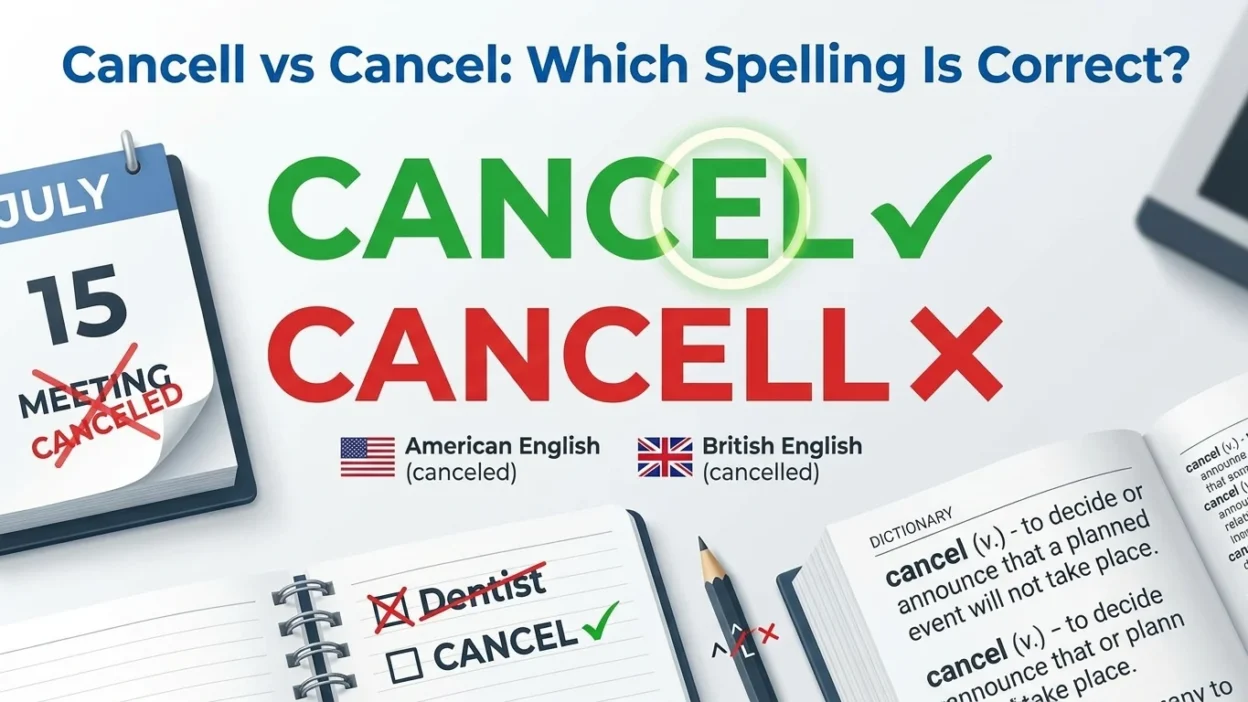
If you are wondering whether cancell or cancel is correct, cancel is the standard English spelling. Cancell is a misspelling and should not be used in standard English. The verb cancel means to stop something that was planned, arranged, or scheduled. For example, “We had to cancel the meeting because of bad weather.”
The confusion often comes from the different forms of cancel, especially canceled and cancelled. American English commonly uses canceled, while British English commonly uses cancelled with a double l. However, the base verb is always spelled cancel, not cancell. Understanding this distinction is useful for students, ESL learners, writers, and anyone who wants to avoid common spelling mistakes.
Quick Answer
Cancel is the correct spelling of the base verb. Cancell is incorrect. The word cancel means to stop, call off, or prevent something from happening as planned. For example, “They decided to cancel the trip.” The double l appears in cancelled in British English, not in the base form cancel.
Why Do People Confuse It?
People often write cancell because they know that some forms of cancel use two ls.
For example:
- British English: cancelled
- American English: canceled
This difference can make learners think that the base word should also contain two ls.
However, the base verb is:
cancel ✅
Not:
cancell ❌
The spelling becomes different when certain endings are added, but that does not change the spelling of the original verb.
First Word: Cancell
Cancell is not the standard spelling of the English verb.
If you mean “to stop something that was planned,” do not write:
We need to cancell the meeting.
Write:
We need to cancel the meeting.
The extra l is unnecessary in the base form.
This mistake can happen because cancelled is correctly spelled with two ls in British English.
Second Word: Cancel
Cancel is the correct standard spelling.
As a verb, cancel means to decide that something planned will not happen.
For example:
They had to cancel the flight.
It can also mean to stop an arrangement, appointment, subscription, event, order, or service.
Common expressions include:
- cancel a meeting
- cancel an appointment
- cancel a flight
- cancel an order
- cancel a subscription
- cancel a reservation
- cancel a plan
- cancel an event
The word can also be used in other contexts, such as mathematics, where one quantity can cancel another.
Cancell vs Cancel: Comparison Table
| Word | Correct? | Meaning | Example |
|---|---|---|---|
| cancel | ✅ Yes | To stop or call off something | We had to cancel the meeting. |
| cancell | ❌ No | Misspelling of cancel | Do not write “cancell.” |
The correct base form is always cancel.
When to Use Each
When to Use “Cancel”
Use cancel when you mean to stop something that was planned or arranged.
Examples:
Please cancel my appointment.
They decided to cancel the event.
I need to cancel my subscription.
You should also use cancel after helping verbs such as can, will, should, must, and to:
We need to cancel the order.
She will cancel the reservation.
You can cancel the booking online.
When to Use “Cancell”
Do not use cancell in standard English.
If you are unsure because you have seen cancelled, remember that cancelled is a different grammatical form of cancel, not the base spelling.
10+ Examples of Cancel
- We had to cancel the meeting.
- She decided to cancel her appointment.
- They may cancel the flight because of the storm.
- Please cancel my order.
- He wants to cancel his subscription.
- The organizers decided to cancel the event.
- I need to cancel my reservation.
- The school may cancel classes tomorrow.
- You can cancel the service at any time.
- They were forced to cancel the match.
- Please cancel the previous request.
- We should cancel the trip if the weather becomes dangerous.
Common Mistakes
Mistake 1: Adding an extra “l”
Incorrect:
I want to cancell the booking.
Correct:
I want to cancel the booking.
The base verb has only one l.
Mistake 2: Confusing “cancel” with “cancelled”
The forms can look different depending on the variety of English.
American English:
canceled
British English:
cancelled
However:
cancel ✅
is the base form in both varieties.
Mistake 3: Assuming every form has two “l”s
The spelling of a word can change when an ending is added. Therefore, do not use cancelled as a reason to spell the base verb cancell.
Think of the forms separately:
cancel → canceled in American English
cancel → cancelled in British English
Memory Trick
Use this simple rule:
One L in CANCEL, two Ls can appear in CANCELLED.
Remember:
CANCEL → one L
CANCELLED → two Ls in British English
You can also remember the phrase:
Cancel the extra L.
So:
CANCEL ✅
CANCELL ❌
American vs British English
The base spelling cancel is the same in American and British English.
The main difference appears in the past tense and past participle.
American English
American English commonly uses:
canceled
Example:
The airline canceled the flight.
British English
British English commonly uses:
cancelled
Example:
The airline cancelled the flight.
The -ing form is generally spelled cancelling in both varieties:
They are cancelling the event.
The important point is that neither variety uses cancell as the base verb.
Similar Words
Depending on the context, several words can have a meaning similar to cancel.
Call off
Call off means to decide that something planned will not happen.
They called off the meeting.
Stop
Stop means to bring an activity to an end.
The company stopped the service.
Abandon
Abandon means to give up a plan, activity, or attempt.
They abandoned the project.
Withdraw
Withdraw can mean to remove yourself or something from an arrangement or activity.
She withdrew her application.
Postpone
Postpone means to move something to a later time rather than canceling it completely.
They postponed the meeting until Friday.
It is therefore not always a direct replacement for cancel.
Final Verdict
Cancel is the correct standard English spelling.
Cancell is a misspelling and should not be used as the base form of the verb.
Remember:
CANCEL ✅
CANCELL ❌
The double l you may see in cancelled is a separate spelling issue. British English commonly uses cancelled, while American English commonly uses canceled. However, the base verb remains cancel in both varieties.
Frequently Asked Questions
Is it cancell or cancel?
Cancel is correct. Cancell is a misspelling.
Why does cancelled have two Ls?
In British English, cancelled is commonly spelled with two ls. American English commonly uses canceled with one l.
Is cancel spelled the same in American and British English?
Yes. The base verb is cancel in both American and British English.
Is cancell a word?
Cancell is not the standard English spelling of the verb. Use cancel instead.
Is it canceled or cancelled?
Both forms are used. Canceled is common in American English, while cancelled is common in British English.
How do you spell cancel in the past tense?
In American English, the usual spelling is canceled. In British English, the usual spelling is cancelled.
What is the difference between cancel and postpone?
To cancel means something will not happen as planned. To postpone means to delay it until a later time.
What is an example of cancel?
A simple example is: “We decided to cancel the meeting.”
Remember This
CANCEL = correct ✅
CANCELL = incorrect ❌
Remember the key rule:
One L in CANCEL.
When you add certain endings, the spelling may change:
cancel → canceled
cancel → cancelled
But never change the base word to cancell.
Conclusion
The correct spelling is cancel, not cancell. The verb is used when you stop an event, appointment, order, reservation, service, or other planned activity. Although the word can take different spellings when endings are added, its base form always remains cancel.
The main source of confusion is the spelling difference between canceled and cancelled. American English commonly uses canceled, while British English commonly uses cancelled. Therefore, if you are unsure about the base word, simply remember: cancel has one L.