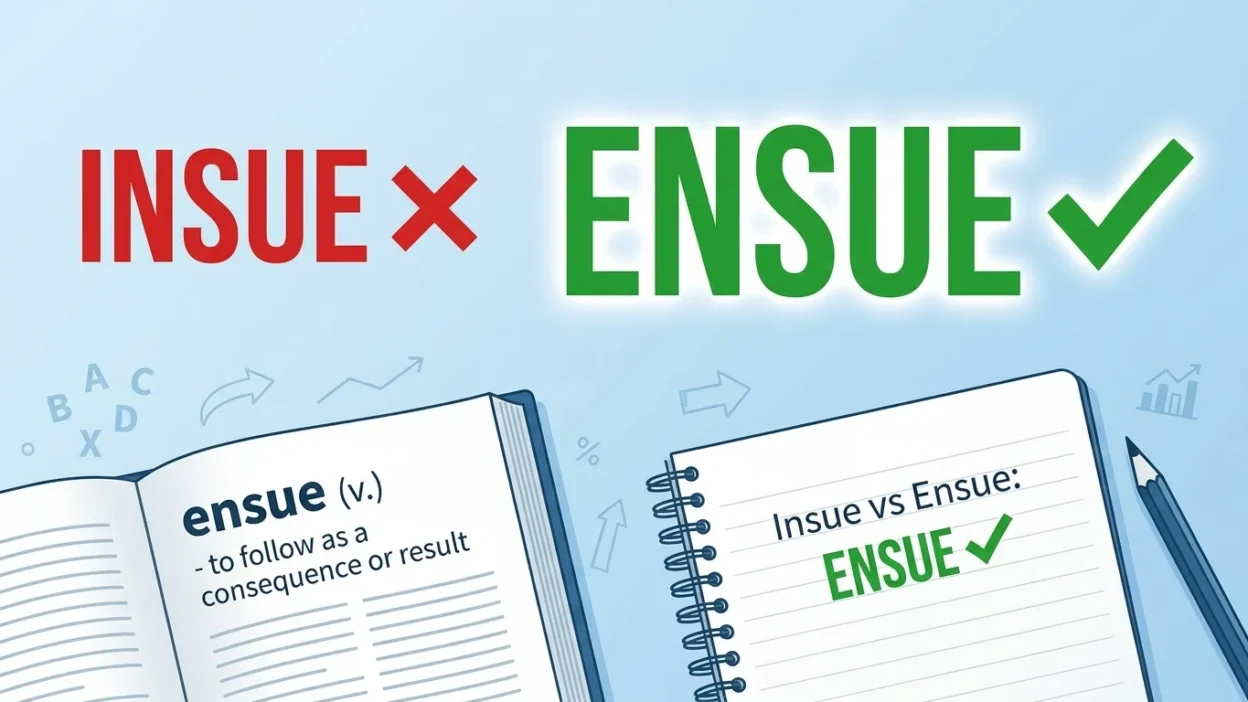
If you are confused about insue vs ensue, the correct English word is ensue. Insue is a common spelling mistake and is not the standard spelling of the verb. Ensue means to happen afterward, especially as a result of something that has already happened. For example, “A heated argument ensued after the meeting.” The word often appears in formal writing, news reports, stories, and academic contexts.
Because insue and ensue sound similar when spoken quickly, it is easy for learners and even experienced writers to mix them up. However, only ensue should be used when you mean that something happens or follows as a result. Learning the correct spelling and meaning can help you avoid mistakes in essays, emails, articles, and everyday writing. This guide explains insue vs ensue, shows how to use ensue correctly, and provides simple examples to make the difference easy to remember.
Quick Answer
Ensue is the correct spelling, while insue is a misspelling. Ensue means “to happen afterward” or “to follow as a result of something.” For example, “Confusion ensued after the announcement.” Use ensue when describing an event, situation, or consequence that follows another event.
Why Do People Confuse Insue and Ensue?
People often confuse insue and ensue because they look and sound very similar. The only major difference in spelling is the first vowel: in- versus en-.
However, English does not form every word by simply changing common prefixes. In this case, ensue is the established standard word. Insue is not the correct spelling when you want to say that something happened afterward.
For example:
- Correct: Chaos ensued after the power failed.
- Incorrect: Chaos insued after the power failed.
Therefore, when you mean “follow” or “happen afterward,” always choose ensue.
What Does “Insue” Mean?
Insue is generally considered a misspelling of ensue in modern standard English.
If you write “insue” when you mean “happen afterward,” readers will usually understand what you intended. However, the spelling is incorrect in standard contemporary English.
For formal writing, school assignments, professional communication, and published content, use ensue instead.
Is “Insue” a Word?
In standard modern English, insue is not the spelling you should use for the meaning “to happen afterward.” The correct word is ensue.
What Does “Ensue” Mean?
Ensue is a verb meaning to happen after something else or to follow as a result.
It is commonly used when one event leads to another event or situation.
For example:
- A long discussion ensued.
- Panic ensued after the alarm sounded.
- Several problems ensued from the mistake.
The word can describe positive, negative, or neutral results depending on the context.
Simple Definition of Ensue
Ensue = to happen afterward or to follow as a result.
Synonyms for Ensue
Depending on the sentence, useful alternatives include:
- follow
- happen afterward
- result
- occur
- come next
- develop
- arise
- follow on
However, these words are not always interchangeable in every sentence. Ensue is especially useful when one event follows another.
Insue vs Ensue: Comparison Table
| Word | Correct spelling? | Meaning | Example |
|---|---|---|---|
| insue | ❌ No | Usually a misspelling of ensue | ❌ Confusion insued after the announcement. |
| ensue | ✅ Yes | To happen afterward or follow as a result | ✅ Confusion ensued after the announcement. |
The key difference is simple: ensue is the correct word; insue is the incorrect spelling.
When Should You Use Each?
When to Use “Insue”
In standard modern English, you should not use insue when you mean “to happen afterward.”
If you see insue in your writing, proofreading, or a draft, check whether you intended to write ensue.
When to Use “Ensue”
Use ensue when something happens after another event, particularly when the second event is a consequence or development that follows the first.
For example:
An argument ensued after the decision was announced.
Here, the argument happened after the announcement.
Similarly:
Heavy rain caused flooding, and traffic problems ensued.
The traffic problems followed as a result of the flooding.
12 Examples of Ensue in a Sentence
Here are practical examples showing how ensue works in different contexts:
- A heated debate ensued after the proposal was introduced.
- Confusion ensued when the instructions were changed.
- A period of silence ensued after her question.
- Panic ensued when the fire alarm went off.
- Several delays ensued because of the storm.
- An awkward conversation ensued after the misunderstanding.
- A lively discussion ensued during the class.
- Chaos ensued when the crowd rushed toward the exit.
- Further problems ensued after the machine stopped working.
- A disagreement ensued between the two teams.
- Celebrations ensued after the final announcement.
- Unexpected changes ensued following the company’s decision.
Notice that ensue usually describes something that comes after another event. The word does not normally mean simply “to begin.”
Common Mistakes With Insue and Ensue
Mistake 1: Writing “insued”
A very common mistake is adding a past-tense ending to the incorrect spelling.
❌ An argument insued.
✅ An argument ensued.
The past tense of ensue is ensued.
Mistake 2: Writing “insues”
The same mistake can occur in the third-person singular form.
❌ Confusion insues after the announcement.
✅ Confusion ensues after the announcement.
Mistake 3: Confusing Ensue With Ensure
Ensue and ensure are different words.
- Ensue = happen afterward or follow as a result
- Ensure = make certain that something happens
For example:
A debate ensued after the announcement.
Please ensure that the door is locked.
Therefore, do not use ensure when you mean “happen afterward.”
Mistake 4: Assuming “Ensuing” Is Incorrect
Ensuing is a correct form related to ensue.
For example:
The ensuing discussion lasted two hours.
Here, ensuing means “following” or “happening afterward.”
Memory Trick: How to Remember Ensue
A simple way to remember ensue is:
ENsue = an Event comes Next.
Think of ensue as meaning:
“Something comes next.”
For example:
The announcement → confusion ensued.
The storm → delays ensued.
The victory → celebrations ensued.
Whenever you want to describe something that follows afterward, think of ensue.
American vs British English
There is no standard American-versus-British spelling difference between ensue and insue.
In both American English and British English, ensue is the standard spelling for the verb meaning “to happen afterward” or “to follow as a result.”
Therefore:
- American English: ensue
- British English: ensue
- Incorrect spelling: insue
The spelling does not change based on which variety of English you are using.
Similar Words to Ensue
Several words are related to ensue, but their meanings are not exactly the same.
Follow
Follow means to come after something in time, order, or sequence.
A short break followed the meeting.
Result
Result focuses on an outcome caused by something else.
Several problems resulted from the delay.
Occur
Occur simply means to happen.
The accident occurred late at night.
Arise
Arise often means that a problem, situation, or opportunity appears or develops.
Several questions arose during the discussion.
Ensuing
Ensuing is an adjective meaning “following” or “happening afterward.”
The ensuing debate attracted a large audience.
These words overlap with ensue, but each has its own typical use.
Final Verdict
When choosing between insue vs ensue, use ensue.
Ensue is the standard English verb meaning to happen afterward or to follow as a result. Insue is a misspelling when used with this meaning.
A useful example to remember is:
Confusion ensued after the announcement.
If you are unsure, remember that the correct spelling begins with en-, not in-.
Frequently Asked Questions
Is “insue” a correct English word?
No. Insue is generally a misspelling of ensue when the intended meaning is “to happen afterward” or “to follow as a result.”
What is the correct spelling, insue or ensue?
The correct spelling is ensue. For example, “A heated argument ensued after the meeting.”
What does ensue mean?
Ensue means to happen afterward or to follow as a result of something else.
What is the past tense of ensue?
The past tense is ensued.
Example: A long discussion ensued after the announcement.
What is the difference between ensue and ensure?
Ensue means “to happen afterward,” while ensure means “to make certain.”
Example: A debate ensued.
Example: Please ensure the documents are complete.
Is ensuing related to ensue?
Yes. Ensuing comes from ensue and means “following” or “happening afterward.”
Example: The ensuing discussion lasted for an hour.
Can I use “ensue” in formal writing?
Yes. Ensue is a standard English verb and can be used in formal writing, academic contexts, journalism, and everyday writing when appropriate.
Is ensue the same as follow?
They can have similar meanings, but they are not always interchangeable. Ensue often emphasizes that something happens afterward as a consequence or development, while follow has a broader range of meanings.
Remember This
Insue ❌
Ensue ✅
Ensue = happen afterward or follow as a result.
Think: An event comes next → it ensues.
Conclusion
The difference between insue vs ensue is straightforward once you remember the correct spelling. Ensue is the standard word, while insue is a misspelling when you mean that something happens afterward or follows as a result. The word can describe events such as arguments, discussions, confusion, celebrations, delays, or problems.
Therefore, use ensue in your writing whenever one event follows another. Also remember related forms such as ensued and ensuing, and avoid confusing ensue with ensure. With a little practice, this commonly confused spelling becomes much easier to recognize and use correctly.