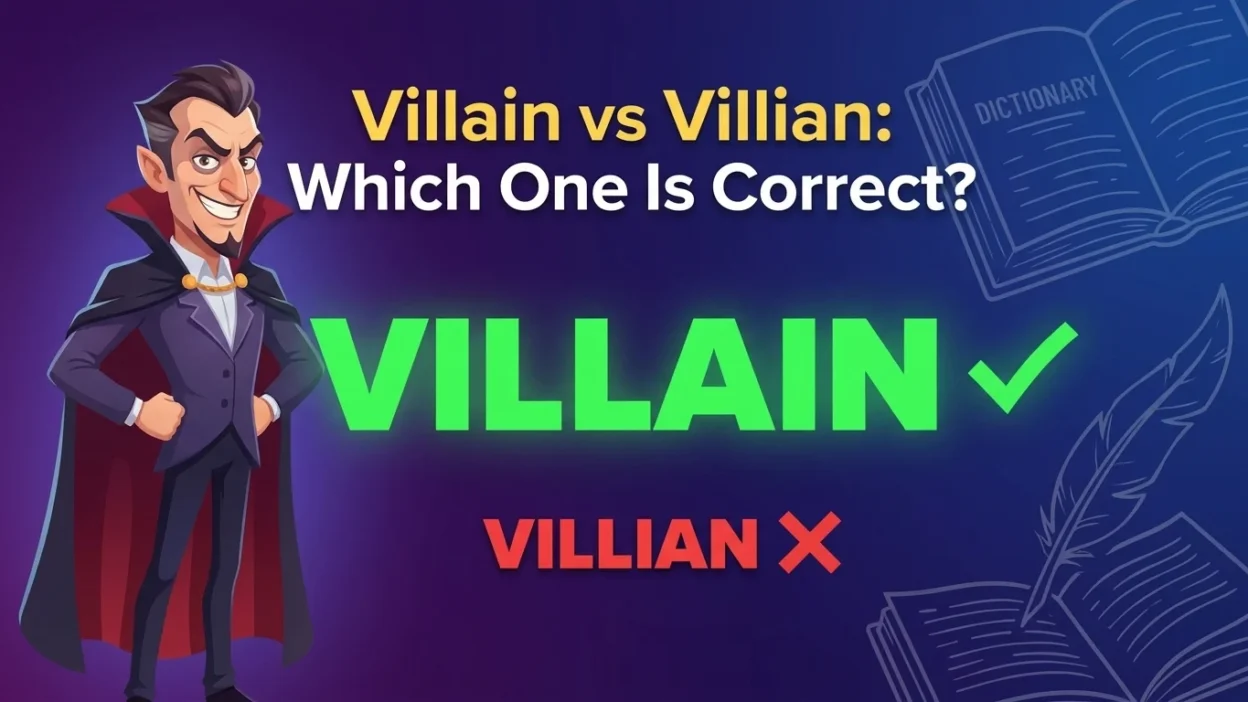
If you are confused about villain vs villian, the correct spelling is villain. Villian is a common spelling mistake and is not the standard spelling of the word. A villain is a character or person who does harmful, immoral, or opposing things, especially in a story, movie, play, or novel. For example, “The villain tried to destroy the city.” Remembering the correct spelling is especially useful for students, writers, ESL learners, and anyone who wants to improve their English vocabulary.
The confusion happens because villain is not spelled exactly as it sounds. When people say the word quickly, the middle sounds can make villian seem like a natural spelling. However, the letters -llain belong in the correct form. This guide explains the meaning and spelling of villain, shows why villian is incorrect, and provides practical examples, common mistakes, and memory tips to help you use the word confidently.
Quick Answer
Villain is the correct spelling, while villian is incorrect. A villain is a bad or harmful character, especially one who opposes the hero in a story. For example, “The villain escaped before the hero arrived.” Use villain in standard English writing.
Why Do People Confuse Villain and Villian?
People often confuse villain and villian because the word does not sound exactly like its spelling suggests. The final part, -lain, can be difficult to remember, especially when writing quickly.
Another reason is that English has many words ending in -ian, so villian may look familiar even though it is incorrect.
Compare these spellings:
- ❌ villian
- ✅ villain
The correct word has “ai” before the final “n”:
v i l l a i n
Therefore, when you mean an evil or opposing character, write villain, not villian.
What Does “Villain” Mean?
Villain is a noun that usually refers to a person or character who behaves in an evil, harmful, cruel, or morally wrong way.
In fiction, a villain is often the main character who opposes the hero or protagonist. Villains can appear in:
- movies
- novels
- fairy tales
- comics
- television shows
- video games
- plays
For example:
The villain planned to take control of the kingdom.
However, villain can also describe a real person who is considered responsible for harmful actions.
Simple Definition of Villain
Villain = a person or character who does harmful or evil things, especially an opponent of the hero.
Villain vs Antagonist
Although these words are related, they do not always mean exactly the same thing.
A villain is typically a morally bad or harmful character. An antagonist is a character or force that opposes the protagonist, but that character does not necessarily have to be evil.
For example, a rival, opposing team, natural force, or difficult circumstance can act as an antagonist without being a villain.
What Does “Villian” Mean?
Villian is an incorrect spelling of villain in standard modern English.
If you write villian, readers may understand what you mean from context, but the spelling should be corrected in formal writing, schoolwork, professional communication, and published content.
Correct:
The villain was defeated at the end of the story.
Incorrect:
The villian was defeated at the end of the story.
The easiest correction is to remember the “ai” in villain.
Villain vs Villian: Comparison Table
| Word | Correct Spelling? | Meaning | Example |
|---|---|---|---|
| villain | ✅ Yes | A harmful or evil person or character | The villain escaped from the castle. |
| villian | ❌ No | Misspelling of villain | ❌ The villian escaped from the castle. |
The main difference is spelling. Villain is correct, while villian is not.
When Should You Use Each?
When to Use “Villain”
Use villain whenever you are referring to an evil, harmful, or opposing character or person.
For example:
The villain threatened the entire village.
You can also use the word when discussing fictional characters:
The movie has a memorable villain.
When to Use “Villian”
In standard English, you should not use villian. If you see this spelling in your draft, it is usually a sign that you need to change it to villain.
12 Examples of Villain in a Sentence
- The villain wanted to rule the entire kingdom.
- The hero finally defeated the villain.
- The story introduces the villain in the first chapter.
- The villain secretly planned an attack on the city.
- Everyone feared the villain because of his cruel actions.
- The movie’s villain became one of its most memorable characters.
- The detective discovered that the villain had left a clue behind.
- The villain escaped before the police arrived.
- The author created a complex villain with understandable motives.
- The hero and villain faced each other in the final scene.
- The villain disguised himself to enter the palace.
- A good story often gives the villain a clear motivation.
These examples show that villain can be used in stories, movies, books, games, and discussions about characters or harmful people.
Common Mistakes With Villain and Villian
Mistake 1: Writing “Villian”
The most common mistake is switching the positions of a and i.
❌ villian
✅ villain
Remember that the correct middle spelling is -llai-.
Mistake 2: Adding the Wrong Ending
Some writers may write forms such as villan or villainy incorrectly because they are unsure about the base spelling.
The basic word is:
villain
Related words should be built from the correct spelling.
Mistake 3: Confusing Villain With Antagonist
A villain and an antagonist can overlap, but they are not always identical.
- Villain → usually a morally bad or harmful character
- Antagonist → a character or force that opposes the protagonist
Therefore, every villain can function as an antagonist, but not every antagonist is necessarily a villain.
Mistake 4: Confusing Villain With Hero
A hero is generally the central character who faces challenges and is presented positively, while a villain usually creates conflict or causes harm.
For example:
The hero protected the town from the villain.
Memory Trick: How to Remember Villain
A simple memory trick is:
Villain has “AI” in it.
Think:
VILLA + IN? ❌
VILLA + IN?
Instead, remember the correct sequence:
V I L L A I N
The word contains “AI” near the end:
vill + AI + n
So, when you are unsure between villain and villian, remember:
A villain has AI.
This can help you quickly recall the correct spelling.
American vs British English
There is no standard spelling difference between American and British English for villain.
Both varieties use:
- American English: villain
- British English: villain
Villian is not the standard spelling in either variety.
The pronunciation can vary somewhat by accent, but the spelling remains villain.
Similar Words to Villain
Several words are related to villain, but their meanings are slightly different.
Antagonist
An antagonist is a person, character, or force that opposes the protagonist.
The antagonist challenged the hero throughout the novel.
Enemy
An enemy is someone who is hostile toward another person or group.
The hero faced a powerful enemy.
Criminal
A criminal is a person who commits a crime.
The criminal was arrested by the police.
A criminal is not necessarily a villain in a fictional or moral sense.
Evil Character
An evil character is a fictional character who behaves in a deeply harmful or immoral way.
The novel’s evil character caused many problems.
Bad Guy
Bad guy is an informal expression often used for a villain or enemy.
The bad guy was defeated at the end.
Opponent
An opponent is someone who competes against or challenges another person.
The champion defeated his strongest opponent.
An opponent does not necessarily behave badly, so it is broader than villain.
Final Verdict
When choosing between villain vs villian, the correct spelling is villain.
Villain refers to a harmful, evil, or morally bad person or character, especially one who opposes the hero in a story. Villian is simply a misspelling and should be avoided in standard English.
The easiest way to remember the spelling is to focus on the “ai” in villain:
V I L L A I N ✅
Frequently Asked Questions
Is it villain or villian?
The correct spelling is villain. Villian is a misspelling.
What does villain mean?
A villain is a person or fictional character who behaves in a harmful, cruel, or evil way, especially one who opposes the hero.
Why do people spell villain as villian?
People often make this mistake because the pronunciation of villain can make the spelling difficult to remember. The familiar-looking -ian ending can also lead writers toward villian.
How do you spell villain correctly?
Spell it V-I-L-L-A-I-N.
A useful memory aid is: vill + AI + n.
What is the difference between a villain and an antagonist?
A villain is generally a morally bad or harmful character. An antagonist is someone or something that opposes the protagonist and does not necessarily have to be evil.
Is “villian” a word?
Villian is not the standard spelling of the English word villain. Use villain instead.
Is villain the same as bad guy?
In many informal contexts, bad guy can mean villain, particularly in stories and movies. However, villain is the more precise and standard term for a fictional character who causes harm or opposes the hero.
Is villain spelled the same in American and British English?
Yes. Villain is spelled the same in both American and British English.
Remember This
Villain ✅
Villian ❌
The correct spelling is:
V I L L A I N
Remember: A villain has “AI” in the spelling.
Conclusion
The villain vs villian confusion is mainly a spelling issue. Villain is the correct word, while villian is an incorrect spelling. A villain is usually a harmful or evil person or character, particularly one who creates conflict for the hero or protagonist in a story.
Whenever you need this word, remember the letters AI near the end: villain. This simple spelling trick can help students, ESL learners, writers, and general readers avoid the common villian mistake and use the word confidently in their writing.