
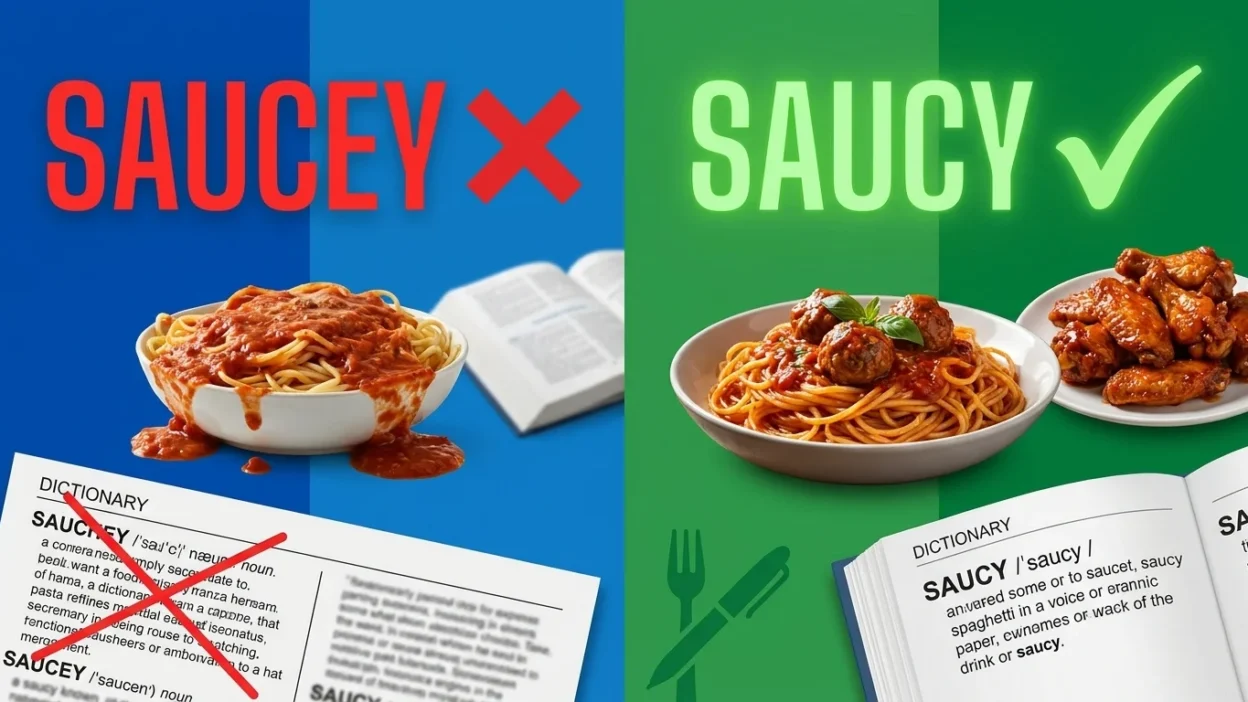
If you are confused about saucey vs saucy, the correct spelling depends on the meaning you intend, but saucy is the standard modern English spelling. Saucey is generally considered an incorrect or nonstandard spelling when you mean the adjective saucy. The word saucy can describe food containing plenty of sauce, or it can describe someone who is playful, cheeky, or slightly disrespectful. For example, you can say, “This pasta is very saucy,” or “That was a saucy comment.”
The confusion usually comes from the noun sauce, which is spelled with -ce. When forming the adjective, however, English changes the ending to -cy, giving us saucy, not saucey. This small spelling difference can be confusing for students, ESL learners, writers, and anyone learning English. In this guide, you will learn the difference between saucey and saucy, understand the meanings of saucy, see practical examples, and learn an easy way to remember the correct spelling.
Quick Answer
Saucy is the standard correct spelling, while saucey is generally a misspelling. Saucy can mean containing or covered with sauce, or it can describe someone who is cheeky, playful, or slightly bold. For example, “The chicken is saucy” and “He made a saucy remark.”
Why Do People Confuse Saucey and Saucy?
People often confuse saucey and saucy because the word comes from sauce. It seems logical to add -y directly to sauce, producing saucey.
However, English spelling does not always work by simply adding a letter or suffix to the original word. In this case, the standard adjective is formed as:
sauce → saucy
The final e is removed before -y is added.
Therefore:
- ❌ saucey
- ✅ saucy
The pronunciation can also contribute to the confusion because saucy sounds similar to what someone might expect from the spelling saucey.
What Does “Saucey” Mean?
Saucey is generally a nonstandard or incorrect spelling of saucy in modern English.
If you want to describe food as having a lot of sauce or describe someone as cheeky or playful, use saucy.
For example:
❌ The wings are very saucey.
✅ The wings are very saucy.
In standard writing, including schoolwork, professional communication, articles, and formal documents, saucy is the safer and correct spelling.
What Does “Saucy” Mean?
Saucy is an adjective with several meanings depending on context.
When describing food, saucy means containing or covered with a noticeable amount of sauce.
The pasta was rich and saucy.
When describing a person, comment, or behavior, saucy can mean cheeky, bold, playful, or slightly disrespectful.
The child gave a saucy reply to his teacher.
It can also describe something slightly suggestive or flirtatious, depending on the context.
The magazine included a saucy joke.
Simple Definition of Saucy
Saucy = containing plenty of sauce, or being cheeky, playful, bold, or slightly suggestive.
Saucy in Food
When talking about food, saucy often suggests that a dish has a generous amount of sauce or that the sauce is an important part of the dish.
Examples include:
- saucy chicken
- saucy pasta
- saucy noodles
- saucy wings
- saucy vegetables
Saucy in Personality or Behavior
When describing a person, saucy can suggest a confident, cheeky, or slightly disrespectful attitude.
She gave a saucy smile.
The exact meaning depends strongly on context.
Saucey vs Saucy: Comparison Table
| Word | Standard spelling? | Meaning | Example |
|---|---|---|---|
| saucey | ❌ Generally no | Nonstandard spelling of saucy | ❌ The noodles are saucey. |
| saucy | ✅ Yes | Full of sauce; cheeky, bold, or playful | ✅ The noodles are saucy. |
The key point is simple: saucy is the standard spelling.
When Should You Use Each?
When to Use “Saucey”
In standard modern English, avoid saucey when you mean saucy.
If you see saucey in your writing, it is usually best to change it to saucy.
When to Use “Saucy”
Use saucy when describing food with plenty of sauce.
The restaurant serves delicious saucy ribs.
Use it for a person’s cheeky or bold behavior:
He gave a saucy response.
You can also use it for something playful or slightly suggestive:
The advertisement had a saucy sense of humor.
Because saucy has several meanings, context is important.
12 Examples of Saucy in a Sentence
- The restaurant is famous for its saucy chicken wings.
- I ordered a bowl of saucy noodles for lunch.
- The pasta was creamy, rich, and saucy.
- These ribs are tender and wonderfully saucy.
- She gave him a saucy smile.
- The child made a saucy comment during dinner.
- He gave a saucy reply when his friend teased him.
- The comedian made a few saucy jokes.
- The sauce made the vegetables more flavorful and saucy.
- She has a playful and saucy personality.
- The advertisement used a saucy sense of humor.
- Add more sauce if you want the dish to be extra saucy.
These examples show why context matters. In food-related sentences, saucy usually relates to sauce. When describing people or behavior, it can mean cheeky, bold, playful, or slightly suggestive.
Common Mistakes With Saucey and Saucy
Mistake 1: Keeping the “e” From Sauce
A common mistake is assuming that sauce + y = saucey.
❌ saucey
✅ saucy
The standard spelling removes the final e before adding -y.
Mistake 2: Confusing Saucy With Sauce
Sauce and saucy are related but have different grammatical roles.
- Sauce → noun
- Saucy → adjective
For example:
The sauce is spicy.
The chicken is saucy.
Mistake 3: Assuming Saucy Only Describes Food
Saucy does not only describe food.
It can also describe a person, remark, smile, joke, or behavior.
He gave a saucy answer.
Here, saucy has nothing to do with food.
Mistake 4: Confusing Saucy With Spicy
Saucy and spicy are different words.
- Saucy → containing sauce or being cheeky/bold
- Spicy → containing spices or having a hot, strong flavor
For example:
The chicken is saucy but not very spicy.
Memory Trick: How to Remember Saucy
Use this simple spelling trick:
SAUCE → SAUCY
When sauce becomes an adjective, drop the final e and add y.
Think:
SAUCE + Y → SAUCY
Not:
SAUCE + Y → SAUCEY ❌
You can also remember:
Saucy drops the E.
This makes it easier to remember the correct spelling when writing quickly.
American vs British English
There is no standard American-versus-British spelling difference between saucy and saucey.
Both American English and British English use:
saucy
For example:
- American English: The chicken is saucy.
- British English: The chicken is saucy.
Saucey is generally not the standard spelling in either variety.
The word can have slightly different shades of meaning depending on context and regional usage, but its standard spelling remains saucy.
Similar Words to Saucy
Several words can be related to saucy, depending on the meaning.
Cheeky
Cheeky often means slightly rude or disrespectful in a playful way.
The child gave a cheeky grin.
Sassy
Sassy describes someone who is confident and lively, sometimes in a slightly disrespectful way.
She gave a sassy response.
Bold
Bold can describe confident or daring behavior.
He made a bold comment.
Playful
Playful means lighthearted, fun, or not serious.
She gave him a playful smile.
Flirtatious
Flirtatious describes behavior that shows romantic or sexual interest in a playful way.
He gave her a flirtatious smile.
Rich
When describing food, rich can refer to a strong, full flavor or texture.
The pasta had a rich sauce.
These words may overlap with saucy, but they are not exact replacements in every situation.
Final Verdict
When choosing between saucey vs saucy, use saucy.
Saucy is the standard English spelling and can describe food that contains plenty of sauce. It can also describe someone or something as cheeky, bold, playful, or slightly suggestive depending on context.
Saucey is generally considered a misspelling in standard modern English. The easiest way to remember the correct form is:
SAUCE → SAUCY
Drop the final e before adding -y.
Frequently Asked Questions
Is it saucey or saucy?
The standard spelling is saucy. Saucey is generally considered a misspelling.
What does saucy mean when describing food?
When describing food, saucy means containing or covered with a noticeable amount of sauce.
Example: The chicken wings are very saucy.
What does saucy mean when describing a person?
When describing a person, saucy can mean cheeky, bold, playful, or slightly disrespectful. In some contexts, it can also mean slightly suggestive or flirtatious.
Why is saucy spelled without an “e”?
The standard spelling changes sauce to saucy by removing the final e before adding -y.
Is saucey ever correct?
Saucey is not the standard spelling of the adjective saucy in modern English. In ordinary writing, use saucy.
Is saucy the same as spicy?
No. Saucy usually means containing plenty of sauce, while spicy means having a strong or hot flavor caused by spices.
What is the difference between sauce and saucy?
Sauce is a noun for a liquid or semi-liquid food accompaniment. Saucy is an adjective describing something that contains or has a lot of sauce, or something cheeky or bold.
Is saucy spelled the same in American and British English?
Yes. Saucy is the standard spelling in both American and British English.
Remember This
Saucy ✅
Saucey ❌
Remember:
SAUCE → SAUCY
Drop the E, then add Y.
Conclusion
The difference between saucey vs saucy is mainly a spelling issue. Saucy is the standard English spelling, while saucey is generally considered incorrect. When talking about food, saucy describes something containing plenty of sauce. When talking about people or behavior, it can describe someone as cheeky, bold, playful, or slightly suggestive.
The easiest way to remember the spelling is to connect saucy with sauce: remove the final e and add y. Once you remember SAUCE → SAUCY, you can avoid the common saucey mistake and use the word confidently in everyday and formal writing.