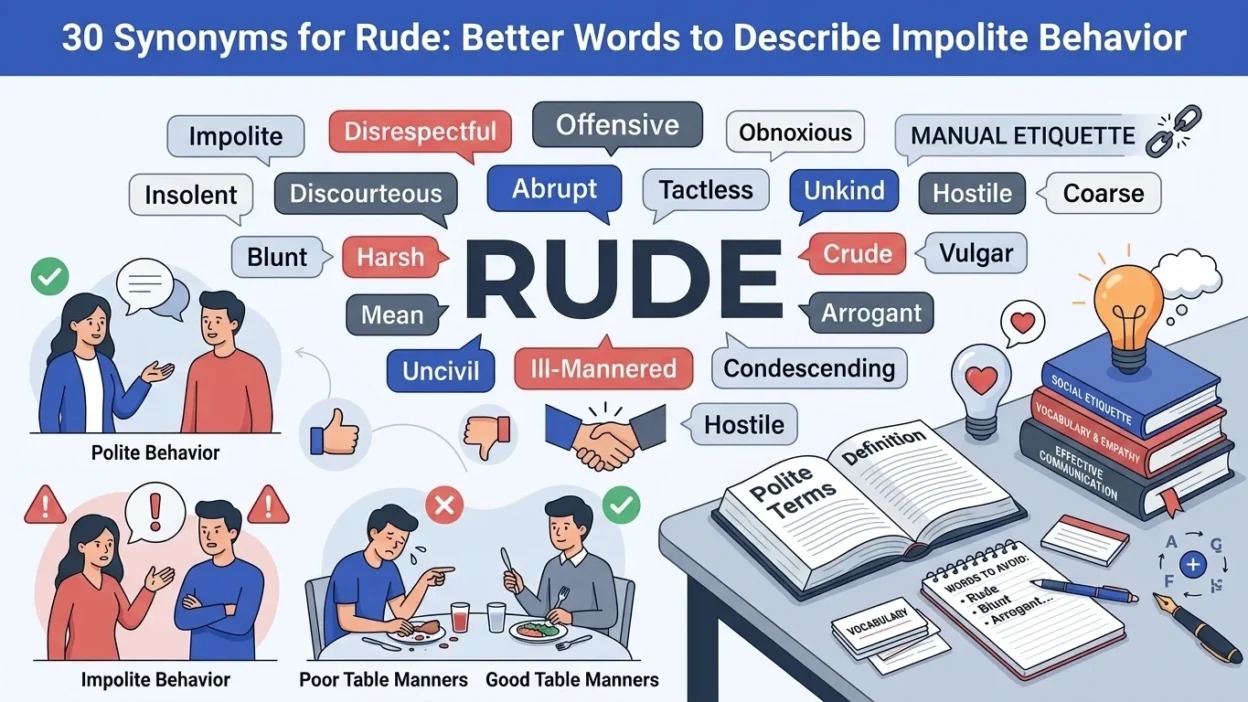
The word rude is commonly used to describe someone who behaves in an impolite, disrespectful, or offensive way. While it is a useful word, using it repeatedly can make your writing sound repetitive. English offers many alternatives that describe different levels and types of rude behavior.
Learning synonyms for rude helps students, ESL learners, writers, and content creators choose more accurate words. Some synonyms describe mild discourtesy, while others express stronger meanings such as insulting, offensive, or disrespectful behavior.
In this guide, you will learn the meaning of rude, discover 30 useful synonyms, understand when each word works best, and improve your English vocabulary with simple explanations and examples.
What Does “Rude” Mean?
Meaning and Usage
The word rude describes behavior that lacks good manners, respect, or politeness. A rude person may interrupt others, speak harshly, ignore social rules, or act without considering another person’s feelings.
Examples:
- It was rude to interrupt the meeting.
- He made a rude comment during dinner.
- Please don’t be rude to the staff.
The meaning of rude can vary depending on the situation. It may describe impolite words, disrespectful actions, or offensive behavior.
30 Synonyms for Rude
1. Impolite
Meaning: Not showing good manners.
Example Sentence: It is impolite to talk loudly in a library.
Best Usage Context: Everyday conversations.
2. Disrespectful
Meaning: Showing little or no respect.
Example Sentence: His disrespectful attitude upset everyone.
Best Usage Context: Schools and workplaces.
3. Offensive
Meaning: Likely to upset or insult others.
Example Sentence: The joke was offensive to many people.
Best Usage Context: Formal discussions.
4. Insolent
Meaning: Boldly disrespectful.
Example Sentence: The student gave an insolent reply.
Best Usage Context: Formal writing.
5. Discourteous
Meaning: Not polite or considerate.
Example Sentence: The driver’s discourteous behavior caused complaints.
Best Usage Context: Professional communication.
6. Abrupt
Meaning: Suddenly unfriendly or short.
Example Sentence: Her abrupt answer surprised me.
Best Usage Context: Conversations.
7. Blunt
Meaning: Speaking very directly without considering feelings.
Example Sentence: His blunt comments sounded rude.
Best Usage Context: Honest conversations.
8. Harsh
Meaning: Very severe or unpleasant.
Example Sentence: The teacher’s harsh criticism made him sad.
Best Usage Context: Feedback and criticism.
9. Crude
Meaning: Lacking refinement or politeness.
Example Sentence: The comedian made crude jokes.
Best Usage Context: Informal behavior.
10. Vulgar
Meaning: Using offensive language or behavior.
Example Sentence: Vulgar language is not appropriate at work.
Best Usage Context: Formal situations.
11. Uncivil
Meaning: Not courteous.
Example Sentence: Their uncivil behavior ended the discussion.
Best Usage Context: Formal writing.
12. Ill-Mannered
Meaning: Having bad manners.
Example Sentence: The ill-mannered guest ignored everyone.
Best Usage Context: Character descriptions.
13. Unkind
Meaning: Not caring or considerate.
Example Sentence: His unkind words hurt her feelings.
Best Usage Context: Emotional situations.
14. Mean
Meaning: Intentionally hurtful.
Example Sentence: It was mean to laugh at him.
Best Usage Context: Everyday English.
15. Hostile
Meaning: Showing anger or opposition.
Example Sentence: The conversation became hostile.
Best Usage Context: Serious conflicts.
16. Arrogant
Meaning: Acting as if you are better than others.
Example Sentence: His arrogant behavior annoyed everyone.
Best Usage Context: Personality descriptions.
17. Condescending
Meaning: Acting as though others are less important.
Example Sentence: She spoke in a condescending tone.
Best Usage Context: Professional settings.
18. Snobbish
Meaning: Looking down on others.
Example Sentence: His snobbish attitude made him unpopular.
Best Usage Context: Social situations.
19. Sarcastic
Meaning: Using irony to mock someone.
Example Sentence: Her sarcastic remark sounded rude.
Best Usage Context: Informal conversations.
20. Dismissive
Meaning: Showing little interest or respect.
Example Sentence: He was dismissive of my ideas.
Best Usage Context: Workplace discussions.
21. Insulting
Meaning: Designed to offend.
Example Sentence: That comment was insulting.
Best Usage Context: Arguments.
22. Obnoxious
Meaning: Extremely unpleasant.
Example Sentence: His obnoxious behavior drove people away.
Best Usage Context: Informal writing.
23. Boorish
Meaning: Rough and bad-mannered.
Example Sentence: The boorish customer shouted at everyone.
Best Usage Context: Formal vocabulary.
24. Churlish
Meaning: Rude and difficult to deal with.
Example Sentence: His churlish reply ended the conversation.
Best Usage Context: Literary or formal writing.
25. Curt
Meaning: Rudely brief.
Example Sentence: She gave a curt response.
Best Usage Context: Business communication.
26. Tactless
Meaning: Not careful with words.
Example Sentence: His tactless joke embarrassed everyone.
Best Usage Context: Social interactions.
27. Inconsiderate
Meaning: Not thinking about others.
Example Sentence: Parking there was inconsiderate.
Best Usage Context: Daily situations.
28. Thoughtless
Meaning: Not considering other people’s feelings.
Example Sentence: That was a thoughtless thing to say.
Best Usage Context: Personal relationships.
29. Overbearing
Meaning: Too controlling and bossy.
Example Sentence: Her overbearing manner frustrated the team.
Best Usage Context: Leadership descriptions.
30. Coarse
Meaning: Rough in speech or behavior.
Example Sentence: His coarse language shocked everyone.
Best Usage Context: Formal descriptions.
Comparison Guide
When to Use Different Synonyms for Rude
| Synonym | Meaning Focus | Best Use |
|---|---|---|
| Impolite | Bad manners | Everyday conversations |
| Disrespectful | Lack of respect | School and workplace |
| Offensive | Causing offense | Formal discussions |
| Blunt | Direct speech | Honest conversations |
| Harsh | Severe language | Criticism |
| Mean | Intentionally hurtful | Informal English |
| Arrogant | Feeling superior | Personality descriptions |
| Tactless | Speaking without care | Social situations |
How to Choose the Right Synonym
For Everyday Conversations
Use:
- Impolite
- Mean
- Unkind
- Inconsiderate
- Thoughtless
These are simple, common, and easy to understand.
For Formal Writing
Use:
- Discourteous
- Insolent
- Uncivil
- Churlish
- Boorish
These words sound more professional and formal.
For Workplace or School Situations
Use:
- Disrespectful
- Curt
- Dismissive
- Condescending
- Abrupt
These describe behavior in professional environments.
For Strong Negative Behavior
Use:
- Offensive
- Hostile
- Obnoxious
- Vulgar
- Coarse
These express stronger levels of rudeness and should be used carefully.
Why Learning Synonyms for Rude Matters
Using different synonyms instead of repeating rude makes your writing more accurate and expressive. Some words describe mild impoliteness, while others explain disrespect, arrogance, or offensive behavior.
Students, ESL learners, writers, and content creators can improve both speaking and writing by choosing the synonym that best matches the situation and tone.
Conclusion
Learning synonyms for rude helps you describe behavior with greater precision. Whether you choose impolite, disrespectful, tactless, or offensive, selecting the right word makes your communication clearer and more effective.
Expanding your vocabulary also improves your writing style, helps avoid repetition, and allows you to express ideas naturally in both formal and informal English.