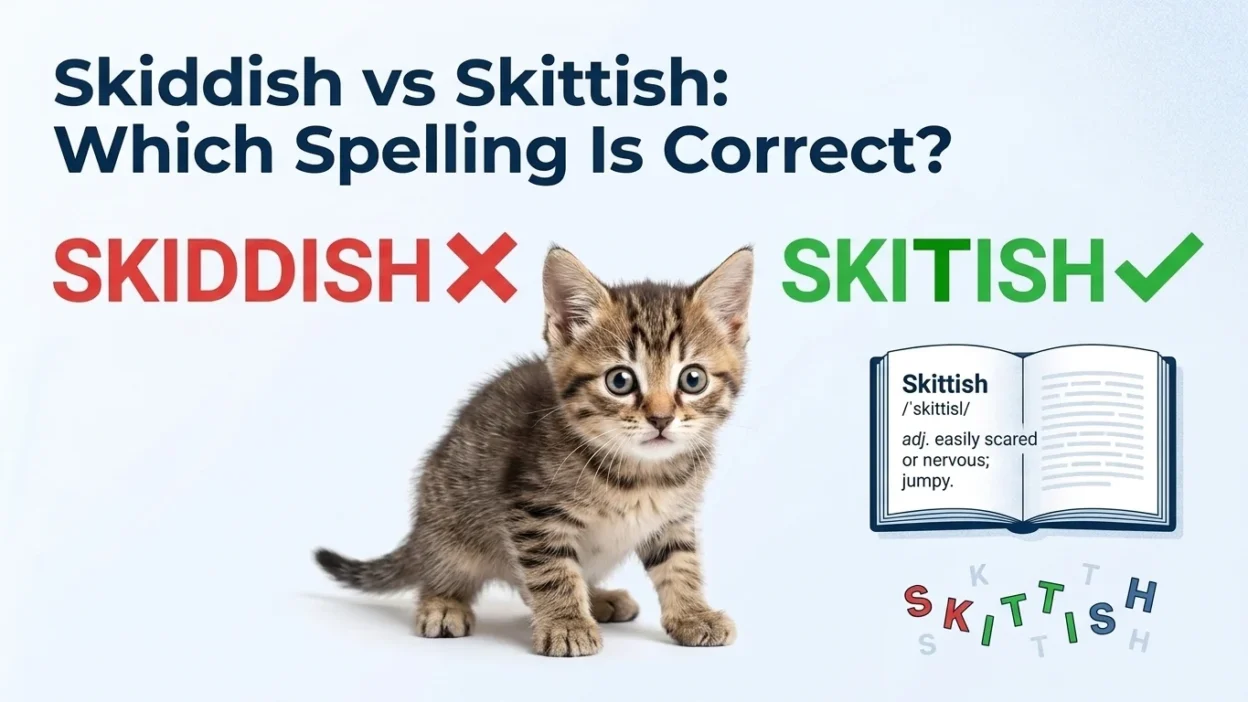
Are you wondering whether to write skiddish or skittish? The correct spelling in standard English is skittish, with two “t” letters. Skiddish is a common misspelling of this word. Skittish describes someone or an animal that is nervous, easily frightened, jumpy, or quick to react to sudden movements and sounds.
Understanding the difference between skiddish and skittish can help you improve your spelling and choose the right word in everyday conversations, school assignments, and professional writing. For example, you might describe a nervous horse as skittish or say that a skittish person becomes uncomfortable in unfamiliar situations. Although skiddish may appear in informal writing, it is not the standard spelling. Therefore, if you want to communicate clearly and use correct English, choose skittish. This guide explains the meaning, spelling, common usage, and examples of both forms so you can remember the correct word with confidence.
Quick Answer: Skiddish or Skittish?
Skittish is the correct standard English spelling. It means nervous, easily frightened, jumpy, or likely to react suddenly. Skiddish is a common misspelling. For example, “The skittish horse moved away when it heard a loud noise.” Remember to use two “t” letters in skittish.
Why Do People Confuse Skiddish and Skittish?
People often confuse these spellings because they sound similar when spoken quickly. In addition, the word skittish is not always familiar to beginner English learners, so writers may spell it according to how they hear it.
The ending can also cause confusion. Some people mistakenly use “-dish” instead of the correct “-ttish.” However, the standard English spelling is always skittish.
Here are the main reasons for the confusion:
- Similar pronunciation: Both forms may look or sound similar to unfamiliar readers.
- Unfamiliar spelling: Some writers do not remember the double “t.”
- Typing mistakes: A person may accidentally replace “tt” with “dd.”
- Informal usage: Misspellings can appear in online conversations and casual writing.
Therefore, remember that skittish is the accepted spelling when you want to describe someone or something that is nervous or easily startled.
First Word: Skiddish
Skiddish is a common misspelling of skittish in standard English. It is generally not the spelling you should use in schoolwork, formal writing, articles, or professional communication.
Meaning of Skiddish
When people write skiddish, they usually intend to express the meaning of skittish: nervous, jumpy, wary, or easily frightened.
For example:
- Incorrect: The skiddish dog ran away from the stranger.
- Correct: The skittish dog ran away from the stranger.
Similarly:
- Incorrect: She felt skiddish around large crowds.
- Correct: She felt skittish around large crowds.
The intended meaning is understandable, but the spelling should be corrected.
Is Skiddish Ever Correct?
In standard English, use skittish. You may encounter skiddish in informal online writing or as an intentional nonstandard spelling, but it is not the accepted spelling for the usual adjective meaning nervous or easily frightened.
If you are writing an essay, email, story, or business document, choose skittish instead.
Second Word: Skittish
Skittish is the correct English adjective for someone or something that is nervous, easily frightened, restless, or quick to react to unexpected events.
Meaning of Skittish
A skittish person or animal may become nervous when faced with unfamiliar people, loud sounds, sudden movements, or uncertain situations. The word often suggests that the reaction happens quickly.
For example:
- The skittish horse backed away from the noisy crowd.
- The kitten was skittish around unfamiliar visitors.
- He became skittish when the conversation turned serious.
- The birds grew skittish after hearing the sudden bang.
In each sentence, skittish describes nervousness or a tendency to react fearfully.
How Is Skittish Used in Everyday English?
You can use skittish in several contexts:
- Animals: A skittish horse may jump at sudden noises.
- People: A skittish child may feel uncomfortable around strangers.
- Social situations: Someone may become skittish during an awkward conversation.
- Business and finance: Investors may be described as skittish when they are nervous about uncertainty or risk.
For example, “Investors became skittish after the unexpected announcement” means they grew nervous and cautious.
Although the word is often associated with animals, it is also natural when describing people or groups that react nervously.
Skiddish vs Skittish: Comparison Table
| Feature | Skiddish | Skittish |
|---|---|---|
| Correct standard spelling? | No | Yes |
| Meaning | Usually intended to mean nervous or easily frightened | Nervous, jumpy, or easily frightened |
| Part of speech | Nonstandard misspelling in this usage | Adjective |
| Double letters | Incorrectly uses “dd” | Correctly uses “tt” |
| Formal writing | Avoid | Appropriate |
| Example | The skiddish horse ran away. | The skittish horse ran away. |
| Best choice | Avoid in standard English | Use this spelling |
The main difference is spelling, not meaning. If you want to describe a nervous or easily startled person or animal, skittish is the word to use.
When to Use Skiddish vs Skittish
Choosing the correct form is simple because skittish is the standard spelling.
Use Skittish to Describe Nervous Animals
The word is particularly useful when an animal reacts quickly to unfamiliar sounds, movements, or people.
Examples:
- The skittish horse refused to approach the gate.
- A skittish rabbit hid when someone entered the room.
- The rescue dog was initially skittish around strangers.
These sentences describe animals that are easily startled or nervous.
Use Skittish to Describe People
You can also use skittish when a person feels uneasy, anxious, or uncomfortable in a particular situation.
Examples:
- She became skittish before the interview.
- He seemed skittish when asked about the mistake.
- The child was skittish around unfamiliar adults.
In these examples, the word suggests nervousness or hesitation rather than a medical condition.
Use Skittish in Business and Finance
In business writing, skittish can describe people who become cautious or nervous because of uncertainty.
Examples:
- Investors grew skittish after the market fell.
- Customers became skittish about spending money.
- The announcement made buyers skittish.
In these situations, the word refers to hesitation or concern about possible risks.
Avoid Skiddish in Standard Writing
Whenever you intend to use the adjective meaning nervous or easily frightened, write skittish.
Incorrect: The skiddish puppy hid under the chair.
Correct: The skittish puppy hid under the chair.
Skiddish vs Skittish: 12 Example Sentences
The following examples demonstrate the correct spelling in different situations.
- The skittish horse jumped when a car honked its horn.
- A skittish kitten hid behind the sofa when visitors arrived.
- She felt skittish before giving her first public speech.
- The farmer carefully approached the skittish sheep.
- The dog became skittish after hearing fireworks.
- Investors grew skittish when the market became unpredictable.
- The skittish child stayed close to her parents in the crowded store.
- The bird was too skittish to eat while people were nearby.
- He became skittish when his manager asked unexpected questions.
- The rescue team worked patiently with the skittish animal.
- Customers grew skittish about making large purchases during uncertain times.
- The normally friendly horse seemed skittish around the new equipment.
Here are three common spelling corrections:
- Incorrect: The skiddish puppy barked at the stranger.
- Correct: The skittish puppy barked at the stranger.
- Incorrect: Investors were skiddish about the announcement.
- Correct: Investors were skittish about the announcement.
- Incorrect: The skiddish child avoided the noisy playground.
- Correct: The skittish child avoided the noisy playground.
These examples reinforce the correct spelling: skittish, with two “t” letters.
Common Mistakes With Skiddish and Skittish
Even when you understand a word’s meaning, its spelling can be confusing. Watch out for these common mistakes.
Mistake 1: Writing Skiddish Instead of Skittish
Incorrect: The skiddish cat ran under the bed.
Correct: The skittish cat ran under the bed.
The standard spelling uses “tt,” not “dd.”
Mistake 2: Thinking Skittish Only Describes Animals
Although skittish is frequently used for animals, it can also describe people, investors, customers, and other groups that react nervously.
For example: “The investors became skittish after the unexpected news.”
Mistake 3: Confusing Skittish With Shy
These words are related in some situations, but they are not identical.
- Skittish: Easily frightened, jumpy, or nervous in response to something.
- Shy: Uncomfortable or reserved around other people.
For example, a shy student may avoid speaking in class, while a skittish student may become startled by sudden noises.
Mistake 4: Assuming Skittish Means Angry
Skittish generally describes nervousness, fear, or uneasiness. It does not usually mean angry or aggressive.
For example, a skittish dog may move away from a stranger because it feels frightened, not because it wants to attack.
Memory Trick: How to Remember Skittish
A simple memory trick can help you remember the correct spelling.
Think of “skittish” as a word with two T’s for a tense reaction. When someone or something feels tense or easily startled, remember the double “t” in skittish.
You can also memorize this short sentence:
“The skittish kitten trembled.”
The repeated “t” sound in skittish and kitten can help you recall the correct spelling.
Before submitting your writing, check that you have written skittish, not skiddish.
American vs British English: Skiddish or Skittish?
There is no standard American-versus-British spelling difference for this word. Both American and British English use skittish as the accepted spelling.
| English variety | Correct spelling | Example |
|---|---|---|
| American English | Skittish | The horse was skittish around strangers. |
| British English | Skittish | The horse was skittish around strangers. |
| Australian English | Skittish | The dog became skittish during the storm. |
| Standard international English | Skittish | The investors were skittish about the news. |
Therefore, you do not need to change the spelling according to your audience’s location. Use skittish in formal, academic, and everyday English.
Similar Words Related to Skittish
Several English words describe nervousness, fear, or discomfort. However, each has a slightly different meaning.
1. Nervous
Meaning: Worried, anxious, or uneasy about something.
Example: She felt nervous before the examination.
Use nervous when someone feels worried or uncertain.
2. Jumpy
Meaning: Easily startled or likely to react suddenly.
Example: The dog became jumpy during the thunderstorm.
Use jumpy when someone or something reacts quickly to sudden sounds or movements.
3. Timid
Meaning: Shy, lacking confidence, or easily frightened.
Example: The timid puppy stayed close to its owner.
Use timid when someone lacks confidence or tends to avoid difficult or unfamiliar situations.
4. Shy
Meaning: Uncomfortable or reserved around other people.
Example: The shy student rarely spoke in large groups.
Use shy when the main idea is social hesitation or reserve.
5. Wary
Meaning: Careful or cautious because of possible danger or problems.
Example: The horse was wary of the unfamiliar equipment.
Use wary when someone is cautious rather than easily startled.
6. Fidgety
Meaning: Unable to stay still, often because of nervousness or impatience.
Example: The fidgety child kept moving in his chair.
Use fidgety when nervousness appears through repeated physical movements.
7. Easily startled
Meaning: Quickly frightened or surprised by sudden sounds or movements.
Example: The easily startled rabbit jumped when the door slammed.
This phrase is a clear alternative when you want to explain exactly what skittish means.
Final Verdict: Skiddish or Skittish?
Skittish is the correct standard English spelling. It describes a person or animal that is nervous, easily frightened, jumpy, or quick to react. Skiddish is a common misspelling and should be avoided in formal writing, school assignments, and professional communication.
To remember the difference, focus on the double “t” in skittish. Whether you are describing a nervous horse, a cautious investor, or a person who feels uneasy in an unfamiliar situation, skittish is the word to use.
Frequently Asked Questions
1. Is skiddish or skittish correct?
Skittish is the correct standard English spelling. Skiddish is a common misspelling. Use skittish to describe someone or something that is nervous, easily frightened, or jumpy.
2. What does skittish mean?
Skittish means nervous, easily frightened, jumpy, or quick to react to sudden sounds or movements. It can describe animals, people, investors, and other groups that become uneasy or cautious.
3. Is skiddish a real word?
Skiddish may appear in informal writing as a misspelling or nonstandard form, but it is not the accepted spelling of the standard English adjective skittish. For correct English usage, write skittish.
4. How do you spell skittish correctly?
The correct spelling is S-K-I-T-T-I-S-H. Remember that it contains two “t” letters in the middle. Avoid writing skiddish when you mean nervous or easily frightened.
5. Can skittish describe a person?
Yes. Skittish can describe a person who is nervous, easily startled, or uncomfortable in a situation. For example, “He became skittish when the interviewer asked unexpected questions.”
6. What is a synonym for skittish?
Common synonyms include nervous, jumpy, timid, wary, and easily startled. The best choice depends on the context. For instance, wary emphasizes caution, while jumpy emphasizes reacting quickly to sudden events.
7. Is skittish the same as shy?
No. Skittish usually describes nervousness or being easily startled, while shy describes someone who feels uncomfortable or reserved around other people. A person can be shy without being easily frightened.
Remember This
- Skittish is the correct standard English spelling.
- Skiddish is a common misspelling.
- Skittish means nervous, jumpy, or easily frightened.
- The word can describe people, animals, and nervous investors.
- Remember the double “t” in skittish.
- American and British English use the same spelling.
Conclusion
The difference between skiddish vs skittish comes down to spelling. Skittish is the correct English word for someone or something that is nervous, easily frightened, or quick to react. Although skiddish may appear in casual writing, it is not the standard spelling you should use.
To avoid this mistake, remember the two “t” letters in skittish and practice using the word in different sentences. Whether you are writing an essay, describing an animal, or discussing nervous investors, choosing the correct spelling will make your English clearer and more accurate.