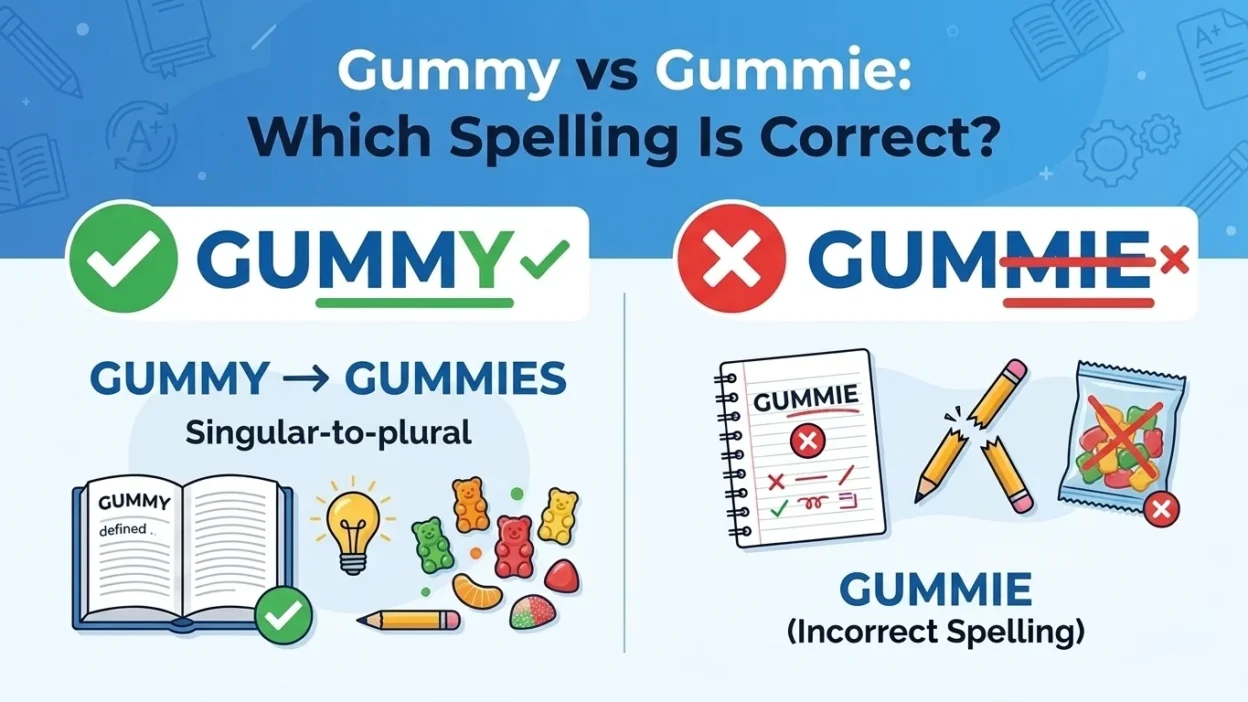
If you are wondering whether gummy or gummie is correct, the standard spelling is usually gummy. Gummie is generally not the standard spelling when you mean something soft, chewy, or made from a gummy material. For example, you can say, “I bought some gummy candy.” The word gummy is also used to describe something related to gums, such as gummy teeth or gummy smiles.
The confusion happens because English has many words that change a final y to ie when forming plurals or certain related forms. This can make gummie look like a possible spelling. However, gummy is the standard adjective and noun form in common English. Understanding when to use gummy, how its plural works, and why gummie is usually incorrect can help students, ESL learners, writers, and general readers avoid spelling mistakes.
Quick Answer
Gummy is the standard spelling in English, while gummie is generally incorrect when referring to something soft, chewy, sticky, or related to the gums. Use gummy in phrases such as gummy candy, gummy bears, and gummy texture. The plural is usually gummies.
Why Do People Confuse It?
People often confuse gummy and gummie because English uses -ies endings in many plural words.
For example:
- candy → candies
- baby → babies
- story → stories
- gummy → gummies
Because gummies is the plural of gummy, some people may incorrectly assume that gummie is the singular form.
However, the singular word is:
gummy ✅
And the plural is:
gummies ✅
The spelling change happens when forming the plural, not because gummie is an alternative singular spelling.
First Word: Gummy
Gummy is the standard English spelling.
It can be used as an adjective or noun, depending on the context.
As an adjective, gummy can describe something that is:
- soft and chewy
- sticky
- resembling gum
- related to the gums
For example:
The candy has a gummy texture.
The word is also commonly used as a noun in expressions such as:
She bought a gummy from the candy store.
In the plural, gummy becomes gummies:
gummy → gummies
Second Word: Gummie
Gummie is generally not the standard singular spelling of gummy.
It is often created by incorrectly transferring the plural spelling gummies back into a singular form.
Incorrect:
I bought a gummie.
Standard:
I bought a gummy.
However, Gummie may appear as a brand name, product name, character name, username, or other proper name. In those special cases, its spelling depends on the name itself.
Gummy vs Gummie: Comparison Table
| Word | Correct? | Common Meaning | Example |
|---|---|---|---|
| gummy | ✅ Yes | Soft, chewy, sticky, or related to gums | I like gummy candy. |
| gummie | ❌ Generally no | Usually a misspelling of gummy | I like gummie candy. |
The key point is that gummy is the standard singular form, while gummies is the standard plural form.
When to Use Each
When to Use “Gummy”
Use gummy when describing something soft, chewy, sticky, or related to gums.
Common expressions include:
- gummy candy
- gummy bears
- gummy worms
- gummy texture
- gummy sweets
- gummy smile
- gummy gums
For example:
These gummy bears are very chewy.
When to Use “Gummie”
In standard English, do not normally use gummie as the singular form of gummy.
Instead, use gummy.
If you are referring to a specific brand, character, product, or name spelled Gummie, keep its official spelling.
10+ Examples of Gummy
- I bought some gummy candy.
- These gummy bears are soft and chewy.
- She likes the fruity flavor of gummy sweets.
- The candy has a gummy texture.
- He ate a colorful gummy worm.
- The children enjoyed the gummy candies.
- This fruit snack has a soft, gummy texture.
- She chose a packet of gummy bears.
- The recipe creates a slightly gummy consistency.
- Some people have a gummy smile.
- The material feels soft and gummy.
- The plural of gummy in the candy sense is gummies.
These examples show that gummy is the standard spelling in common English.
Common Mistakes
The most common mistake is using gummie as the singular form because the plural is gummies.
Incorrect:
I ate one gummie.
Correct:
I ate one gummy.
The plural is:
I ate several gummies.
The spelling pattern is:
gummy → gummies
The final y changes to ie when forming the plural because the word ends in a consonant + y.
This is similar to:
- candy → candies
- baby → babies
- story → stories
- country → countries
Therefore, do not confuse the singular gummy with the plural gummies.
Memory Trick
A simple way to remember the spelling is:
One gummy, many gummies.
Think of it as:
GUMMY → GUMMIES
The singular ends in -y, while the plural ends in -ies.
So remember:
GUMMY = one
GUMMIES = more than one
This makes it easier to avoid writing gummie as the singular form.
American vs British English
Gummy is the standard spelling in both American and British English.
However, there can be differences in related vocabulary.
In American English, gummy candy is a common expression for soft, chewy candy.
In British English, gummy sweets is commonly used for this type of candy.
For example:
- American English: gummy candy
- British English: gummy sweets
The spelling gummy remains the same in both varieties.
The plural is also spelled gummies when the noun is being used in this way.
Similar Words
Several words can describe something similar to gummy, depending on the context.
Chewy
Chewy describes food that requires a lot of chewing.
The candy is soft and chewy.
Sticky
Sticky describes something that adheres easily to surfaces.
The mixture is sticky.
Gelatinous
Gelatinous describes something with a jelly-like consistency.
The dessert has a gelatinous texture.
Soft
Soft describes something that is not hard or firm.
The candy is soft and easy to chew.
Tacky
Tacky can describe something slightly sticky.
The surface feels tacky.
These words can overlap with gummy, but each has its own meaning and appropriate context.
Final Verdict
The standard spelling is gummy.
Gummie is generally incorrect when you mean the common word describing something soft, chewy, sticky, or related to gums.
Remember the correct pattern:
gummy → gummies
For example:
Correct: I bought a gummy bear.
Incorrect: I bought a gummie bear.
If Gummie appears as part of a specific brand, product, character, or proper name, its spelling may intentionally be different.
Frequently Asked Questions
Is it gummy or gummie?
The standard spelling is gummy. Gummie is generally incorrect as the singular form.
Is gummie a correct word?
Gummie is not the standard spelling of the common word gummy. However, it may appear as a proper name, brand, or other intentional name.
What is the plural of gummy?
The plural is gummies.
one gummy → two gummies
Why is gummy spelled with a y?
Gummy is the standard spelling of the adjective and noun. Its plural changes the final y to ie, producing gummies.
Is gummy candy correct?
Yes. Gummy candy is a standard expression, especially in American English.
Is gummy sweets correct?
Yes. Gummy sweets is a common expression in British English for soft, chewy candies.
Is gummy spelled differently in British English?
No. Gummy is spelled the same way in American and British English.
How do you remember gummy vs gummie?
Remember: one gummy, many gummies. The singular ends in -y, while the plural ends in -ies.
Remember This
Gummy = correct ✅
Gummie = generally incorrect ❌
Remember:
ONE GUMMY → MANY GUMMIES
Do not use the plural spelling gummies to create the singular gummie.
Conclusion
The difference between gummy vs gummie is mainly a spelling issue. Gummy is the standard English spelling for something soft, chewy, sticky, or related to the gums. Gummie is generally not the standard singular form, although it may appear intentionally in names or branding.
The easiest way to remember the difference is to learn the singular and plural together: gummy → gummies. The singular uses -y, while the plural changes y to ie and adds s. This simple pattern can help you avoid the common mistake of writing gummie when you mean gummy.