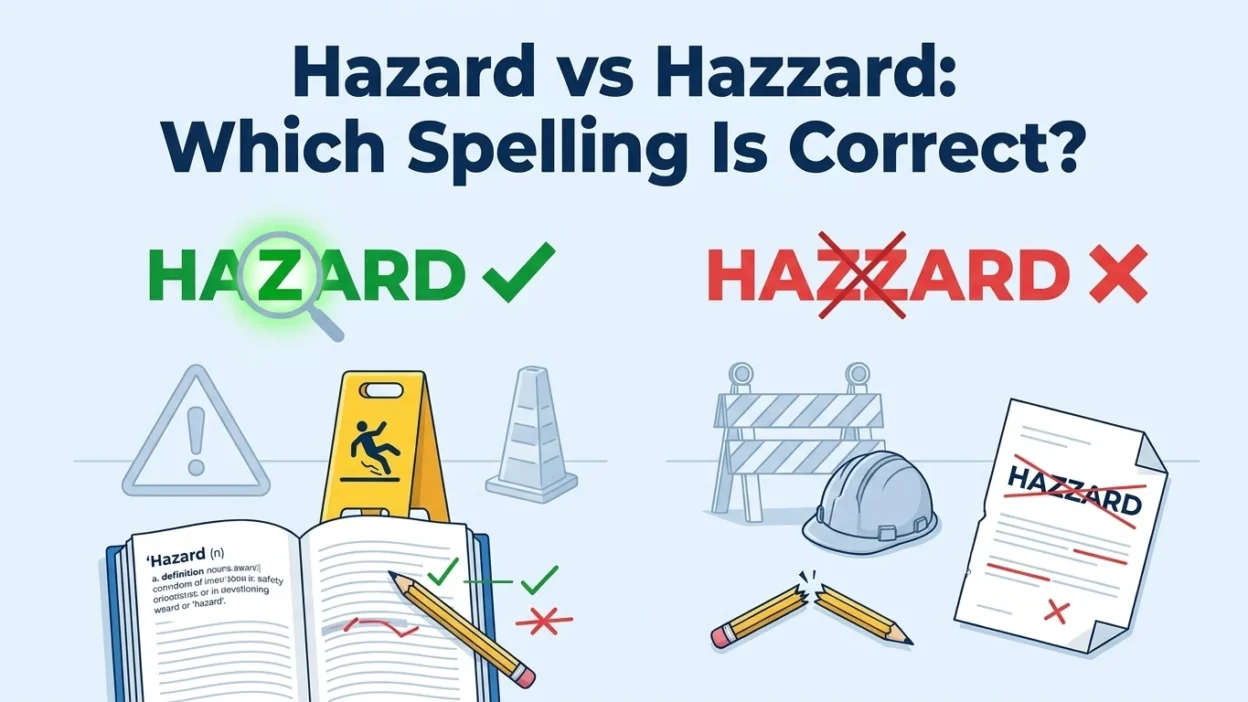
If you are wondering whether hazard or hazzard is correct, the standard English spelling is hazard. Hazzard is generally a misspelling when you mean a danger, risk, or potentially harmful situation. For example, “Wet floors can be a serious hazard.” The word hazard is commonly used when discussing safety, health, workplaces, roads, and environmental risks.
The confusion usually happens because English has many words with doubled consonants, and it can be tempting to write hazzard with two z’s. However, the correct spelling contains only one z: h-a-z-a-r-d. Learning the correct form is especially useful for students, ESL learners, writers, and anyone who needs to describe danger or risk clearly in everyday and professional writing.
Quick Answer
Hazard is the correct spelling, while hazzard is incorrect when you mean a danger or potential source of harm. The correct word is spelled H-A-Z-A-R-D, with only one z. For example, “The broken stairs are a safety hazard.” Remember: hazard, not hazzard.
Why Do People Confuse It?
People often confuse hazard and hazzard because the z sound in hazard may make a double z seem possible when spelling the word.
However, the correct spelling uses only one z:
hazard ✅
Not:
hazzard ❌
English spelling does not always match pronunciation perfectly, so hearing a strong consonant sound does not necessarily mean the letter should be doubled.
The word hazard also looks somewhat similar to words that contain doubled consonants, which can reinforce the mistake.
First Word: Hazard
Hazard is the correct standard English word.
As a noun, hazard means something that can cause harm, injury, damage, or danger.
For example:
The icy road is a serious hazard for drivers.
A hazard does not necessarily mean that harm will definitely occur. Instead, it refers to a source or situation that has the potential to cause harm.
Common expressions include:
- safety hazard
- health hazard
- fire hazard
- workplace hazard
- environmental hazard
- road hazard
- potential hazard
- serious hazard
The word can also be used as a verb, although this use is less common:
Poor planning can hazard the success of the project.
Second Word: Hazzard
Hazzard is not the standard spelling of the common English noun hazard.
If you are writing about danger, risk, or something that could cause harm, use hazard.
Incorrect:
The wet floor is a hazzard.
Correct:
The wet floor is a hazard.
You may occasionally see Hazzard as part of a proper name, title, surname, or fictional name. In those special cases, the spelling depends on the specific name. However, it is not the standard spelling of the everyday word meaning danger.
Hazard vs Hazzard: Comparison Table
| Word | Correct? | Meaning | Example |
|---|---|---|---|
| hazard | ✅ Yes | A danger or potential source of harm | The chemicals are a health hazard. |
| hazzard | ❌ No | Misspelling of hazard in the usual sense | The chemicals are a health hazzard. |
The key difference is simple: hazard has one z, while hazzard incorrectly adds another z.
When to Use Each
When to Use “Hazard”
Use hazard when referring to something that could cause harm or danger.
For example:
- A wet floor is a slipping hazard.
- Smoke can be a health hazard.
- Exposed wires are an electrical hazard.
- Heavy traffic can create a road hazard.
- Chemicals may present a safety hazard.
The word is common in safety instructions, workplace documents, warning signs, educational materials, and everyday conversations.
When to Use “Hazzard”
Do not use hazzard when you mean danger or risk.
Instead, use hazard.
If Hazzard is part of a proper name, however, preserve the original spelling.
10+ Examples of Hazard
- Wet floors can create a serious hazard.
- The broken equipment is a safety hazard.
- Smoke from the fire became a health hazard.
- Drivers should watch for road hazards.
- Exposed electrical wires are a dangerous hazard.
- The workers were trained to identify workplace hazards.
- The storm created several environmental hazards.
- Poor lighting can become a safety hazard.
- The warning sign identifies a potential hazard.
- Chemicals should be stored carefully because they may present a hazard.
- Ice on the sidewalk is a slipping hazard.
- The construction site contains several possible hazards.
These examples show how hazard is used to describe potential sources of harm in many situations.
Common Mistakes
The most common mistake is adding a second z.
Incorrect:
The damaged bridge is a hazzard.
Correct:
The damaged bridge is a hazard.
Another mistake is confusing hazard with risk. These words are related but are not always identical.
A hazard is something that has the potential to cause harm.
A risk generally concerns the possibility or likelihood of harm occurring and the consequences involved.
For example:
A wet floor is a hazard.
Walking across the wet floor creates a risk of falling.
Understanding this distinction can make safety-related writing more precise.
Memory Trick
A simple way to remember the spelling is:
Hazard has one Z.
Think:
HA + ZARD = HAZARD
Not:
HA + ZZARD = HAZZARD
You can also connect the word with common phrases:
safety hazard
health hazard
fire hazard
Each uses one z.
So remember:
HAZARD ✅
HAZZARD ❌
American vs British English
Hazard is spelled the same way in American and British English.
Both varieties use:
hazard ✅
And hazzard is not the standard spelling of the common word in either variety.
The meaning is also essentially the same in both forms of English. You can use hazard when talking about dangers, potential sources of harm, or unsafe conditions.
For example:
The wet floor is a safety hazard.
This spelling remains unchanged regardless of whether you are writing for an American or British audience.
Similar Words
Several words are related to hazard, but their meanings can differ.
Danger
Danger refers to the possibility of harm, injury, or loss.
The damaged building is a danger to nearby residents.
Risk
Risk refers to the possibility of an unwanted outcome or harm.
There is a risk of falling.
Threat
A threat is something or someone that may cause harm or create danger.
The storm poses a serious threat to the area.
Peril
Peril means serious or immediate danger.
The hikers were in great peril.
Menace
A menace is something or someone considered a source of danger or trouble.
The abandoned structure had become a public menace.
Obstacle
An obstacle is something that blocks or makes progress difficult. It is not necessarily dangerous.
The fallen tree was an obstacle on the road.
These words can overlap with hazard, but the exact meaning depends on the situation.
Final Verdict
The correct spelling is hazard.
Hazzard is incorrect when you mean a danger, risk, or potential source of harm. The standard spelling contains only one z:
H-A-Z-A-R-D
For example:
Correct: The wet floor is a safety hazard.
Incorrect: The wet floor is a safety hazzard.
If you remember “Hazard has one Z,” you can easily avoid this common spelling mistake.
Frequently Asked Questions
Is it hazard or hazzard?
The correct standard spelling is hazard. Hazzard is a misspelling when referring to danger or a potential source of harm.
How do you spell hazard correctly?
The correct spelling is H-A-Z-A-R-D: hazard.
What does hazard mean?
A hazard is something that has the potential to cause harm, injury, damage, or danger.
Is hazzard a real word?
Hazzard is not the standard spelling of the common English word hazard. It may appear as part of a proper name, but it is not the normal spelling for danger or risk.
What is an example of hazard in a sentence?
A simple example is: “The wet floor is a safety hazard.”
What is the difference between hazard and risk?
A hazard is a potential source of harm, while risk generally describes the possibility or likelihood of harm occurring and its potential consequences.
Is hazard spelled differently in British English?
No. Hazard has the same spelling in American and British English.
What are common types of hazards?
Common examples include safety hazards, health hazards, fire hazards, electrical hazards, workplace hazards, environmental hazards, and road hazards.
Remember This
Hazard = correct ✅
Hazzard = incorrect ❌
Remember:
Hazard has one Z.
The correct spelling is:
H-A-Z-A-R-D
Not:
H-A-Z-Z-A-R-D
Conclusion
The difference between hazard vs hazzard is straightforward. Hazard is the correct standard English spelling for something that can cause harm, injury, damage, or danger. Hazzard is a misspelling when used with this meaning.
To remember the correct form, focus on the single z in hazard. Whether you are writing about a safety hazard, health hazard, workplace hazard, or road hazard, always use hazard in standard English. The spelling is the same in both American and British English.