If you are confused about havnt vs havent, neither form is correct in standard English. The correct contraction is haven’t, with an apostrophe. Haven’t is the shortened form of have not. For example, “I haven’t finished my homework” is correct, while “I havnt finished my homework” and “I havent finished my homework” are incorrect in standard writing.
The confusion usually happens because people leave out the apostrophe when typing quickly or writing informal messages. However, the apostrophe is an important part of the contraction. Therefore, students, ESL learners, writers, and general readers should remember that have + not = haven’t. The word haven’t commonly appears with subjects such as I, you, we, and they. Once you understand what the contraction represents, the spelling becomes much easier to remember and use correctly in conversations, emails, essays, messages, and everyday English.
Quick Answer
Haven’t is the correct standard spelling. It is a contraction of have not. Havnt and havent are informal spellings that omit the apostrophe and should be avoided in standard writing. For example, “They haven’t arrived yet” is correct.
Why Do People Confuse It?
People often confuse havnt, havent, and haven’t because the three forms are pronounced similarly in ordinary speech.
When people type quickly, they may leave out the apostrophe:
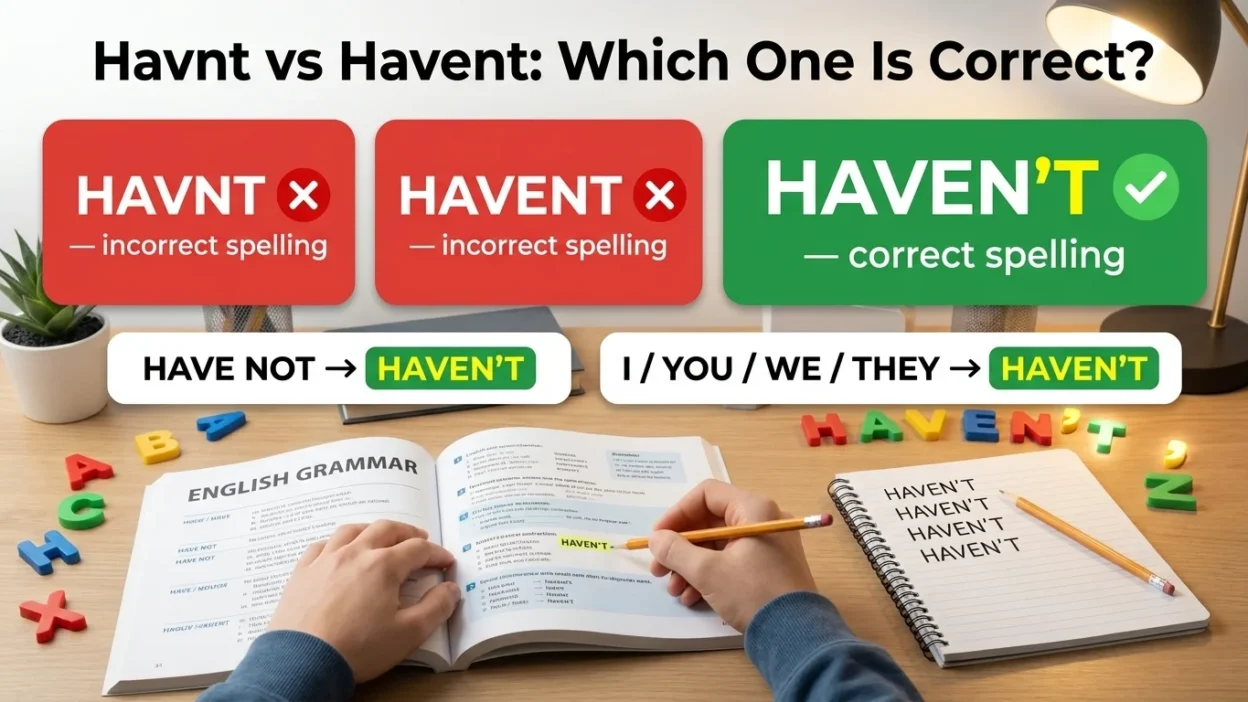
❌ havnt
❌ havent
However, standard English uses:
✅ haven’t
The apostrophe shows that letters have been removed from have not.
Therefore:
have not → haven’t
The apostrophe appears between n and t because it represents the omitted letters from the original phrase.
What Does the First Word Mean: Havnt?
Is Havnt Correct?
Havnt is not the standard spelling of the contraction haven’t.
For example:
❌ “I havnt seen him today.”
Correct:
✅ “I haven’t seen him today.”
The main problem is the missing apostrophe.
Why Is Havnt Incorrect?
The contraction comes from:
have not
When these words are shortened, the standard form becomes:
haven’t
Therefore, writing havnt removes the apostrophe and does not follow standard spelling conventions.
What Does the Second Word Mean: Havent?
Is Havent Correct?
Havent without an apostrophe is also not the standard spelling.
For example:
❌ “We havent finished yet.”
Correct:
✅ “We haven’t finished yet.”
Although you may see havent in casual texts, social media posts, or informal online writing, standard English uses haven’t.
Why Does Havent Look Almost Correct?
Havent contains the same letters as haven’t, except for the apostrophe.
The correct form is:
H-A-V-E-N-’-T
The apostrophe is not optional in standard writing.
What Does Haven’t Mean?
Definition of Haven’t
Haven’t is the contraction of have not.
For example:
“I haven’t eaten.”
This means:
“I have not eaten.”
Similarly:
“They haven’t arrived.”
means:
“They have not arrived.”
Therefore, whenever you can expand haven’t to have not, the contraction is being used correctly.
Haven’t with I
Use haven’t with I:
“I haven’t finished the book.”
Haven’t with You
Use haven’t with you:
“You haven’t answered my question.”
Haven’t with We
Use haven’t with we:
“We haven’t decided yet.”
Haven’t with They
Use haven’t with they:
“They haven’t arrived.”
Havnt vs Havent vs Haven’t Comparison Table
| Form | Standard? | Meaning | Example |
|---|---|---|---|
| Havnt | ❌ No | Nonstandard spelling of haven’t | “I havnt finished.” |
| Havent | ❌ No | Missing apostrophe | “I havent finished.” |
| Haven’t | ✅ Yes | Contraction of have not | “I haven’t finished.” |
| Have not | ✅ Yes | Full form | “I have not finished.” |
When Should You Use Each?
When to Use Haven’t
Use haven’t when you want the standard contraction of have not.
For example:
“I haven’t seen that movie.”
“We haven’t completed the project.”
It is common in everyday speech and writing.
When to Use Have Not
Use have not when you want the full form.
For example:
“I have not received your message.”
The full form can sound more formal or emphatic.
When to Use Havnt
Avoid havnt in standard English writing.
Instead, write:
haven’t
When to Use Havent
Avoid havent in standard English writing as well.
Instead, use:
haven’t
12 Examples of Haven’t
Example 1
I haven’t finished my homework yet.
Example 2
We haven’t seen that movie.
Example 3
They haven’t arrived at the station.
Example 4
You haven’t answered my question.
Example 5
I haven’t eaten breakfast today.
Example 6
We haven’t decided where to go.
Example 7
They haven’t completed the project.
Example 8
You haven’t told me the whole story.
Example 9
I haven’t visited London.
Example 10
We haven’t received the package.
Example 11
They haven’t called us yet.
Example 12
You haven’t made a mistake.
Common Mistakes
Mistake 1: Writing Havnt
Incorrect:
“I havnt finished.”
Correct:
“I haven’t finished.”
Remember to include the apostrophe.
Mistake 2: Writing Havent
Incorrect:
“They havent arrived.”
Correct:
“They haven’t arrived.”
The apostrophe belongs between n and t.
Mistake 3: Using Haven’t with they
In standard English, haven’t does not normally follow they.
Incorrect:
“She haven’t finished.”
Correct:
“She hasn’t finished.”
Similarly:
“He hasn’t arrived.”
Therefore, remember:
I/you/we/they → haven’t
he/she/it → hasn’t
Mistake 4: Confusing Haven’t and Hasn’t
Haven’t means have not.
“They haven’t left.”
Hasn’t means has not.
“She hasn’t left.”
Therefore, the subject determines which contraction you need.
Mistake 5: Removing Apostrophes in Formal Writing
Typing havent may seem harmless in a quick message. However, leaving out the apostrophe can make formal writing look careless.
Therefore, use haven’t in essays, emails, applications, reports, and other standard writing.
What Is an Easy Memory Trick?
Remember “Have Not”
Start with the full form:
HAVE NOT
Shorten it:
HAVEN’T
The apostrophe reminds you that part of the original phrase has been removed.
You can also remember:
HAVE + NOT = HAVEN’T
So:
❌ havnt
❌ havent
✅ haven’t
A Simple Subject Trick
Remember:
I, You, We, They → Haven’t
For example:
- I haven’t
- You haven’t
- We haven’t
- They haven’t
But:
- He hasn’t
- She hasn’t
- It hasn’t
American vs British English
Is Haven’t Correct in American English?
Yes. Haven’t is standard in American English.
“I haven’t finished yet.”
Is Haven’t Correct in British English?
Yes. Haven’t is also standard in British English.
“I haven’t finished yet.”
Therefore, the spelling is the same in both varieties.
The forms havnt and havent are not standard spellings in either variety.
Similar Words
Hasn’t
Hasn’t means has not.
“She hasn’t arrived.”
Hadn’t
Hadn’t means had not.
“They hadn’t finished.”
Don’t
Don’t means do not.
“I don’t know.”
Doesn’t
Doesn’t means does not.
“He doesn’t agree.”
Didn’t
Didn’t means did not.
“We didn’t see him.”
Won’t
Won’t means will not.
“I won’t forget.”
These contractions all use apostrophes to show that letters have been omitted.
What Is the Difference Between Haven’t and Hasn’t?
Haven’t vs Hasn’t
Haven’t is the contraction of have not.
“They haven’t finished.”
Hasn’t is the contraction of has not.
“She hasn’t finished.”
Therefore, the subject determines the correct form.
What Is the Difference Between Haven’t and Hadn’t?
Haven’t vs Hadn’t
Haven’t means have not and usually relates to the present perfect.
“I haven’t finished.”
Hadn’t means had not and refers to an earlier past situation.
“I hadn’t finished when she arrived.”
Therefore, the tense changes the meaning.
Final Verdict
The answer to havnt vs havent is that neither is the standard spelling. The correct form is haven’t, which is a contraction of have not. The apostrophe is an important part of the contraction and should not be omitted in standard English writing.
Therefore, remember the simple pattern have not → haven’t. Also, use haven’t with I, you, we, and they, while hasn’t normally follows he, she, and it. By remembering these two rules, you can avoid common spelling and grammar mistakes in everyday and formal writing.
Frequently Asked Questions
Is it havnt or havent?
Neither is the standard spelling. The correct form is haven’t, with an apostrophe.
Is havent a correct word?
Havent without an apostrophe is not the standard spelling. Use haven’t instead.
What does haven’t mean?
Haven’t is a contraction of have not.
“I haven’t finished.”
means:
“I have not finished.”
Why does haven’t have an apostrophe?
The apostrophe shows that letters have been omitted when have and not are contracted into haven’t.
Can I use havent in texting?
People sometimes omit apostrophes in informal digital messages. However, haven’t is the standard form and is the safer choice when you want correct English.
What is the difference between haven’t and hasn’t?
Haven’t means have not, while hasn’t means has not.
“They haven’t arrived.”
“She hasn’t arrived.”
Which is correct: I haven’t or I havent?
I haven’t is correct in standard English.
“I haven’t seen him.”
Is haven’t the same in American and British English?
Yes. Haven’t is spelled and used the same way in standard American and British English.
Remember This
Havnt ❌
Havent ❌
Haven’t ✅
Remember:
HAVE NOT → HAVEN’T
Also remember:
I / You / We / They → haven’t
He / She / It → hasn’t
The apostrophe matters.
Conclusion
The difference between havnt vs havent is simple once you remember that both forms are missing the apostrophe. The standard English contraction is haven’t, which means have not. Therefore, use haven’t in sentences such as “I haven’t finished” or “They haven’t arrived.”
Moreover, paying attention to the subject can help you avoid another common mistake. Use haven’t with I, you, we, and they, but use hasn’t with he, she, and it. By remembering have not → haven’t, you can quickly identify the correct spelling and write more accurately in both everyday and formal situations.