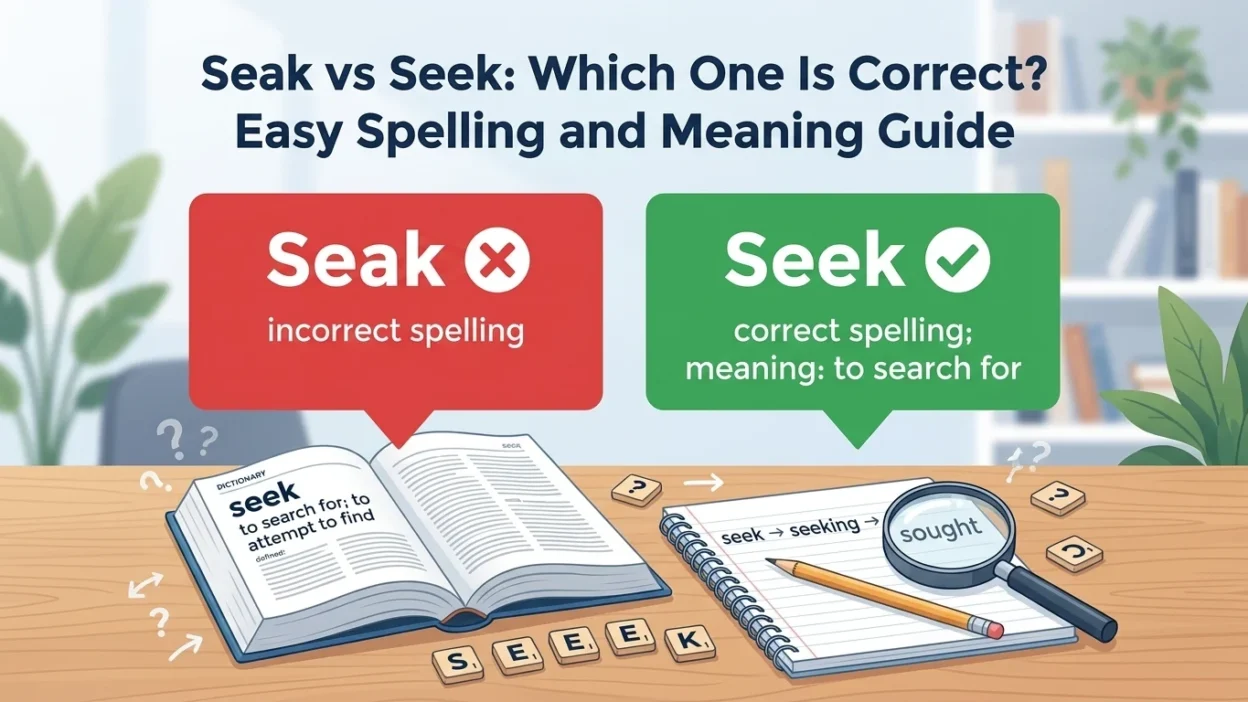
If you are wondering whether “seak” or “seek” is correct, the answer is seek. Seek is the standard English word meaning to look for, search for, or try to obtain something. For example, “I am seeking a new job” is correct. Seak is generally a misspelling of seek and should not be used in standard English writing. Learning the difference is especially useful for students, ESL learners, writers, and anyone who wants to improve everyday English spelling.
The confusion happens mainly because seek has an unusual spelling and pronunciation. The letters ee represent the long /iː/ sound, as in see and need. Some learners may therefore accidentally write seak, especially because words such as speak and break contain ea. However, seek follows a different spelling pattern. Once you connect seek with its meanings and related forms, such as seeking, sought, and seeker, the correct spelling becomes much easier to remember.
Quick Answer
Seek is the correct spelling. Seak is generally an incorrect spelling in standard English. Seek means to look for, search for, or try to obtain something. For example, “She is seeking advice.” Remember: seek → seeking → sought. The word seak should normally be corrected to seek.
Why Do People Confuse It?
People often confuse seak and seek because English spelling does not always match pronunciation in an obvious way.
The word seek is pronounced with a long ee sound, similar to:
- see
- tree
- need
- green
Because English also has many words containing ea, learners may mistakenly write seak.
For example:
- speak
- weak
- clean
- dream
However, seek uses ee, not ea.
Another reason for confusion is that seek has an irregular past tense:
seek → sought
This unusual change can make the word harder for learners to recognize and remember.
First Word: Seak
Seak is generally not a standard English word.
When someone writes seak, they usually mean seek.
For example:
❌ I want to seak help.
The correct sentence is:
✅ I want to seek help.
Similarly:
❌ She is seaking advice.
✅ She is seeking advice.
Therefore, if you are using seak to mean “look for” or “try to obtain,” replace it with seek.
Second Word: Seek
Seek is the correct standard English word.
It is a verb that can mean to look for something, to search for something, or to try to obtain something.
For example:
- I am seeking information about the course.
- They went to seek help.
- She is seeking a better opportunity.
- We should seek professional advice.
The word can also describe an attempt to achieve or find something that is not necessarily a physical object.
For example:
Many people seek happiness and success.
Here, seek means to try to find or achieve something.
Forms of Seek
The main forms of the verb are:
- seek — present/base form
- seeks — third-person singular present
- seeking — present participle
- sought — past tense and past participle
Examples:
I seek advice when I need help.
She seeks new opportunities.
They are seeking answers.
He sought professional guidance.
Seak vs Seek: Comparison Table
| Word | Correct? | Meaning | Example |
|---|---|---|---|
| seak | ❌ Incorrect in standard English | Usually a misspelling of seek | I want to seak help. |
| seek | ✅ Correct | To look for, search for, or try to obtain | I want to seek help. |
The main spelling difference is the vowel combination:
seak ❌
seek ✅
The correct word uses ee.
When to Use Each
When to Use “Seak”
In standard English, seak should generally not be used when you mean “look for” or “try to obtain.”
If you see seak in your writing, check whether you actually mean seek.
For example:
❌ We need to seak more information.
✅ We need to seek more information.
When to Use “Seek”
Use seek when you mean:
- look for something
- search for something
- try to find something
- try to obtain something
- ask for something
- try to achieve something
For example:
You should seek advice before making a decision.
Here, seek means to try to obtain advice.
12 Examples of “Seek” in Sentences
1. Seeking Help
You should seek help if you cannot solve the problem yourself.
2. Seeking Advice
She decided to seek advice from her teacher.
3. Seeking Information
We are seeking more information about the program.
4. Seeking a Job
He is seeking a new job.
5. Seeking Opportunities
Many graduates seek opportunities to gain experience.
6. Seeking Answers
Scientists often seek answers to difficult questions.
7. Seeking Guidance
The student decided to seek guidance from a mentor.
8. Seeking Peace
The group is seeking a peaceful solution.
9. Seeking Attention
Some advertisements are designed to seek attention.
10. Seeking Knowledge
Good learners constantly seek new knowledge.
11. Seeking Approval
He was seeking approval from his parents.
12. Seeking a Solution
The team is seeking a solution to the problem.
These examples show that seek can be used for physical searches, information, help, opportunities, advice, solutions, and abstract goals.
Common Mistakes
Mistake 1: Writing “Seak” Instead of “Seek”
This is the most common spelling error.
❌ I need to seak help.
✅ I need to seek help.
Mistake 2: Writing “Seaking”
The -ing form of seek is seeking, not seaking.
❌ They are seaking information.
✅ They are seeking information.
Mistake 3: Using “Seeked” as the Past Tense
The past tense of seek is sought, not seeked.
❌ She seeked professional advice.
✅ She sought professional advice.
This is important because seek is an irregular verb.
Mistake 4: Confusing Seek With Search
Although seek and search can have similar meanings, they are not always interchangeable.
For example:
I am seeking a new job.
This means I am trying to obtain a new job.
The police searched the building.
This specifically describes looking through a place to find something.
Therefore, context matters.
Memory Trick
A simple way to remember seek is:
SEE + K = SEEK
The word seek begins with see, and both contain the same ee spelling.
You can also remember:
seek → seeking → sought
This three-word pattern helps you recognize the correct spelling and grammar.
Another useful sentence is:
“I seek what I want to see.”
The repeated see/seek sound can help you remember that seek uses ee.
American vs British English
There is no standard spelling difference between American and British English for seek.
Both varieties use:
seek ✅
The misspelling seak is not the standard form in either variety.
For example:
American English:
She is seeking a new opportunity.
British English:
She is seeking a new opportunity.
The spelling remains the same.
Similar Words
Several words are related to seek and can help you understand its meaning.
| Word | Meaning | Example |
|---|---|---|
| seek | Look for or try to obtain | We seek better solutions. |
| seeking | Looking for or trying to obtain | She is seeking advice. |
| sought | Past form of seek | They sought help. |
| seeker | A person who seeks something | He is a job seeker. |
| search | Look carefully for something | They searched the room. |
| pursue | Try to achieve or obtain something | She wants to pursue her goals. |
| look for | Try to find something | I am looking for my keys. |
Seek vs Search
Seek often emphasizes the goal of finding, obtaining, or achieving something.
We seek advice from experts.
Search often emphasizes the process of looking carefully.
We searched the room for the missing document.
Both words can involve looking for something, but their usage and emphasis can differ.
Seek vs Look For
Look for is very common in everyday conversation:
I am looking for my phone.
Seek can sound more formal:
I am seeking professional advice.
Therefore, seek is especially common in formal writing, announcements, applications, and professional contexts.
Final Verdict
Seek is the correct spelling when you mean “to look for,” “to search for,” or “to try to obtain.”
Seak is generally a misspelling and should be corrected to seek.
Remember:
Seek ✅
Seak ❌
The correct forms are:
seek → seeking → sought
For example:
We are seeking more information.
Not:
We are seaking more information.
Once you remember that seek uses ee, this spelling mistake becomes much easier to avoid.
Frequently Asked Questions
Is “seak” a correct English word?
Seak is generally not the standard English word when you mean “look for” or “try to obtain.” The correct word is seek.
Is it “seak” or “seek”?
It is seek. For example, “I need to seek help” is correct.
What does “seek” mean?
Seek means to look for, search for, or try to obtain something. It can refer to physical things as well as ideas, opportunities, advice, help, or solutions.
What is the past tense of seek?
The past tense of seek is sought.
Example:
She sought advice from her teacher.
Is “seaking” the correct spelling?
No. The correct -ing form is seeking.
seek → seeking
Is “seeked” correct?
No. Seeked is not the standard past tense of seek. The correct past tense is sought.
What is the difference between seek and search?
Seek often means trying to find, obtain, or achieve something, while search often emphasizes looking carefully for something. The exact choice depends on context.
Does British English use “seak”?
No. Standard British English uses seek, just like standard American English.
Remember This
Keep this simple spelling pattern in mind:
SEEK ✅
SEAK ❌
And remember the related forms:
seek → seeking → sought
If you mean “look for,” “try to find,” “ask for,” or “try to obtain,” seek is usually the word you need.
For example:
Seek help when you need it.
She is seeking a new opportunity.
They sought advice from an expert.
Conclusion
The difference between seak and seek is mainly a spelling issue. Seek is the correct standard English word, while seak is generally a misspelling when used with the meaning “look for” or “try to obtain.” The correct spelling uses ee, just like in see, need, and green. Understanding this pattern can make the word easier to remember.
It is also helpful to learn the related forms seeking and sought. While seek is commonly used in formal contexts such as seeking advice, information, help, employment, or opportunities, everyday English may often use phrases such as look for. Therefore, remember the core pattern: seek → seeking → sought.