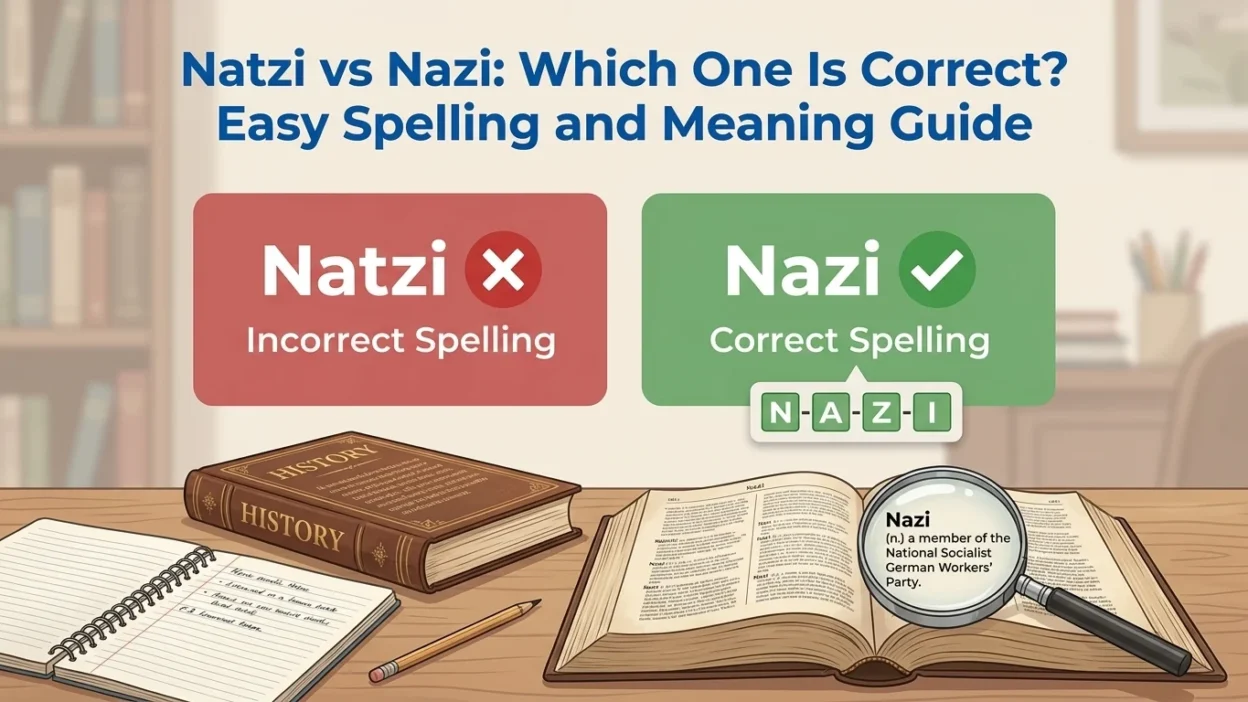
If you are wondering whether “natzi” or “Nazi” is the correct spelling, the standard English spelling is Nazi. Natzi is a misspelling when the writer means the historical term connected with the National Socialist German Workers’ Party. The word Nazi can be used as a noun for a member of that party or as an adjective for something connected with the party, such as Nazi Germany or Nazi propaganda.
The confusion is understandable because Nazi is commonly pronounced with a sound that can be heard as “nat-see.” Cambridge gives the UK and US pronunciation as /ˈnɑːt.si/, which helps explain why some people insert a t when writing the word. However, the established spelling is Nazi, not Natzi. The distinction is particularly important in historical and educational writing because the term refers to a specific political movement and its members.
Quick Answer
Nazi is the correct standard English spelling. Natzi is a misspelling when referring to the Nazi Party, its members, or things associated with Nazi Germany. The extra t does not belong in the standard spelling. Remember the four-letter form: N-A-Z-I.
Why Do People Confuse It?
The main reason people write natzi is pronunciation.
In both UK and US English, Cambridge represents the pronunciation of Nazi as /ˈnɑːt.si/. The t-s sound can make the word seem as though it should contain the letters t and z separately.
This can lead to the spelling:
❌ Natzi
However, English spelling does not always represent every sound with a separate letter. In this case, the established spelling is:
✅ Nazi
Another reason for the confusion is that many learners first encounter the word through speech rather than writing. If they have not seen the historical term written before, they may try to spell it according to how it sounds.
Therefore, the safest approach is to remember the standard four-letter spelling rather than spelling the word phonetically.
First Word: Natzi
Natzi is not the standard English spelling of the historical political term.
When someone writes natzi in a sentence about Nazi Germany, the Nazi Party, or World War II history, they normally mean Nazi.
For example:
❌ The Natzi Party came to power in Germany.
Correct:
✅ The Nazi Party came to power in Germany.
Similarly:
❌ The museum displayed information about Natzi Germany.
✅ The museum displayed information about Nazi Germany.
The extra t is the spelling error.
If Natzi appears as part of a specific personal name, username, title, quotation, or another proper name, that is a separate matter. It should not be treated as an alternative spelling of the historical term.
Second Word: Nazi
Nazi is the standard English spelling.
Historically, Nazi refers to a member of the National Socialist German Workers’ Party, the political party led by Adolf Hitler that controlled Germany from 1933 to 1945. Cambridge also lists Nazi as an adjective meaning connected with that party.
The U.S. Holocaust Memorial Museum identifies the party by its formal German name, Nationalsozialistische Deutsche Arbeiterpartei (NSDAP), commonly translated as the National Socialist German Workers’ Party. The party was founded after World War I and came to power in Germany in 1933.
The word can therefore appear in several common expressions:
- Nazi Party
- Nazi Germany
- Nazi regime
- Nazi ideology
- Nazi propaganda
- Nazi occupation
- Nazi persecution
The related noun Nazism refers to the beliefs and policies associated with the National Socialist German Workers’ Party under Hitler.
Natzi vs Nazi: Comparison Table
| Word | Correct? | Meaning | Example |
|---|---|---|---|
| Natzi | ❌ Incorrect | Usually a misspelling of Nazi | ❌ The Natzi Party ruled Germany. |
| Nazi | ✅ Correct | A member of the Nazi Party or something connected with it | ✅ The Nazi Party ruled Germany. |
| Nazism | ✅ Correct | The beliefs and policies of the Nazi movement | Nazism shaped the regime’s policies. |
| Nazis | ✅ Correct | Plural of Nazi | The Nazis controlled Germany from 1933 to 1945. |
The key spelling difference is simple:
Natzi = N-A-T-Z-I ❌
Nazi = N-A-Z-I ✅
When to Use Each
When to Use “Natzi”
In standard English, do not use natzi when you mean the historical political term Nazi.
For example:
❌ Natzi Germany
Use:
✅ Nazi Germany
Likewise:
❌ Natzi Party
Use:
✅ Nazi Party
The only time you might preserve Natzi is when it is part of a specific name, quotation, username, fictional name, or source that intentionally uses that spelling. In that situation, you are reproducing a particular name or wording rather than using Natzi as the standard spelling of the historical term.
When to Use “Nazi”
Use Nazi when referring to:
- a member of the Nazi Party
- the Nazi Party
- Nazi Germany
- the Nazi regime
- Nazi ideology
- Nazi policies
- Nazi propaganda
- Nazi persecution
- historical events involving the Nazi regime
For example:
The museum contains documents from Nazi Germany.
The book examines Nazi propaganda.
The lesson discusses the rise of the Nazi Party.
The U.S. Holocaust Memorial Museum describes the Nazi Party as a racist, antisemitic, anti-democratic political movement led by Adolf Hitler.
12 Examples of “Nazi” in Sentences
1. Nazi Party
The Nazi Party came to power in Germany in 1933.
2. Nazi Germany
The textbook discusses the history of Nazi Germany during World War II.
3. Nazi Regime
The documentary examines the Nazi regime and its policies.
4. Nazi Propaganda
The museum displays historical examples of Nazi propaganda.
5. Nazi Ideology
The course explains the central features of Nazi ideology.
6. Nazi Persecution
The lesson covers Nazi persecution of Jews and other targeted groups.
7. A Nazi Officer
The historical account mentions a Nazi officer.
8. Nazi Occupation
The book describes life during the Nazi occupation.
9. Nazi Policies
Researchers examined the effects of Nazi policies on German society.
10. Nazi Leaders
The museum provides information about important Nazi leaders.
11. The Nazis
The Nazis established a one-party dictatorship in Germany from 1933 to 1945.
12. Nazism
The historian studied the development of Nazism in Germany.
These examples show that Nazi can function as a noun or adjective, while Nazism is the noun used for the ideology and associated beliefs and policies.
Common Mistakes
Mistake 1: Adding “T”
The most obvious spelling mistake is adding t:
❌ Natzi
✅ Nazi
The pronunciation may contain a /t/ sound, but that does not mean the spelling needs a separate t. Cambridge’s pronunciation guide shows the /t/ sound in the spoken form of Nazi.
Mistake 2: Writing “Natzi Party”
The established name is:
✅ Nazi Party
Not:
❌ Natzi Party
The Nazi Party was formally known as the National Socialist German Workers’ Party, or NSDAP.
Mistake 3: Writing “Natzi Germany”
The standard expression is:
✅ Nazi Germany
For example:
The documentary explores life in Nazi Germany.
Mistake 4: Confusing Nazi With Nazism
These words are related but do not have exactly the same grammatical function.
Nazi can refer to a person or describe something connected with the Nazi Party.
Nazism refers to the beliefs and policies of the National Socialist German Workers’ Party.
For example:
He was a Nazi.
But:
The book examines Nazism.
Mistake 5: Treating Natzi as a Different English Word
Natzi is not an alternative spelling comparable to British and American variants such as colour and color.
When referring to the historical political term, use Nazi.
Memory Trick
The easiest way to remember the spelling is:
N-A-Z-I
Think of it as a short, four-letter word:
NAZI
Do not insert T.
A useful memory sentence is:
“Nazi has no T.”
You can also connect the spelling to the related word:
Nazi → Nazism
Both forms use Nazi at the beginning.
If you remember N-A-Z-I, you can avoid the common pronunciation-based mistake Natzi.
American vs British English
There is no standard American-versus-British spelling difference between Nazi and Natzi.
Both American and British English use:
Nazi ✅
Cambridge gives the same basic phonetic pronunciation for the word in both UK and US English: /ˈnɑːt.si/.
Therefore:
American English: Nazi
British English: Nazi
The spelling remains the same.
The pronunciation can vary somewhat by speaker or accent, but the standard written form does not change.
Similar Words
Several related words are useful when discussing this historical subject.
| Word | Meaning | Example |
|---|---|---|
| Nazi | A member of the Nazi Party or something connected with it | The book discusses Nazi Germany. |
| Nazis | Plural of Nazi | The Nazis ruled Germany from 1933 to 1945. |
| Nazism | The beliefs and policies of the Nazi movement | The course examines Nazism. |
| Nazi Party | The National Socialist German Workers’ Party | The Nazi Party came to power in 1933. |
| NSDAP | Abbreviation of the party’s German name | The NSDAP was the formal party organization. |
| Nazi regime | The government controlled by the Nazi Party | The Nazi regime persecuted many groups. |
| Nazi Germany | Germany under Nazi rule | The documentary covers Nazi Germany. |
The U.S. Holocaust Memorial Museum notes that the party’s formal German name was Nationalsozialistische Deutsche Arbeiterpartei (NSDAP) and that the party became a one-party dictatorship after taking power.
Nazi vs Nazism
These two terms are closely connected but serve different grammatical purposes.
Nazi can be a noun:
He was a Nazi.
It can also be an adjective:
The museum studies Nazi propaganda.
Nazism is a noun describing the beliefs and policies of the Nazi Party:
The course examines Nazism.
Cambridge defines Nazism as the beliefs and policies of the National Socialist German Workers’ Party led by Hitler.
Nazi vs National Socialist
National Socialist is part of the formal name of the political party:
National Socialist German Workers’ Party
Nazi is the commonly used shortened English term.
The U.S. Holocaust Memorial Museum identifies the party by its full German name, Nationalsozialistische Deutsche Arbeiterpartei, and explains that it became commonly known as the Nazi Party.
Final Verdict
Nazi is the correct standard spelling when referring to the historical political movement, its members, or things connected with it.
Natzi is a misspelling in that context.
Remember:
Nazi ✅
Natzi ❌
The extra t comes from the way the word may sound when spoken. Cambridge’s pronunciation includes a /t/ sound, but the established spelling contains only four letters: N-A-Z-I.
So, write Nazi Party, Nazi Germany, Nazi regime, and Nazi ideology, not Natzi Party, Natzi Germany, or Natzi ideology.
Frequently Asked Questions
Is “Natzi” a correct spelling?
No, not when it is intended as the historical term Nazi. The standard English spelling is Nazi.
Is it Nazi or Natzi?
It is Nazi. Natzi is a spelling error caused in part by the pronunciation of the word.
Why do people spell Nazi as Natzi?
The confusion is mainly pronunciation-based. Cambridge represents the word’s UK and US pronunciation as /ˈnɑːt.si/, which contains a noticeable /t/ sound. Some writers therefore add a t when spelling it.
What does Nazi mean?
Historically, Nazi refers to a member of the National Socialist German Workers’ Party, the political party led by Adolf Hitler that controlled Germany from 1933 to 1945. It can also function as an adjective for things connected with that party.
What is the difference between Nazi and Nazism?
Nazi can refer to a person or describe something connected with the Nazi Party. Nazism refers to the beliefs and policies of the Nazi movement.
Is “Nazi” spelled differently in American and British English?
No. Nazi is the standard spelling in both American and British English. The pronunciation can vary by accent, but the spelling remains the same.
What is the plural of Nazi?
The standard plural is Nazis.
For example:
The Nazis controlled Germany from 1933 to 1945.
What is the full name of the Nazi Party?
Its formal German name was Nationalsozialistische Deutsche Arbeiterpartei (NSDAP), commonly translated as the National Socialist German Workers’ Party.
Remember This
The spelling is short and simple:
Nazi ✅
Natzi ❌
Remember the four letters:
N-A-Z-I
The spoken word may contain a t sound, but the written form does not contain the letter t.
Also remember these related forms:
- Nazi
- Nazis
- Nazism
- Nazi Party
- Nazi Germany
- Nazi regime
Using the correct spelling is especially important when writing about history, World War II, the Holocaust, or the political ideology associated with the Nazi movement.
Conclusion
The difference between Natzi and Nazi is a simple spelling issue, but the word appears in important historical contexts, so accuracy matters. Nazi is the established English spelling for a member of the National Socialist German Workers’ Party and for things connected with that party. Natzi is not an alternative standard spelling.
The easiest way to remember the correct form is to focus on the four letters N-A-Z-I. Although the pronunciation includes a /t/ sound in both UK and US English, the written word does not contain a t. Therefore, use Nazi Party, Nazi Germany, and Nazi ideology in standard writing, and use Nazism when referring to the movement’s beliefs and policies.