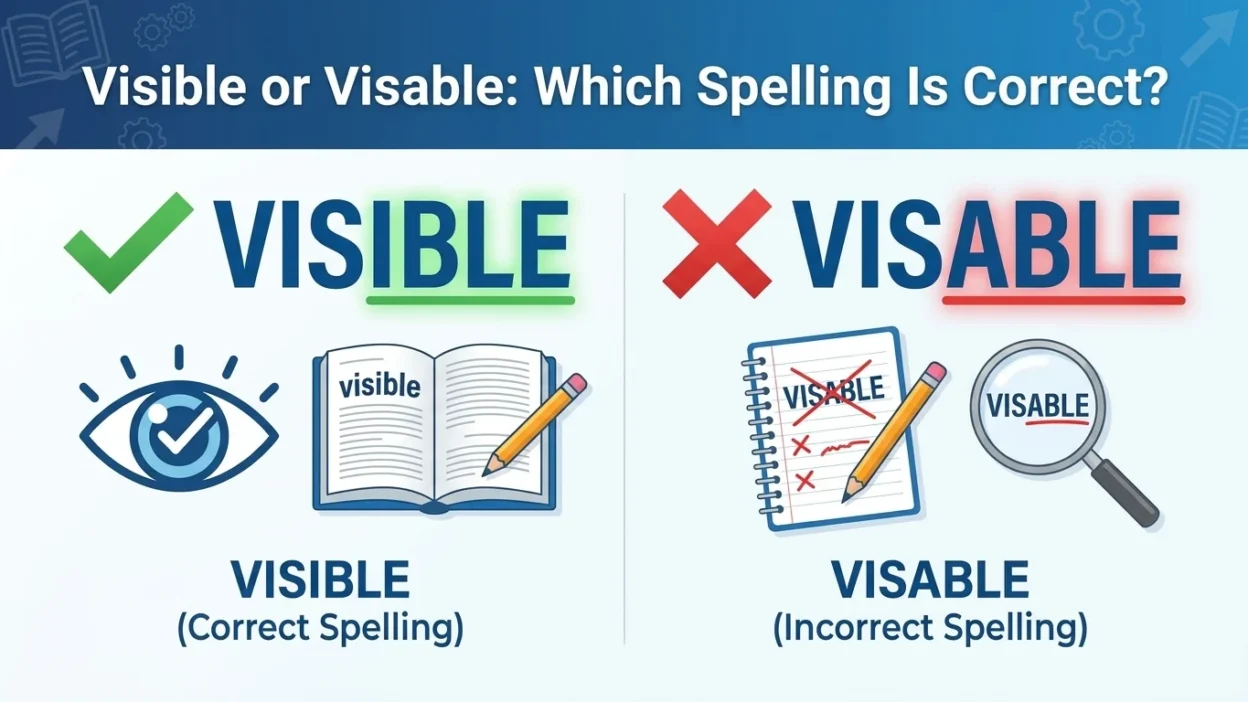
If you are wondering whether visible or visable is correct, the standard English spelling is visible. Visable is incorrect. Visible is an adjective meaning something that can be seen, noticed, or clearly observed. For example, “The mountains were clearly visible from the window.” This word is common in everyday English, academic writing, technology, science, and professional communication.
The confusion usually happens because visible is pronounced in a way that can make the middle vowel sound unclear. As a result, some people write visable instead of visible. However, the correct spelling uses -ible, not -able: visible. Learning this spelling is especially useful for students, ESL learners, writers, and anyone who wants to avoid common spelling mistakes. In this guide, you will learn the difference between visible and visable, see practical examples, and discover an easy memory trick.
Quick Answer
Visible is the correct spelling, while visable is incorrect. Visible means something can be seen or noticed. The correct spelling ends in -ible, not -able: visible. For example, “The writing is clearly visible.” Remember visible as the standard form whenever you mean “able to be seen.”
Why Do People Confuse It?
People often confuse visible and visable because the two spellings sound similar when spoken.
The ending can also cause uncertainty because English has many words ending in -able, such as:
- comfortable
- readable
- washable
- understandable
This may lead people to assume that visible should be spelled visable.
However, the standard spelling is:
visible ✅
not:
visable ❌
The word follows a different spelling pattern, so it is best to learn visible as a complete word rather than trying to spell it from pronunciation alone.
First Word: Visible
Visible is the correct spelling.
It means able to be seen, noticeable, or apparent.
For example:
The moon was clearly visible in the night sky.
It can describe something that can physically be seen:
The sign was visible from the road.
It can also describe something that is noticeable or apparent:
There was visible excitement among the students.
The noun form is visibility, while the opposite adjective is invisible.
Second Word: Visable
Visable is an incorrect spelling in standard English.
It is usually created because the pronunciation of visible may make the middle letters difficult to identify.
Incorrect:
The text is not visable on the screen.
Correct:
The text is not visible on the screen.
If you are writing an essay, report, email, website content, or professional document, use visible.
Visible vs Visable: Comparison Table
| Word | Correct? | Meaning | Example |
|---|---|---|---|
| visible | ✅ Yes | Able to be seen or noticed | The stars were visible at night. |
| visable | ❌ No | Incorrect spelling of visible | The stars were visable at night. |
The main difference is spelling. Visible is the standard English word, while visable is a misspelling.
When to Use Each
When to Use “Visible”
Use visible when something can be seen, noticed, or clearly observed.
Common expressions include:
- clearly visible
- easily visible
- barely visible
- highly visible
- visible sign
- visible damage
- visible change
- visible difference
- visible improvement
- visible evidence
For example:
There was a visible improvement in her writing.
When to Use “Visable”
You should not use visable in standard English.
Whenever you mean “able to be seen,” use visible.
10+ Examples of Visible
- The mountains were clearly visible from the window.
- The writing is not visible in the dark.
- The stars were visible after the clouds disappeared.
- There was a visible change in his behavior.
- The sign is easily visible from the road.
- The damage was visible from a distance.
- Her excitement was visible to everyone.
- The message should remain visible on the screen.
- The results showed a visible improvement.
- The building is clearly visible from the highway.
- A small crack was visible on the wall.
- The logo should be visible on every page.
These examples show that visible can describe something physically seen as well as something noticeable or apparent.
Common Mistakes
The most common mistake is spelling visible with -able.
Incorrect:
The instructions are not visable.
Correct:
The instructions are not visible.
Another common mistake is relying entirely on pronunciation. The ending of visible does not sound exactly like its spelling, so listening alone may lead to errors.
Remember:
visible = correct
visable = incorrect
You may also see related words such as:
- visibility
- visibly
- invisible
- visualize
These words are related in meaning but have different spellings and grammatical uses.
Memory Trick
A simple way to remember the spelling is:
Visible has “ible.”
Think:
VIS + IBLE = VISIBLE
You can also connect it with its opposite:
visible ↔ invisible
Both words contain -ible.
So remember:
If you can see it, it is visible.
Do not change -ible to -able.
American vs British English
There is no spelling difference between American and British English for visible.
Both varieties use:
visible ✅
And both consider:
visable ❌
an incorrect spelling.
The meaning is also essentially the same in both varieties: something that can be seen, noticed, or observed.
Similar Words
Several words are related to visible, but each has its own meaning.
Noticeable
Noticeable means easy to see, recognize, or observe.
There was a noticeable difference between the two results.
Apparent
Apparent means clear or easy to understand or recognize.
The reason for the change became apparent.
Observable
Observable means something that can be seen or detected through observation.
The experiment produced observable changes.
Obvious
Obvious means easy to recognize or understand.
The mistake was obvious.
Detectable
Detectable means capable of being discovered or identified.
The chemical was detectable in the sample.
Perceptible
Perceptible means capable of being noticed or detected, often subtly.
There was a perceptible change in temperature.
These words can be similar to visible, but they are not always interchangeable.
Final Verdict
The correct spelling is visible.
Visable is a misspelling and should not be used in standard English.
Remember:
VISIBLE ✅
VISABLE ❌
For example:
Correct: The sign is clearly visible.
Incorrect: The sign is clearly visable.
The easiest memory trick is to remember the -ible ending in visible and connect it with invisible.
Frequently Asked Questions
Is it visible or visable?
The correct spelling is visible. Visable is incorrect.
What does visible mean?
Visible means able to be seen, noticed, or observed.
Why is visible spelled with “ible”?
Visible is the standard spelling of the adjective meaning “able to be seen.” It uses the ending -ible, so the correct form is visible, not visable.
Is visable a real word?
Visable is not the standard English spelling of the word meaning “able to be seen.” The correct spelling is visible.
How do you spell visible correctly?
The correct spelling is v-i-s-i-b-l-e: visible.
Is visible the same in British and American English?
Yes. Visible has the same standard spelling and basic meaning in both British and American English.
What is the opposite of visible?
The opposite of visible is invisible, meaning something cannot be seen.
What words are similar to visible?
Similar words include noticeable, apparent, observable, obvious, detectable, and perceptible, depending on the context.
Remember This
Visible = correct ✅
Visable = incorrect ❌
Remember:
VISIBLE = able to be seen
The spelling contains -ible:
VIS + IBLE = VISIBLE
So write:
The text is clearly visible.
Not:
The text is clearly visable.
Conclusion
The difference between visible or visable is a straightforward spelling issue. Visible is the correct standard English word, while visable is a misspelling. Visible means something can be seen, noticed, or observed, and it can describe both physical objects and noticeable changes or effects.
To remember the correct spelling, focus on the -ible ending in visible. Connecting it with invisible, its opposite, can also make the spelling easier to remember. Whenever you mean “able to be seen,” choose visible, not visable.