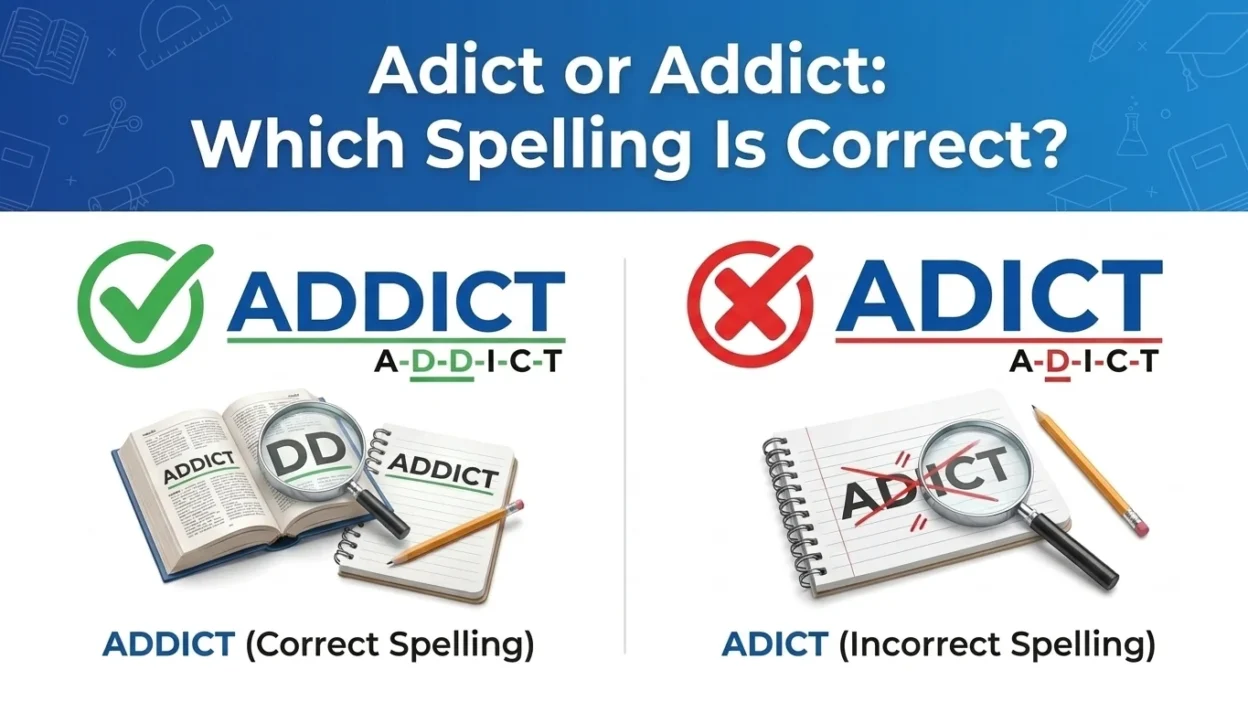
If you are wondering whether adict or addict is correct, the standard English spelling is addict. Adict is a misspelling. The word addict can be used as a noun for a person who is strongly dependent on a substance or activity, and it can also be used as a verb meaning to cause someone to become dependent on something. For example, “He is addicted to video games.”
This spelling can be confusing because the word contains a double d, and English learners may accidentally leave one out. However, the correct spelling is always addict, with two d’s: a-d-d-i-c-t. Learning the correct form is useful for students, ESL learners, writers, and anyone who wants to communicate clearly in everyday, academic, or professional writing.
Quick Answer
Addict is the correct spelling, while adict is incorrect. The word addict contains two d’s: a-d-d-i-c-t. It can refer to a person who is dependent on a substance or activity, or it can function as a verb in less common formal usage. Adict is simply a spelling mistake.
Why Do People Confuse It?
People often confuse adict and addict because the word is pronounced without strongly emphasizing the two separate d sounds.
When writing quickly, it can be easy to remember the pronunciation but forget one of the letters.
The incorrect spelling is:
adict ❌
The correct spelling is:
addict ✅
A useful way to remember it is to think of the word as containing double D:
A + DD + ICT = ADDICT
The same double-letter pattern appears in related words such as addicted and addiction.
First Word: Adict
Adict is an incorrect spelling in standard English.
It is usually created by accidentally leaving out one of the two d’s in addict.
Incorrect:
He is an adict to online games.
Correct:
He is an addict to online games.
You should not use adict in standard English writing.
Second Word: Addict
Addict is the correct spelling.
As a noun, an addict is a person who is dependent on a substance or strongly dependent on an activity.
For example:
He was a gambling addict.
The word can also be used as a verb, although this use is less common in everyday modern English.
For example:
The drug can addict users quickly.
More commonly, English speakers use related forms such as addicted and addiction:
She is addicted to social media.
His addiction affected his daily life.
Adict vs Addict: Comparison Table
| Word | Correct? | Meaning | Example |
|---|---|---|---|
| addict | ✅ Yes | A dependent person; also a verb meaning to cause dependence | He is a video game addict. |
| adict | ❌ No | Incorrect spelling of addict | He is a video game adict. |
The main difference is the extra d. The correct spelling contains two d’s.
When to Use Each
When to Use “Addict”
Use addict when referring to a person who is dependent on a substance or activity.
For example:
- drug addict
- gambling addict
- work addict
- shopping addict
- television addict
However, when discussing health or substance-use issues, more precise and neutral terms such as person with an addiction or person with substance use disorder may be more appropriate depending on the context.
When to Use “Adict”
Do not use adict in standard English. If you mean the English word referring to a person with an addiction, use addict.
10+ Examples of Addict
- He was known as a serious addict to gambling.
- She described herself as a coffee addict.
- The article discusses the experiences of people affected by addiction.
- He became addicted to online games.
- She realized that her phone use was becoming addictive.
- The program helps people overcome addiction.
- He is a self-described fitness addict.
- The character in the novel is portrayed as a drug addict.
- The campaign focuses on preventing substance addiction.
- She sought professional help for her addiction.
- The substance can addict users quickly.
- He was once addicted to gambling but changed his habits.
These examples also show why related forms such as addicted and addiction are often more natural than using addict.
Common Mistakes
The most common mistake is leaving out the second d.
Incorrect:
He is an adict.
Correct:
He is an addict.
Another mistake is forgetting the double d in related words.
Correct forms include:
- addict
- addicted
- addiction
- addictive
All of these words retain the double d.
A useful spelling pattern is:
ADD + ICT = ADDICT
Memory Trick
The easiest way to remember addict is:
An addict has Double D.
Think:
A + DD + ICT
The word contains two d’s:
ADDICT ✅
Not:
ADICT ❌
You can also connect it with:
addict → addicted → addiction
The double d remains important in each related form.
American vs British English
There is no spelling difference between American and British English for addict.
Both varieties use:
addict ✅
And both consider:
adict ❌
an incorrect spelling.
The meaning is also essentially the same in both varieties. However, in health-related or formal contexts, modern writing often prefers person-first language such as a person with an addiction rather than labeling someone simply as an addict.
Similar Words
Several words are related to addict, but they are not always exact synonyms.
Addicted
Addicted is an adjective describing a person who has a strong dependence on a substance or activity.
He is addicted to gambling.
Addiction
Addiction is the condition or pattern of dependence.
Addiction can affect many areas of a person’s life.
Dependent
Dependent describes someone who relies strongly on a substance or activity.
The patient became dependent on the medication.
Compulsive
Compulsive describes behavior that is difficult to control.
He has a compulsive habit of checking his phone.
Enthusiast
Enthusiast describes someone who is very interested in or passionate about something. Unlike addict, it does not necessarily suggest harmful dependence.
She is a photography enthusiast.
Choosing the right term depends on whether you mean dependence, compulsive behavior, or simply strong interest.
Final Verdict
The correct spelling is addict.
Adict is a misspelling because the standard word contains two d’s:
A-D-D-I-C-T
For example:
Correct: He is addicted to gambling.
Incorrect: He is an adict.
Remember that related words such as addicted, addiction, and addictive also contain the double d. In formal or health-related writing, consider whether a more precise term such as person with an addiction is appropriate.
Frequently Asked Questions
Is it adict or addict?
The correct spelling is addict. Adict is incorrect.
How do you spell addict correctly?
The correct spelling is a-d-d-i-c-t: addict.
Why does addict have two d’s?
The standard spelling of the word includes a double d. Remember it as A + DD + ICT.
What does addict mean?
As a noun, addict refers to a person who is dependent on a substance or activity. It can also be used as a verb meaning to cause someone to become dependent.
What is the adjective form of addict?
The adjective is addicted.
She is addicted to social media.
What is the noun form related to addicted?
The noun is addiction.
His addiction affected his daily routine.
Is addict spelled differently in British English?
No. Addict is spelled the same way in British and American English.
Is “person with an addiction” better than “addict”?
In many health and formal contexts, person with an addiction is preferred because it describes the person without reducing their identity to a condition.
Remember This
Addict = correct ✅
Adict = incorrect ❌
Remember the double D:
A + DD + ICT = ADDICT
Also remember:
addict → addicted → addiction
All three forms keep the important double d.
Conclusion
The difference between adict vs addict is a simple spelling issue. Addict is the correct English spelling, while adict is a misspelling. The key detail to remember is the double d in a-d-d-i-c-t.
The word can be used in different grammatical forms, including addict, addicted, and addiction. In everyday language, context matters because addict can describe either dependence or, informally, someone who is extremely enthusiastic about an activity. In health-related writing, more precise and respectful wording may be preferable.