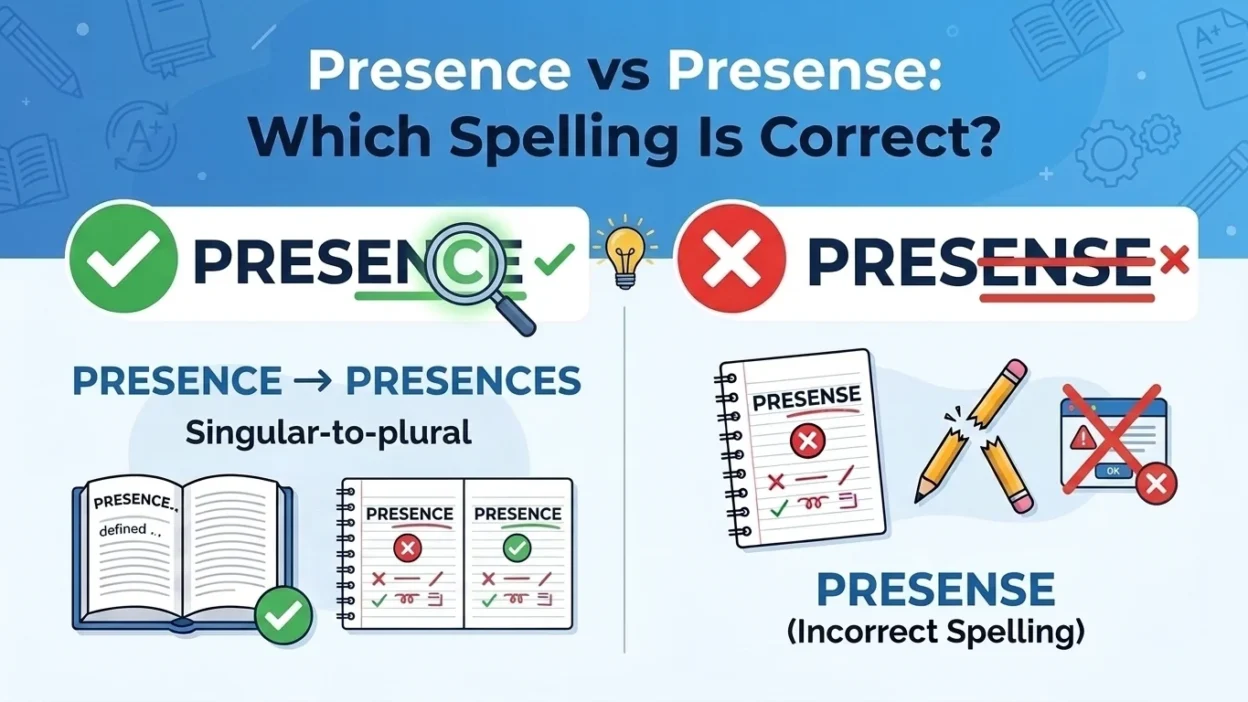
If you are wondering whether presense or presence is correct, the standard English spelling is presence. Presense is a misspelling. The word presence refers to the state of being in a particular place, the fact that someone or something exists or is there, or the noticeable effect a person has on others. For example, “Her presence made everyone feel welcome.”
This spelling mistake is common because presence is pronounced with a sound that can make the final -ence spelling less obvious. As a result, some writers accidentally use -ense and write presense. However, the correct spelling is always presence, with c before the final e. Learning this difference can help students, ESL learners, writers, and general readers use the word correctly in academic, professional, and everyday writing.
Quick Answer
Presence is the correct spelling, while presense is incorrect. Presence means being in a place, existing somewhere, or having a noticeable effect or influence. For example, “The teacher’s presence helped the students stay focused.” Remember the spelling: P-R-E-S-E-N-C-E.
Why Do People Confuse It?
People often confuse presense and presence because the pronunciation of the final part of presence does not clearly indicate whether it should be spelled -ence or -ense.
The incorrect form is:
presense ❌
The correct form is:
presence ✅
The key difference is the letter c.
Another reason for the mistake is that English contains words ending in -ense, such as expense and defense in American English. This can make presense seem logical even though it is not the standard spelling.
First Word: Presense
Presense is an incorrect spelling of presence.
It does not have a separate standard meaning in English. If you are referring to someone’s attendance, existence, or noticeable influence, use presence.
Incorrect:
Her presense was important at the meeting.
Correct:
Her presence was important at the meeting.
The best way to correct this mistake is to remember that presence contains a c near the end.
Second Word: Presence
Presence is the correct standard English word.
It is a noun with several related meanings.
First, presence can mean the state of being in a particular place.
His presence at the meeting was required.
Second, it can refer to the fact that someone or something exists or is there.
The police noticed the presence of several people nearby.
Third, presence can describe the noticeable effect, confidence, or impression a person has.
The speaker had a strong presence on stage.
Thus, the meaning depends on the context, but the spelling remains presence.
Presense vs Presence: Comparison Table
| Word | Correct? | Meaning | Example |
|---|---|---|---|
| presence | ✅ Yes | Being in a place, existence, or noticeable influence | Her presence made the room feel warmer. |
| presense | ❌ No | Misspelling of presence | Her presense made the room feel warmer. |
The main spelling difference is the c in presence.
When to Use Each
When to Use “Presence”
Use presence when talking about:
- someone’s attendance
- being physically somewhere
- the existence of something
- someone’s influence or impression
- confidence or authority
- a company’s visibility in a particular area
For example:
Your presence is required at the meeting.
You can also use it in phrases such as:
- physical presence
- strong presence
- online presence
- professional presence
- stage presence
- military presence
- presence of mind
When to Use “Presense”
Do not use presense in standard English. When you mean the noun described above, use presence.
10+ Examples of Presence
- Her presence made the event more enjoyable.
- The manager requested everyone’s presence at the meeting.
- His presence in the room was immediately noticed.
- The teacher’s presence helped the students remain focused.
- She has a strong presence on stage.
- The company has a growing online presence.
- The doctor checked for the presence of infection.
- His calm presence reassured the team.
- The actor has a powerful screen presence.
- We appreciated your presence at the ceremony.
- The report confirmed the presence of several errors.
- She maintained a professional presence during the presentation.
These examples show that presence can describe physical attendance, existence, influence, or a person’s overall impression.
Common Mistakes
The most common mistake is spelling presence as presense.
Incorrect:
Thank you for your presense.
Correct:
Thank you for your presence.
Another common mistake is confusing presence with present.
Present can be an adjective, noun, or verb, while presence is a noun.
For example:
She is present at the meeting.
Her presence is important.
Remember that the noun presence contains c.
Memory Trick
A simple memory trick is:
Presence has C because you can see someone’s presence.
Focus on the spelling:
P-R-E-S-E-N-C-E
You can break it into:
PRES + ENCE
The important part is:
-ENCE ✅
Not:
-ENSE ❌
Another useful connection is:
present → presence
Both words begin with pres-, but presence ends in -ence.
American vs British English
Presence is spelled the same way in American and British English.
Both varieties use:
presence ✅
And presense is incorrect in both.
There are some spelling differences between American and British English for other words, but presence is not one of them.
For example, the word defense is commonly spelled defence in British English, while American English generally uses defense. This difference can sometimes contribute to confusion about whether presence should end in -ence or -ense. However, the standard spelling remains presence in both varieties.
Similar Words
Several words are related to presence, but their meanings are not identical.
Attendance
Attendance means being present at an event, class, meeting, or place.
Her attendance at the meeting was recorded.
Existence
Existence refers to the state of being real or existing.
Scientists are studying the existence of the species.
Appearance
Appearance can refer to the way someone or something looks or the act of appearing somewhere.
He made a brief appearance at the event.
Proximity
Proximity means being physically close to something.
The hotel’s proximity to the airport was convenient.
Influence
Influence refers to the power to affect someone or something.
Her influence helped shape the project.
Aura
Aura can describe a distinctive feeling or quality that seems to surround someone or something.
The performer had an energetic aura.
These words may relate to presence, but the exact choice depends on what you want to express.
Final Verdict
The correct spelling is presence.
Presense is a misspelling and should be corrected to presence in standard English writing.
Remember:
PRESENCE ✅
PRESENSE ❌
The key is the c before the final e. For example:
Correct: Thank you for your presence.
Incorrect: Thank you for your presense.
Frequently Asked Questions
Is it presense or presence?
The correct spelling is presence. Presense is a misspelling.
How do you spell presence correctly?
The correct spelling is P-R-E-S-E-N-C-E: presence.
What does presence mean?
Presence can mean being in a particular place, the existence of someone or something, or the noticeable impression or influence of a person.
Why is presence spelled with a c?
The standard English spelling is presence, ending in -ence. The spelling presense is incorrect.
What is an example of presence?
A simple example is: “Her presence made everyone feel comfortable.”
Is presence spelled differently in British English?
No. Presence has the same spelling in American and British English.
What is the difference between presence and attendance?
Attendance usually focuses on being present at a particular event, class, or meeting. Presence has a broader meaning and can also refer to existence, influence, or a noticeable impression.
What is the adjective related to presence?
The related adjective is present.
The students were present in the classroom.
Remember This
Presence = correct ✅
Presense = incorrect ❌
Remember the ending:
PRESENCE → -ENCE
Not:
PRESENSE → -ENSE
A useful sentence to remember is:
Your presence is appreciated.
Conclusion
The difference between presense vs presence is a simple spelling issue. Presence is the correct English word, while presense is a misspelling. Presence can describe someone’s attendance, physical existence, or the noticeable impression and influence they have on others.
To avoid this mistake, remember the final letters carefully: presence ends in -ence, with a c before the final e. The spelling is the same in American and British English, so you can confidently use presence in standard English writing.