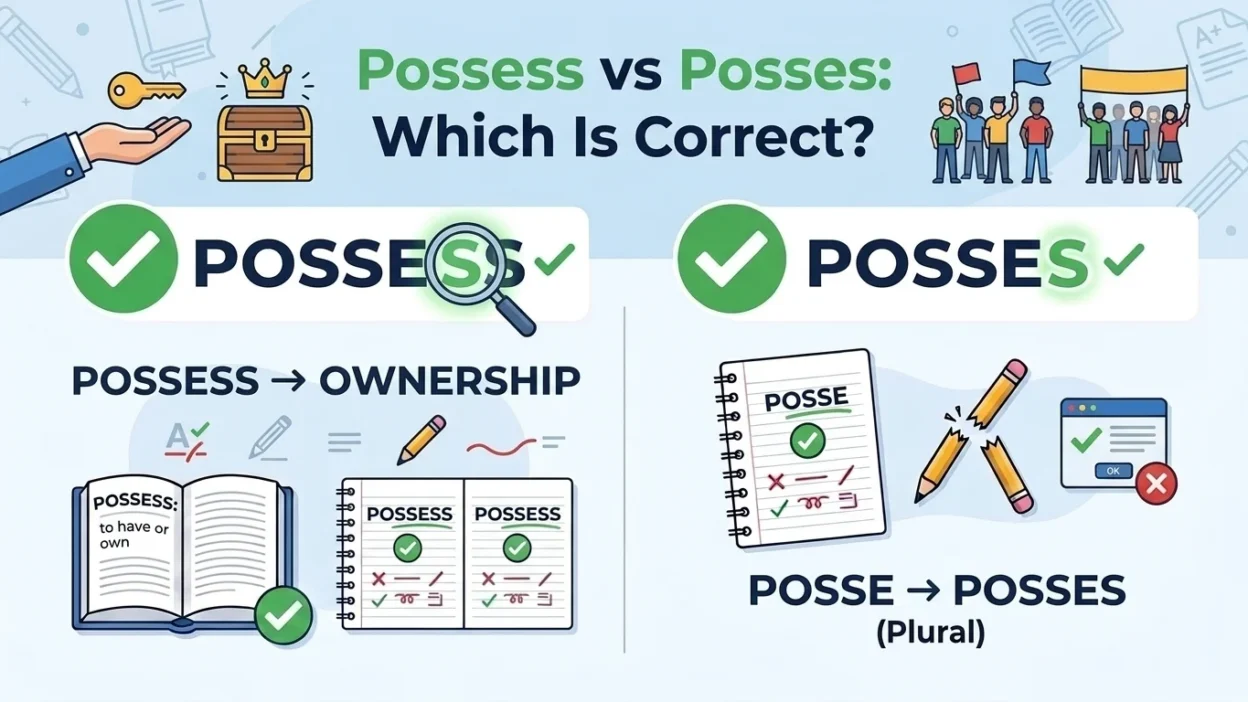
If you are wondering whether possess or posses is correct, both are real English words, but they have different meanings and uses. Possess means to own, have, or hold something, while posses is the plural form of posse, meaning groups of people, especially groups organized for a particular purpose. For example, “She possesses excellent communication skills” uses possess, while “Several posses searched the area” uses posses.
These words are easy to confuse because they look almost identical and are pronounced similarly. The extra s in possess is important because it changes the word completely. For students, ESL learners, writers, and general readers, understanding this difference makes it easier to choose the correct word based on meaning. The key is simple: use possess when you mean “own” or “have,” and use posses when you mean more than one posse.
Quick Answer
Possess and posses are both correct words, but they do not mean the same thing. Possess means to own, have, or hold something. Posses is the plural of posse, meaning groups of people organized for a particular purpose. Choose the spelling according to the intended meaning.
Why Do People Confuse It?
People often confuse possess and posses because they contain almost the same letters.
The difference is the number of s’s at the end:
possess → p-o-s-s-e-s-s
posses → p-o-s-s-e-s
The word possess has three s’s after the initial p-o in its written form, while posses has two.
More importantly, the two words have completely different meanings.
For example:
She possesses great talent.
Here, possesses comes from possess and means “has.”
But:
The sheriff gathered several posses.
Here, posses is the plural of posse.
Understanding the meaning is more reliable than trying to remember the spelling alone.
First Word: Possess
Possess is a verb that means to own, have, or hold something.
It can refer to physical possessions:
He possesses several valuable paintings.
It can also refer to qualities, skills, knowledge, or characteristics:
She possesses excellent leadership skills.
The verb possess is commonly used in formal or descriptive writing. In everyday conversation, have is often more natural.
Forms of Possess
| Form | Example |
|---|---|
| possess | I possess the necessary documents. |
| possesses | She possesses great patience. |
| possessed | He possessed a rare collection. |
| possessing | They are possessing valuable knowledge. |
The most common everyday alternative is have.
She possesses a car.
She has a car.
Both can express ownership, although has sounds more natural in casual conversation.
Second Word: Posses
Posses is the plural form of the noun posse.
A posse traditionally refers to a group of people assembled to pursue or capture someone, especially in historical contexts involving law enforcement.
For example:
The sheriff organized a posse to search for the escaped prisoner.
The plural is:
The sheriff organized several posses.
In modern informal English, posse can also mean a group of friends or associates.
For example:
He arrived with his posse.
The plural can be:
Several posses gathered at the event.
Therefore, posses is a correct word, but it is not the plural or alternate spelling of possess.
Possess vs Posses: Comparison Table
| Word | Meaning | Part of Speech | Example |
|---|---|---|---|
| possess | To own, have, or hold something | Verb | She possesses great talent. |
| posses | More than one group called a posse | Plural noun | Several posses searched the area. |
The key difference is meaning. Possess relates to ownership or having something, while posses refers to multiple groups of people.
When to Use Each
When to Use “Possess”
Use possess when you mean:
- own something
- have something
- hold something
- have a particular quality
- have a particular skill or ability
Examples:
He possesses strong communication skills.
The museum possesses several rare artifacts.
She possesses the knowledge needed for the job.
When to Use “Posses”
Use posses only when you mean more than one posse.
Examples:
Several posses were formed during the search.
The novel describes rival posses in the Old West.
In most modern everyday writing, you will encounter possess much more often than posses.
10+ Examples of Possess and Posses
Examples with Possess
- She possesses excellent writing skills.
- He possesses a large collection of books.
- The company possesses valuable intellectual property.
- They possess the knowledge required for the project.
- The museum possesses several historical artifacts.
- She possesses remarkable patience.
- The team possesses the skills needed to succeed.
- He does not possess a valid driver’s license.
- The organization possesses important historical records.
- The candidate possesses considerable experience in the field.
Examples with Posses
- Several posses searched the surrounding countryside.
- The story describes rival posses chasing the outlaw.
- Multiple posses were organized during the search.
- The historical documentary discusses frontier posses.
- The novel features several competing posses.
The context makes the difference clear: possess means “have,” while posses means multiple groups called posse.
Common Mistakes
A common mistake is using posses when you mean “own” or “have.”
Incorrect:
She posses excellent communication skills.
Correct:
She possesses excellent communication skills.
Another common error is confusing possess with possesses.
Use possess with:
I possess the necessary skills.
Use possesses with:
She possesses the necessary skills.
A different mistake is assuming that posses is simply a shortened spelling of possess. It is not. Posses has its own meaning as the plural of posse.
Memory Trick
Use this simple trick:
Possess = own or have.
Think of possess as being connected with possession.
possess → possession
Both words are about having or owning something.
For posses, think:
One posse, two posses.
So:
possess = own or have ✅
posses = more than one posse ✅
This meaning-based trick makes the difference much easier to remember.
American vs British English
Possess has the same spelling and meaning in American and British English.
Posses, as the plural of posse, is also spelled the same way in both varieties.
The main difference is not regional spelling but usage. The word posse is strongly associated with historical groups of people, especially in American frontier contexts, although it can also be used informally for a group of friends or associates.
For example:
The sheriff formed a posse.
In informal modern English:
He went to the concert with his posse.
Similar Words
Several words are related to possess, but their meanings can vary.
Own
Own means to have something as your property.
She owns a small business.
Have
Have is the most common everyday word for possession.
He has a new laptop.
Hold
Hold can mean to have or keep something physically or figuratively.
She holds an important position.
Retain
Retain means to continue to have or keep something.
The company retained its original customers.
Control
Control means to have power or authority over something.
The manager controls the budget.
Posse
A posse is a group of people, especially one assembled for a particular purpose.
The sheriff formed a posse.
These words are related to possession or groups, but they should not be treated as exact substitutes in every sentence.
Final Verdict
Both possess and posses are correct English words, but they have different meanings.
Use possess when you mean own, have, or hold something:
She possesses excellent skills.
Use posses when you mean more than one posse:
Several posses searched the area.
The easiest way to remember the difference is to connect possess with possession and posses with the plural of posse.
Frequently Asked Questions
Is possess or posses correct?
Both are correct, but they have different meanings. Possess means to own or have something, while posses is the plural of posse.
What does possess mean?
Possess means to own, have, or hold something. It can also describe having a particular quality, skill, or characteristic.
What does posses mean?
Posses is the plural form of posse, which can refer to groups of people organized for a particular purpose.
Is posses a spelling mistake?
No. Posses is a legitimate word when it is the plural of posse. However, it is incorrect if you intend to write the verb possess.
What is the difference between possess and possession?
Possess is a verb meaning to own or have something. Possession is a noun referring to something owned or the state of owning something.
She possesses a valuable painting.
The painting is one of her possessions.
How do you use possess in a sentence?
You can say: “She possesses excellent communication skills.” Here, possesses means “has.”
What is the plural of posse?
The plural of posse is posses.
one posse → two posses
Is possess the same in British and American English?
Yes. Possess is spelled and used in essentially the same way in both American and British English.
Remember This
Possess = own or have ✅
Posses = plural of posse ✅
Remember these two connections:
possess → possession → ownership
posse → posses → groups
If you mean “have,” choose possess.
If you mean more than one posse, choose posses.
Conclusion
The difference between possess vs posses is important because both spellings are valid, but they serve completely different purposes. Possess is a verb meaning to own, have, or hold something, while posses is the plural of posse, a word used for groups of people organized for a particular purpose.
When choosing between them, focus on meaning rather than pronunciation. If you can replace the word with have or own, possess is probably the correct choice. If you are talking about multiple groups called posse, use posses. This simple distinction will help you use both words accurately.