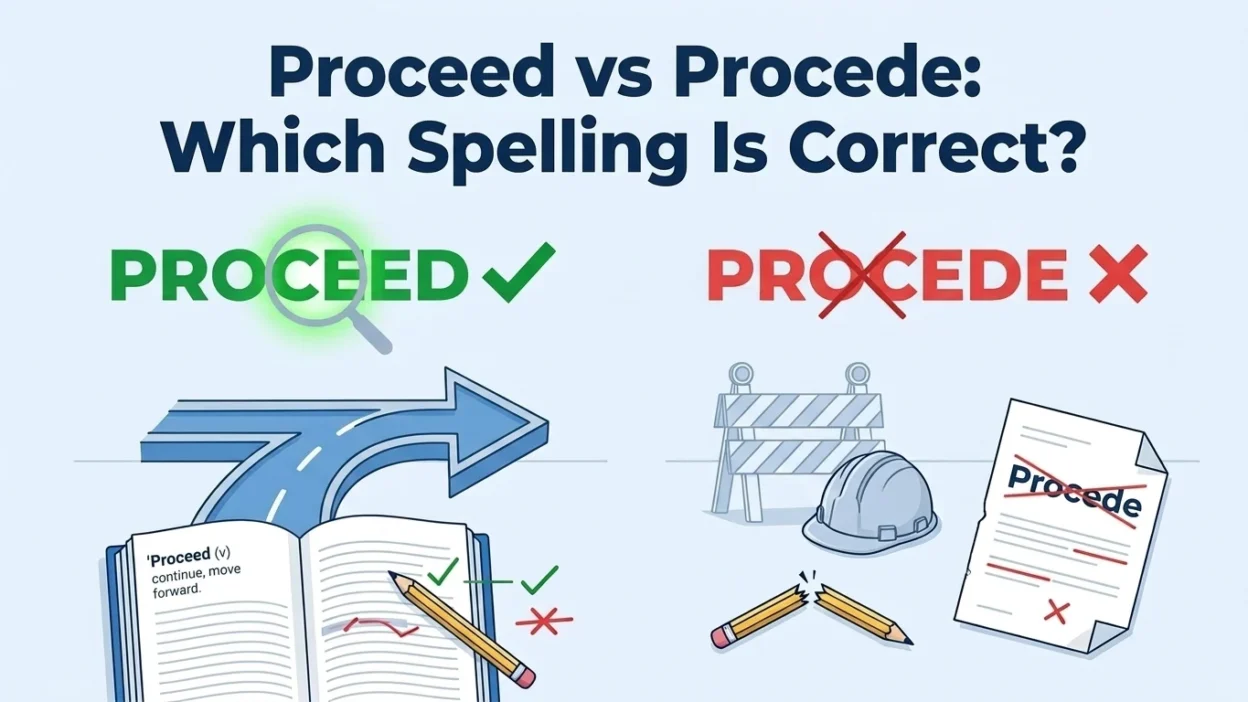
If you are wondering whether proceed or procede is correct, proceed is the standard English spelling. Procede is generally a misspelling and should not be used when you mean “to continue,” “to move forward,” or “to take the next step.” For example, you can say, “Please proceed with the meeting.”
The confusion is understandable because proceed and procede sound very similar, especially in spoken English. The ending can make it difficult to remember whether the final letters should be -eed or -ede. However, in standard English, the verb is spelled proceed. Learning this distinction is useful for students, ESL learners, writers, and professionals because proceed appears frequently in instructions, formal communication, academic writing, and everyday situations.
Quick Answer
Proceed is the correct spelling, while procede is a misspelling in standard English. Proceed means to continue, move forward, or take the next step. For example, “You may proceed with the application.” Remember the spelling as pro-ceed, with -ceed at the end.
Why Do People Confuse It?
People often confuse proceed and procede because they are pronounced similarly.
The correct spelling is:
proceed ✅
The incorrect spelling is:
procede ❌
The main difficulty is remembering the final letters. English has several words that end in -cede, such as precede, recede, and concede. Because of these familiar patterns, procede can look reasonable.
However, proceed follows a different spelling pattern.
A useful comparison is:
- precede = come before
- proceed = continue or move forward
Although the words are related historically, their modern spellings are different.
First Word: Proceed
Proceed is the correct standard English verb.
It means to continue doing something, move forward, or take the next step in a process.
For example:
You may proceed with the application.
It can also mean to move from one place or stage to another:
The students proceeded to the next room.
Common phrases include:
- proceed with the plan
- proceed with caution
- proceed to the next step
- proceed with the application
- proceed as planned
- proceed to checkout
The word is particularly common in formal instructions and professional communication.
Second Word: Procede
Procede is generally an incorrect spelling of proceed in modern standard English.
If you mean “continue,” “move forward,” or “go on,” use proceed.
Incorrect:
Please procede with the payment.
Correct:
Please proceed with the payment.
However, procedé or similar forms may occasionally appear in specialized contexts or as names in other languages. These should not be confused with the standard English verb proceed.
Proceed vs Procede: Comparison Table
| Word | Correct? | Meaning | Example |
|---|---|---|---|
| proceed | ✅ Yes | To continue or move forward | Please proceed with the plan. |
| procede | ❌ No | Usually a misspelling of proceed | Please procede with the plan. |
The important point is simple: when you mean continue or move forward, use proceed.
When to Use Each
When to Use “Proceed”
Use proceed when you want to say:
- continue
- move forward
- take the next step
- go ahead
- continue with a process
For example:
We can proceed with the project.
You can also use it in instructions:
Please proceed to the next room.
Or as a polite permission:
You may proceed.
When to Use “Procede”
In standard English, do not use procede as the spelling of proceed.
Instead, write:
proceed ✅
10+ Examples of Proceed
- Please proceed with the registration.
- You may proceed to the next step.
- The meeting will proceed as planned.
- We decided to proceed with the project.
- Please proceed with caution.
- The train will proceed after a short delay.
- Once everyone agrees, we can proceed.
- The lawyer advised us to proceed carefully.
- The students proceeded to the next classroom.
- The company will proceed with the investigation.
- You can proceed to checkout when you are ready.
- Despite the difficulty, the team proceeded with the work.
These examples show that proceed can describe continuing an activity, moving forward, or advancing to another stage.
Common Mistakes
The most common mistake is spelling proceed as procede.
Incorrect:
Please procede with the instructions.
Correct:
Please proceed with the instructions.
Another common mistake is confusing proceed with precede.
These are different words:
Proceed = continue or move forward.
We will proceed with the meeting.
Precede = come before something.
A short introduction will precede the presentation.
This distinction is especially important because precede is correctly spelled with -cede, while proceed is spelled with -ceed.
Memory Trick
Use this simple trick:
Proceed = go forward.
Think of the word as:
PRO + CEED
The ending is:
-CEED ✅
Not:
-CEDE ❌
You can also remember:
Proceed = continue and move ahead.
If you are telling someone to move forward, choose proceed.
American vs British English
Proceed is spelled the same way in American and British English.
Both varieties use:
proceed ✅
The incorrect spelling procede is not a standard alternative spelling in either variety.
The word is also used in similar contexts in both forms of English, including instructions, formal writing, business communication, and everyday speech.
For example:
Please proceed to the next stage.
The spelling does not change based on whether you are writing for an American or British audience.
Similar Words
Several words have meanings related to proceed, but each has a slightly different use.
Continue
Continue means to keep doing something without stopping.
Please continue reading.
Advance
Advance means to move forward, either physically or figuratively.
The project continues to advance.
Progress
Progress means to develop or move forward toward a goal.
The work is progressing well.
Move Forward
Move forward means to continue or advance.
We need to move forward with the plan.
Go Ahead
Go ahead is an informal expression meaning to proceed or continue.
You can go ahead with the presentation.
Resume
Resume means to begin again after stopping temporarily.
The meeting will resume after lunch.
These words can sometimes replace proceed, but the best choice depends on the context.
Final Verdict
The correct spelling is proceed.
Procede is generally a misspelling when you mean to continue, move forward, or take the next step.
Remember:
PROCEED ✅
PROCEDE ❌
A useful memory aid is “Proceed = move forward.” The correct word ends with -ceed, not -cede.
Also remember the difference between proceed and precede:
- proceed = move forward
- precede = come before
Frequently Asked Questions
Is it proceed or procede?
The correct spelling is proceed. Procede is generally a misspelling in standard English.
What does proceed mean?
Proceed means to continue, move forward, or take the next step in a process.
How do you spell proceed correctly?
The correct spelling is P-R-O-C-E-E-D: proceed.
Is procede ever correct?
Procede is not the standard spelling of the English verb meaning “continue” or “move forward.” Use proceed instead.
What is an example of proceed?
A simple example is: “Please proceed with the application.”
What is the difference between proceed and precede?
Proceed means to continue or move forward, while precede means to come before something.
Is proceed the same in British and American English?
Yes. Proceed has the same spelling and basic meaning in both American and British English.
What is the opposite of proceed?
Depending on the context, possible opposites include stop, halt, remain, or retreat.
Remember This
Proceed = correct ✅
Procede = incorrect ❌
Remember:
PROCEED = MOVE FORWARD
The spelling ends in -ceed.
Also keep this pair in mind:
proceed → continue
precede → come before
Conclusion
The difference between proceed vs procede is mainly a spelling issue. Proceed is the correct English verb for continuing, moving forward, or taking the next step. Procede is generally a misspelling and should be avoided in standard English writing.
The easiest way to remember the correct form is to connect proceed with the idea of moving forward. Think PRO + CEED, and remember that it ends with -ceed, not -cede. Once you also understand the difference between proceed and precede, this commonly confused spelling becomes much easier to use correctly.