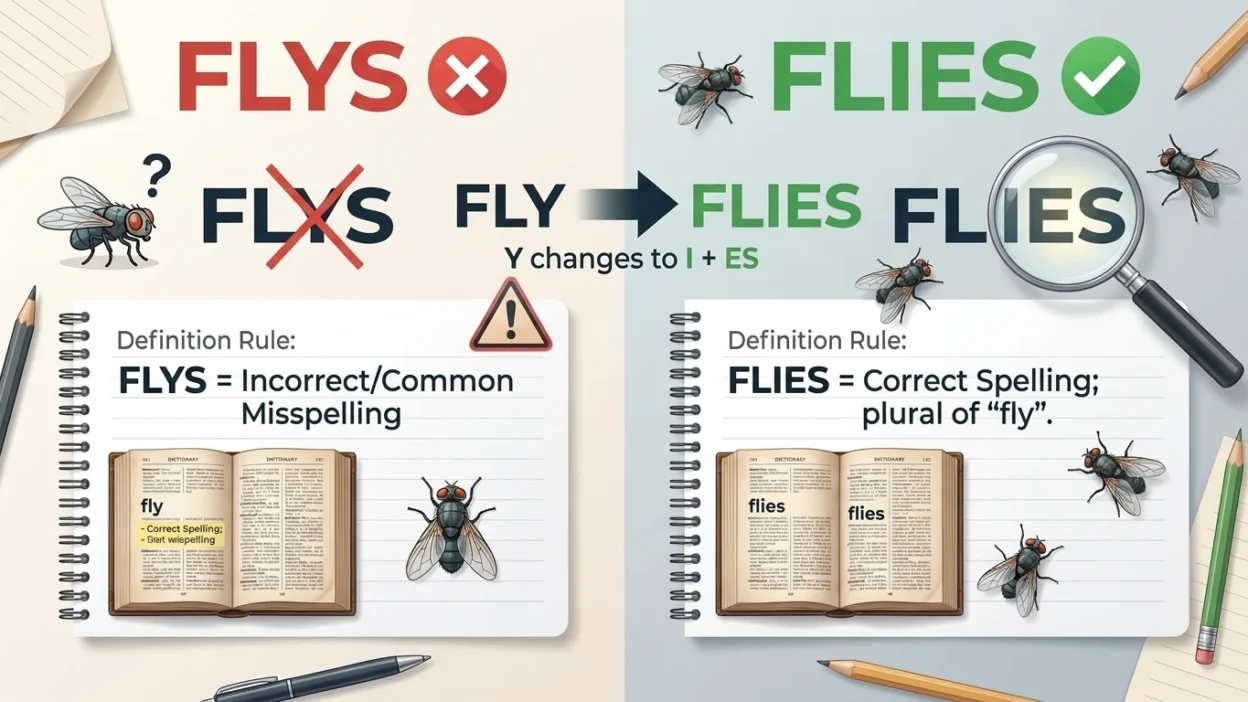
If you are confused about flys vs flies, the correct spelling depends on what you mean. Flies is the standard plural of fly and the correct third-person singular form of the verb fly. Flys is generally incorrect in standard English. For example, “The bird flies over the trees” and “There are many flies in the kitchen” are both correct.
The confusion happens because many English nouns form their plurals by simply adding -s. However, words ending in a consonant followed by y often change y to i before adding -es. Therefore, fly becomes flies when it means more than one insect or when used as a third-person singular verb. Understanding this difference is especially useful for students, ESL learners, writers, and anyone learning English grammar. Moreover, knowing when to use fly, flies, flew, and flown can make both speaking and writing more accurate.
Quick Answer
Flies is the correct standard spelling, while flys is generally incorrect. Flies can be the plural of the noun fly or the third-person singular form of the verb fly. For example, “Two flies landed here” and “The bird flies south” are correct.
Why Do People Confuse It?
People often confuse flys and flies because many English plurals are formed by adding -s.
For example:
- book → books
- car → cars
- chair → chairs
However, when a word ends in a consonant + y, English commonly changes the y to i and adds -es.
Therefore:
fly → flies
not:
fly → flys
The same spelling pattern appears in words such as:
- baby → babies
- city → cities
- story → stories
- party → parties
As a result, remembering this pattern can help you avoid the mistake.
What Does the First Word Mean: Flys?
Is Flys Correct?
Flys is generally not a standard English word when you mean the plural of fly or the third-person singular verb form.
For example:
❌ “There are several flys in the room.”
✅ “There are several flies in the room.”
Similarly:
❌ “The bird flys across the sky.”
✅ “The bird flies across the sky.”
Therefore, in standard English, use flies instead of flys in these situations.
Why Is Flys Incorrect?
The word fly ends with a consonant (l) followed by y. When forming the plural noun or the third-person singular present-tense verb, the y changes to i and -es is added.
The pattern is:
fly + es → flies
This spelling rule explains why flys is not the normal standard form.
What Does the Second Word Mean: Flies?
Definition of Flies
Flies has two common grammatical uses.
First, flies is the plural of the noun fly, referring to more than one flying insect.
“There are three flies near the window.”
Second, flies is the third-person singular present-tense form of the verb fly.
“The eagle flies high above the mountains.”
Therefore, the meaning of flies depends on the context.
Flies as a Noun
When flies is a noun, it means two or more insects called flies.
For example:
“The flies gathered around the food.”
Flies as a Verb
When flies is a verb, it describes someone or something traveling through the air.
For example:
“The airplane flies across the country.”
The same spelling can therefore serve two different grammatical functions.
Flys vs Flies Comparison Table
| Word | Correct? | Use | Example |
|---|---|---|---|
| Flys | ❌ Generally no | Incorrect standard form in these common uses | “The bird flys away.” |
| Flies | ✅ Yes | Plural noun or third-person singular verb | “The bird flies away.” |
| Fly | ✅ Yes | Singular noun or base verb | “I can fly.” |
| Flew | ✅ Yes | Past tense of fly | “The bird flew away.” |
| Flown | ✅ Yes | Past participle of fly | “The plane has flown over the city.” |
When Should You Use Each?
When to Use Flies as a Noun
Use flies when you are talking about more than one fly.
For example:
“The flies are near the window.”
Because the sentence refers to multiple insects, flies is the plural form.
When to Use Flies as a Verb
Use flies with he, she, it, or another singular subject in the present tense.
For example:
“She flies to London every month.”
“The bird flies very quickly.”
Therefore, flies can describe a repeated or current action performed by a singular subject.
When to Use Fly
Use fly as the base form of the verb.
For example:
“Birds fly in the sky.”
You also use fly after modal verbs:
“I can fly.”
“They will fly tomorrow.”
As a noun, fly can refer to one insect:
“There is a fly on the wall.”
When to Use Flys
Avoid flys in standard English when you mean the plural of fly or the present-tense verb form.
Instead, use flies.
12 Examples of Flies
Example 1
The bird flies over the lake.
Example 2
Several flies are near the window.
Example 3
The airplane flies across the country.
Example 4
Two flies landed on the table.
Example 5
She flies to New York every summer.
Example 6
The butterfly flies from flower to flower.
Example 7
There are many flies around the trash can.
Example 8
He flies home every Friday.
Example 9
The eagle flies high above the mountains.
Example 10
The farmer noticed several flies near the animals.
Example 11
The plane flies faster than the old model.
Example 12
A group of flies entered through the open window.
Common Mistakes
Mistake 1: Writing Flys as the Plural
A common mistake is adding -s directly to fly.
Incorrect:
“There are many flys outside.”
Correct:
“There are many flies outside.”
Remember that the plural changes y to i and adds -es.
Mistake 2: Writing Flys as a Verb
Another common mistake is using flys with a singular subject.
Incorrect:
“The bird flys away.”
Correct:
“The bird flies away.”
Mistake 3: Confusing Flies With Flew
Flies is a present-tense form.
“The bird flies every morning.”
Flew is the past tense.
“The bird flew yesterday.”
Therefore, choose the form according to when the action happened.
Mistake 4: Confusing Flies With Flies
The word flies can be either a noun or a verb.
Compare:
“The flies are annoying.”
Here, flies is a noun.
“The bird flies south.”
Here, flies is a verb.
Context tells you which meaning applies.
What Is an Easy Memory Trick?
Remember “Y Changes to I”
A simple spelling rule is:
Consonant + Y → IES
So:
FLY → FLIES
You can remember it with this phrase:
“Fly changes Y to I before ES.”
Therefore:
Flys ❌
Flies ✅
The same pattern appears in:
- baby → babies
- city → cities
- lady → ladies
- story → stories
However, remember that words ending in a vowel + y usually keep the y and simply add -s, such as boy → boys and toy → toys.
American vs British English
Is Flies Correct in American English?
Yes. Flies is the standard spelling in American English.
For example:
“The bird flies over the house.”
Is Flies Correct in British English?
Yes. Flies is also the standard spelling in British English.
For example:
“The plane flies across Europe.”
Therefore, there is no American-versus-British spelling difference between flys and flies in these common uses. Both varieties use flies.
Similar Words
Fly
Fly is the base form of the verb and can also refer to one insect.
“Birds fly south in winter.”
Flew
Flew is the simple past form of fly.
“The bird flew over the river.”
Flown
Flown is the past participle of fly.
“The plane has flown thousands of miles.”
Flying
Flying is the present participle or gerund form.
“The birds are flying south.”
Soar
Soar means to fly high, often smoothly.
“The eagle soared above the valley.”
Glide
Glide means to move smoothly through the air.
“The bird glided over the water.”
Insect
An insect is a small animal with six legs and a body divided into sections. A fly is one type of insect.
“A fly is a common insect.”
These related words help you understand the different forms and meanings associated with fly.
What Is the Difference Between Fly and Flies?
Fly vs Flies
Fly is the base form of the verb and can also be a singular noun.
“Birds fly south.”
“There is a fly on the wall.”
Flies can be the plural noun or the third-person singular present-tense verb.
“There are two flies on the wall.”
“The bird flies south.”
Therefore, the correct choice depends on both meaning and grammar.
What Is the Difference Between Flies and Flew?
Flies vs Flew
Flies refers to the present tense when the subject is singular.
“The bird flies every morning.”
Flew refers to a completed action in the past.
“The bird flew yesterday.”
So, use flies for present actions and flew for past actions.
Final Verdict
The answer to flys vs flies is straightforward: flies is the correct standard form, while flys is generally incorrect when you mean the plural of fly or the third-person singular form of the verb fly.
Use flies when talking about multiple insects or when describing what one person, animal, or thing does in the present tense. For example, “There are many flies outside” uses flies as a noun, while “The bird flies high” uses it as a verb.
The easiest rule is fly → flies. Because fly ends in a consonant followed by y, the y changes to i and -es is added. This rule is the same in American and British English.
Frequently Asked Questions
Is flys or flies correct?
Flies is correct in standard English. Flys is generally incorrect when referring to multiple flies or using fly as a third-person singular present-tense verb.
Why does fly change to flies?
Because fly ends in a consonant followed by y, the y changes to i before -es is added.
fly → flies
What is the plural of fly?
The plural of fly is flies.
For example:
“There are several flies in the room.”
Is flies a verb or a noun?
Flies can be either a noun or a verb. As a noun, it means more than one insect. As a verb, it is the third-person singular present form of fly.
What is the past tense of fly?
The simple past tense of fly is flew.
“The bird flew across the sky.”
What is the past participle of fly?
The past participle is flown.
“The plane has flown over the mountains.”
Is flys ever correct?
Flys is not the standard spelling for the common plural noun or third-person singular verb forms of fly. In those contexts, use flies.
Is flies spelled the same in American and British English?
Yes. Flies is the standard spelling in both American and British English.
Remember This
Flys ❌
Flies ✅
Remember:
FLY → FLIES
The Y changes to I, and -ES is added.
Conclusion
The difference between flys vs flies is mainly a matter of spelling and grammar. Flies is the correct standard form when you mean more than one fly or when fly is used as a third-person singular present-tense verb. Flys should generally be avoided in these contexts.
In short, remember the simple pattern fly → flies. The y changes to i before -es, just as in baby → babies and city → cities. Once you understand this rule, you can confidently choose between fly, flies, flew, and flown and write more accurately in both American and British English.