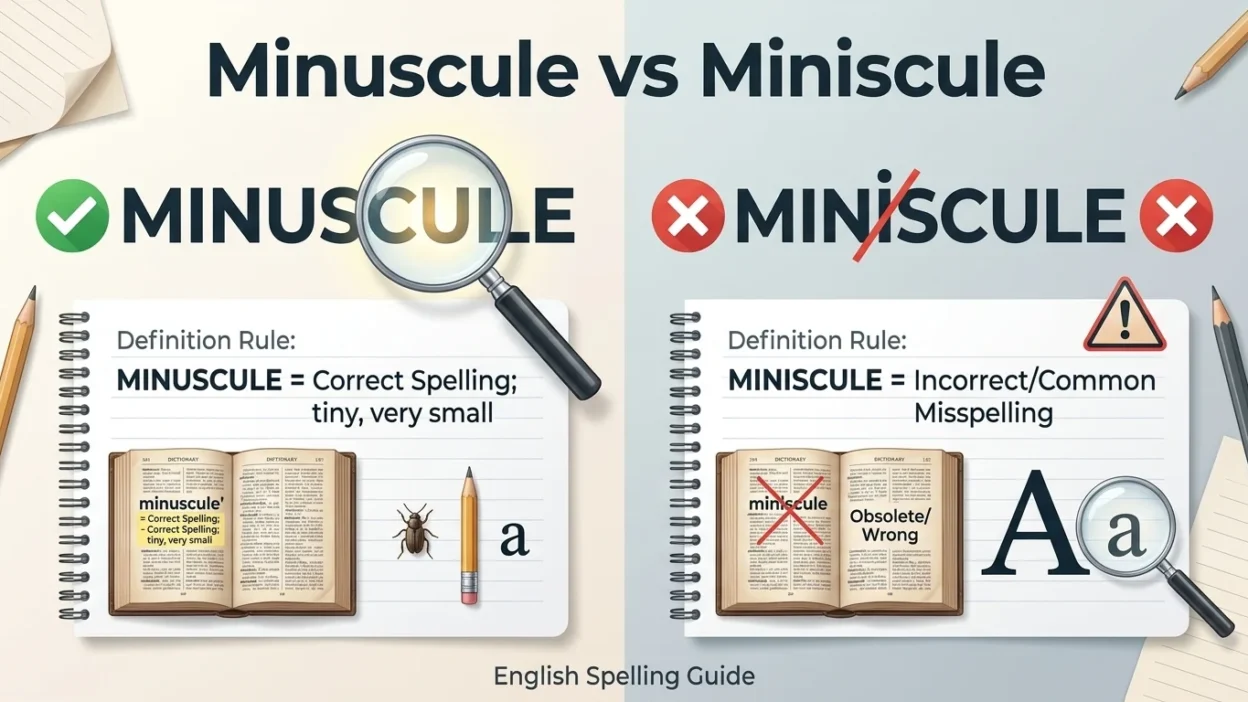
If you are confused about minuscule vs miniscule, the correct standard English spelling is minuscule. Miniscule is a common misspelling. The word minuscule means extremely small, tiny, or very little. For example, “The difference was minuscule” is correct.
This spelling can be confusing because minuscule looks as though it should contain the word mini, which means small. As a result, many people naturally write miniscule because the spelling seems to match its meaning. However, the standard word is spelled m-i-n-u-s-c-u-l-e. Learning the correct form is useful for students, ESL learners, writers, and general readers because minuscule often appears in formal writing, measurements, descriptions, and discussions about small differences. Moreover, understanding its meaning helps you choose between related words such as tiny, minute, microscopic, and negligible.
Quick Answer
Minuscule is the correct standard spelling, while miniscule is generally a misspelling. Minuscule means extremely small or tiny. Remember the spelling as MINUSCULE, with “u” after “n”: m-i-n-u-s-c-u-l-e.
Why Do People Confuse It?
People often confuse minuscule and miniscule because the word means “very small,” making mini- seem like a logical beginning.
However, the standard spelling is not based on the familiar prefix mini. It is minuscule.
The two forms look very similar:
- Minuscule ✅
- Miniscule ❌
Because miniscule looks natural and appears frequently as a spelling mistake, it is easy to remember incorrectly. Therefore, learners should pay particular attention to the letters after min.
What Does the First Word Mean: Minuscule?
Definition of Minuscule
Minuscule is an adjective meaning extremely small, tiny, or very little in size or amount.
For example:
“The insect was minuscule.”
Here, minuscule emphasizes that the insect was extremely small.
The word can describe:
- objects
- amounts
- differences
- details
- chances
- changes
- spaces
- measurements
- errors
Minuscule in Different Contexts
Minuscule can describe physical size:
“She noticed a minuscule crack in the glass.”
It can also describe something small in amount or importance:
“The company made only a minuscule profit.”
Therefore, the word does not always refer to physical dimensions. It can also emphasize that something is extremely small in degree or quantity.
What Does the Second Word Mean: Miniscule?
Is Miniscule Correct?
Miniscule is generally considered a misspelling of minuscule in standard English.
For example:
❌ “There was a miniscule difference between the two results.”
✅ “There was a minuscule difference between the two results.”
Therefore, when you mean “extremely small,” use minuscule.
Why Is Miniscule Incorrect?
The spelling miniscule probably seems logical because English uses mini in words related to small size, such as minibus, miniskirt, and miniature.
However, minuscule has its own established spelling.
Remember:
MINUSCULE ✅
not:
MINISCULE ❌
Minuscule vs Miniscule Comparison Table
| Word | Correct? | Meaning | Example |
|---|---|---|---|
| Minuscule | ✅ Yes | Extremely small or tiny | “The error was minuscule.” |
| Miniscule | ❌ Generally no | Common misspelling of minuscule | “The error was miniscule.” |
| Tiny | ✅ Yes | Very small | “The box was tiny.” |
| Minute | ✅ Yes | Extremely small | “There was a minute difference.” |
| Microscopic | ✅ Yes | Too small to see easily without magnification | “The sample contained microscopic particles.” |
When Should You Use Each?
When to Use Minuscule
Use minuscule when you want to emphasize that something is extremely small.
For example:
“The text was minuscule and difficult to read.”
You can also use it for abstract quantities:
“The change had a minuscule effect on the results.”
When to Use Miniscule
Avoid miniscule when you mean minuscule. In standard English writing, choose the established spelling minuscule.
For example:
❌ “The difference is miniscule.”
✅ “The difference is minuscule.”
When to Use Tiny
Use tiny in everyday, informal English when you simply want to say that something is very small.
“The puppy has tiny paws.”
Tiny is usually more conversational than minuscule.
When to Use Minute
Use minute when you want to describe something extremely small, especially a detail, difference, or measurement.
“The scientist observed a minute change.”
Be careful: minute has two different pronunciations and meanings. When it means “extremely small,” it is pronounced like my-NOOT.
12 Examples of Minuscule
Example 1
The insect was minuscule and difficult to see.
Example 2
There was a minuscule crack in the window.
Example 3
The difference between the two prices was minuscule.
Example 4
She made a minuscule change to the design.
Example 5
The chance of success was minuscule.
Example 6
The company reported a minuscule increase in sales.
Example 7
He noticed a minuscule mark on the surface.
Example 8
The apartment had a minuscule kitchen.
Example 9
A minuscule amount of dust covered the table.
Example 10
The error was so minuscule that nobody noticed it.
Example 11
The scientist examined a minuscule sample.
Example 12
Even a minuscule improvement can make a difference over time.
Common Mistakes
Mistake 1: Writing Miniscule
The most common mistake is replacing u with i.
Incorrect:
“The difference was miniscule.”
Correct:
“The difference was minuscule.”
Mistake 2: Connecting It to Mini
Because minuscule means extremely small, learners often connect it with mini.
However, the correct spelling is not miniscule.
Therefore, remember the word as a complete spelling rather than trying to build it from mini.
Mistake 3: Confusing Minuscule With Minute
Both minuscule and minute can mean extremely small.
However, minute has another very common meaning: a unit of time.
For example:
“Wait five minutes.”
But:
“There was a minute difference.”
Context and pronunciation distinguish these meanings.
Mistake 4: Using Minuscule When Tiny Sounds More Natural
Although minuscule is correct, it can sound more formal or emphatic than tiny.
For example:
“The puppy had tiny ears.”
sounds more natural in casual conversation than:
“The puppy had minuscule ears.”
Therefore, choose the word according to tone and context.
What Is an Easy Memory Trick?
Remember “MINU”
A simple memory trick is to focus on the middle of the word:
MINUscule
Remember:
MIN + U + SCULE
The important point is that U comes after N, not I.
So:
Minuscule ✅
Miniscule ❌
You can also remember:
“Minuscule uses U.”
This short phrase can help you recall the correct spelling whenever you hesitate.
American vs British English
Is Minuscule Correct in American English?
Yes. Minuscule is the standard spelling in American English.
For example:
“The difference was minuscule.”
Is Minuscule Correct in British English?
Yes. Minuscule is also the standard spelling in British English.
For example:
“The amount of damage was minuscule.”
Therefore, there is no American-versus-British spelling difference between minuscule and miniscule. Both varieties use minuscule as the standard spelling.
Is Miniscule Ever Used?
Miniscule does appear in real-world writing, but it is generally treated as a nonstandard or misspelled form of minuscule when it has the meaning “extremely small.” In careful formal writing, use minuscule.
Similar Words
Tiny
Tiny means very small.
“The kitten had tiny feet.”
It is common and natural in everyday English.
Minute
Minute can mean extremely small.
“The scientist noticed a minute difference.”
Microscopic
Microscopic describes something so small that it may require a microscope or magnification to see clearly.
“The researchers found microscopic particles.”
Minuscule
Minuscule means extremely small.
“The insect was minuscule.”
Little
Little can describe something small in size or amount.
“There was little space left.”
Small
Small is the general word for something that is not large.
“The room is small.”
Negligible
Negligible means so small or unimportant that it can be ignored.
“The cost difference was negligible.”
Unlike minuscule, negligible focuses more on importance or effect than physical size.
Microscopic
Microscopic is especially useful when talking about extremely small physical objects or details.
“The material contained microscopic particles.”
These alternatives overlap with minuscule, but each one has a slightly different use or tone.
What Is the Difference Between Minuscule and Tiny?
Minuscule vs Tiny
Both minuscule and tiny mean very small. However, tiny is more common and conversational, while minuscule often emphasizes extremely small size.
For example:
“She found a tiny piece of paper.”
“The difference in weight was minuscule.”
Therefore, tiny works well in everyday speech, while minuscule can sound more precise or emphatic.
What Is the Difference Between Minuscule and Negligible?
Minuscule vs Negligible
Minuscule mainly describes very small size, amount, or degree.
Negligible means so small or unimportant that it has little practical effect.
For example:
“The insect was minuscule.”
This describes its physical size.
“The difference in cost was negligible.”
This emphasizes that the difference was not important.
Thus, these words should not always be used interchangeably.
Final Verdict
The answer to minuscule vs miniscule is clear: minuscule is the correct standard spelling, while miniscule is generally a misspelling.
Use minuscule when you mean extremely small, tiny, or very little. It can describe physical objects, amounts, differences, chances, changes, and details. For example, “The difference was minuscule” correctly uses the word to emphasize a very small difference.
The easiest memory trick is MINUscule: remember the U after N. The correct spelling is M-I-N-U-S-C-U-L-E, and it remains the same in both American and British English.
Frequently Asked Questions
Is minuscule or miniscule correct?
Minuscule is the correct standard spelling. Miniscule is generally a misspelling of the word meaning “extremely small.”
Why is miniscule wrong?
Miniscule changes the u in the standard spelling to i. The established spelling is minuscule, so careful English writing should use that form.
What does minuscule mean?
Minuscule means extremely small, tiny, or very little.
For example:
“The insect was minuscule.”
How do you spell minuscule?
The correct spelling is:
M-I-N-U-S-C-U-L-E
Remember the U after N.
Is minuscule an adjective?
Yes. Minuscule is commonly used as an adjective meaning extremely small.
For example:
“The company experienced a minuscule increase in sales.”
Is minuscule the same as tiny?
They have similar meanings, but tiny is more common in everyday English. Minuscule can emphasize an extremely small size or amount and may sound more formal.
Is minuscule the same as negligible?
Not exactly. Minuscule emphasizes very small size or amount, while negligible emphasizes something so small or unimportant that it has little practical effect.
Is minuscule spelled differently in British English?
No. Minuscule is spelled the same way in American and British English.
Remember This
Miniscule ❌
Minuscule ✅
Remember:
MINUscule uses U.
The correct spelling is:
M-I-N-U-S-C-U-L-E
Conclusion
The difference between minuscule vs miniscule is primarily a spelling issue. Minuscule is the correct standard English word for something extremely small, tiny, or very little. Although miniscule may look logical because of the word mini, it is generally considered an incorrect spelling when used with this meaning.
In short, remember the middle of the word: MINU. You can use minuscule for tiny objects, small amounts, minor changes, slight differences, and very low chances. By remembering MINUscule uses U, you can avoid this common spelling mistake and use the word naturally in both American and British English.