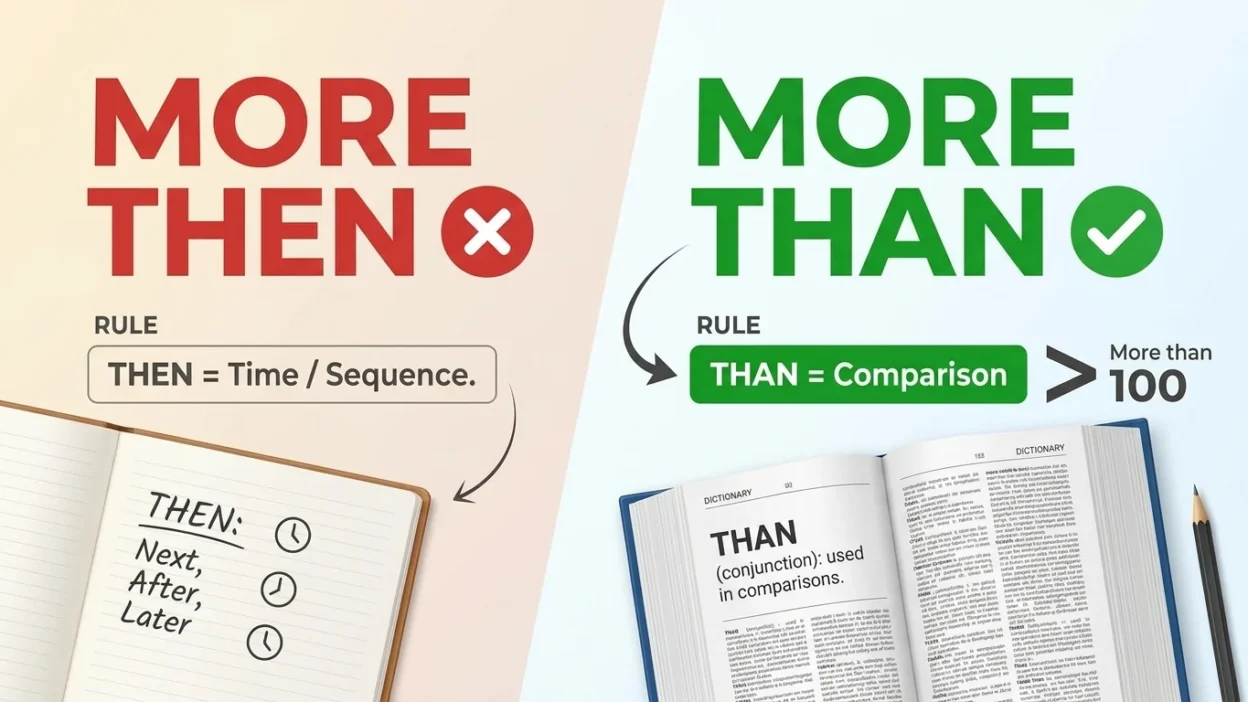
If you are confused about more then vs more than, the correct phrase for comparisons is more than. More then is incorrect when you mean “a greater amount or number than something else.” For example, “She has more than ten books” is correct. The word than is used to compare two things, people, amounts, or ideas.
This mistake is common because then and than sound similar in some varieties of English and differ by only one letter. However, they have completely different meanings and grammatical functions. Than is mainly used for comparisons, while then usually refers to time, sequence, or what happens next. Therefore, understanding the difference can help students, ESL learners, writers, and everyday English users avoid a frequent grammar and spelling mistake. Once you remember when to use each word, choosing between more than and more then becomes much easier.
Quick Answer
More than is the correct phrase when you are comparing amounts, numbers, people, or things. More then is incorrect for this meaning. Use than after more in comparisons: “I have more than you.” Use then when talking about time or sequence: “Finish your work, then go home.”
Why Do People Confuse It?
People often confuse then and than because they look and sound similar. Both words are short, common, and frequently used in everyday English.
However, their meanings are different.
- Than → used for comparisons
- Then → used for time or sequence
For example:
“This box is more than five kilograms.”
Here, than introduces a comparison.
On the other hand:
“First, pack the box, then close it.”
Here, then shows what happens next.
As a result, remembering the function of each word is more useful than simply memorizing their spelling.
What Does the First Word Mean: More Then?
Is More Then Correct?
More then is not the standard phrase when you want to make a comparison.
For example:
❌ “There were more then 100 people at the event.”
✅ “There were more than 100 people at the event.”
The problem is the use of then. In this sentence, the writer needs than because the phrase compares an amount with 100.
When Can Then Be Correct?
Then is a real and important English word, but it does not normally belong in the phrase more than when making a comparison.
Use then to talk about:
- what happens next
- a particular time
- a previous situation
- a result or consequence
For example:
“We ate dinner, then watched a movie.”
Therefore, then is not a replacement for than in comparisons.
What Does the Second Word Mean: More Than?
Definition of More Than
More than is used to show that one amount, number, size, degree, or quantity is greater than another.
For example:
“The building is more than 100 years old.”
This means its age is greater than 100 years.
Similarly:
“She earns more than her brother.”
This compares two people’s earnings.
More Than With Numbers
More than frequently appears before numbers.
For example:
“More than 50 students attended the class.”
This means the number of students was greater than 50.
You can also use it with measurements:
“The road is more than five miles long.”
Therefore, more than is especially useful when expressing amounts and comparisons.
More Then vs More Than Comparison Table
| Phrase | Correct for comparison? | Main use | Example |
|---|---|---|---|
| More then | ❌ No | Incorrect when comparing amounts | “She has more then ten books.” |
| More than | ✅ Yes | Shows a greater amount or degree | “She has more than ten books.” |
| Then | ✅ Yes | Shows time or sequence | “Finish this, then call me.” |
| Than | ✅ Yes | Introduces a comparison | “He is taller than me.” |
When Should You Use Each?
When to Use More Than
Use more than when you mean a quantity or degree that is greater than another.
Examples:
“The journey took more than three hours.”
“More than 20 people applied.”
“This phone costs more than mine.”
You can use more than with:
- numbers
- prices
- ages
- distances
- quantities
- measurements
- abilities
- degrees
- comparisons
When to Use Then
Use then when you are describing time, order, or the next step.
For example:
“Finish your homework, then watch television.”
Here, then means “after that.”
You can also use it to refer to a particular time:
“Things were different then.”
Therefore, then is connected with time or sequence rather than comparison.
When to Use Than
Use than when comparing two things or ideas.
For example:
“This book is better than that one.”
“She is older than her sister.”
“I have more experience than he does.”
Thus, than commonly appears after comparative words such as:
- more
- less
- better
- worse
- bigger
- smaller
- faster
- slower
- older
- younger
12 Examples of More Than
Example 1
I have more than ten books.
Example 2
The building is more than 100 years old.
Example 3
She waited for more than an hour.
Example 4
The company has more than 500 employees.
Example 5
This bag costs more than mine.
Example 6
He has traveled to more than 20 countries.
Example 7
The movie lasted more than two hours.
Example 8
There were more than 1,000 people at the concert.
Example 9
The child is more than six feet tall.
Example 10
Learning a language takes more than memorizing vocabulary.
Example 11
She has more than enough time to finish the project.
Example 12
The temperature stayed more than five degrees above normal.
Common Mistakes
Mistake 1: Writing More Then
The most common mistake is writing more then instead of more than.
Incorrect:
“The box weighs more then ten kilograms.”
Correct:
“The box weighs more than ten kilograms.”
Because the sentence compares the weight with ten kilograms, use than.
Mistake 2: Using Then in Every Comparison
Some writers remember that then and than sound similar and accidentally use then after every comparative word.
Incorrect:
“She is taller then her brother.”
Correct:
“She is taller than her brother.”
The comparison requires than.
Mistake 3: Forgetting That Then Is Still a Correct Word
Although more then is wrong for comparisons, then itself is not an incorrect word.
For example:
“First, eat breakfast, then go to school.”
Here, then is correct because it shows sequence.
Mistake 4: Confusing More Than With Then
Consider these two sentences:
“I have more than five dollars.”
“I finished my work, then I went home.”
The first sentence compares an amount. The second describes what happened afterward.
Therefore, context determines which word you need.
What Is an Easy Memory Trick?
Remember “Than = Comparison”
A simple memory trick is:
THAN = comparison
If you are comparing two things, choose than.
For example:
“More than five.”
“Bigger than mine.”
“Better than before.”
Then remember:
THEN = time or next
For example:
“First study, then relax.”
“We ate, then left.”
So the easiest rule is:
More THAN = greater amount
Then = after that
American vs British English
Is More Than Correct in American English?
Yes. More than is the standard phrase in American English when expressing a comparison or greater amount.
For example:
“More than 50 people attended.”
Is More Than Correct in British English?
Yes. More than is also standard in British English.
For example:
“More than 50 people attended.”
Therefore, there is no American-versus-British difference here. Both varieties use more than for comparisons.
Likewise, both varieties use then for time and sequence.
Similar Words
Greater Than
Greater than means larger in amount, number, or degree.
“Five is greater than three.”
Over
Over can sometimes mean more than, especially with numbers or quantities.
“More than 100 people attended.”
“Over 100 people attended.”
Above
Above can indicate a higher amount, level, or position.
“The temperature stayed above 30 degrees.”
Less Than
Less than expresses the opposite comparison.
“The box weighs less than five kilograms.”
Fewer Than
Fewer than is generally used with countable plural nouns.
“Fewer than 20 students attended.”
Then
Then relates to time or sequence.
“We finished dinner, then went home.”
These words can appear in similar sentences, but their meanings and grammatical functions differ.
What Is the Difference Between Than and Then?
Than vs Then
Than is primarily used to make comparisons.
“My car is faster than yours.”
Then usually refers to time, order, or sequence.
“We finished dinner and then watched a movie.”
Therefore, a useful rule is:
Than compares; then sequences.
This distinction works in most everyday English situations.
What Is the Difference Between More Than and Over?
More Than vs Over
Both more than and over can express a quantity greater than a particular number.
For example:
“More than 100 people attended.”
“Over 100 people attended.”
Both sentences communicate that the number was greater than 100.
However, more than is often the clearer choice when you want to make the comparison explicit. Over can also have meanings related to position, movement, completion, or physical location.
Final Verdict
The answer to more then vs more than is simple: use more than when you are comparing amounts, numbers, quantities, or degrees. More then is incorrect for this common comparison.
For example, write “more than ten people”, not “more then ten people.” The word than introduces the comparison, while then usually describes time or sequence.
The easiest rule is than = comparison and then = time or next. Therefore, whenever you see more ___, ask yourself whether you are comparing something. If you are, choose than.
Frequently Asked Questions
Is it more then or more than?
More than is correct when you mean a greater amount, number, or degree.
“She has more than ten books.”
Why is more then wrong?
Then usually refers to time or sequence, while than is used for comparisons. Therefore, more than is the correct phrase for expressing a greater amount.
Is it more than 10 or more then 10?
The correct form is more than 10.
“The class has more than 10 students.”
What is the difference between than and then?
Than is used for comparisons, while then is used for time, order, or sequence.
“She is taller than me.”
“Finish your work, then leave.”
Can then ever be used after more?
Yes, but not as a replacement for than in a comparison. Then can appear later in a sentence when it refers to sequence or time.
“We need more time, then we can finish the project.”
Here, then means “after that.”
Is more than correct in British English?
Yes. More than is standard in both British and American English.
Can I use over instead of more than?
Often, yes, especially with numbers and quantities.
“More than 100 people attended.”
“Over 100 people attended.”
However, more than makes the comparison especially clear.
How can I remember than vs then?
Remember:
THAN = comparison
THEN = time or sequence
So, write more than, not more then, when expressing a greater amount.
Remember This
More then ❌
More than ✅
Remember this simple rule:
THAN compares. THEN comes next.
Examples:
More than 20 students → comparison
Study, then sleep → sequence
Conclusion
The difference between more then vs more than becomes easy once you understand the roles of than and then. More than is the correct phrase when you want to show that an amount, number, size, or degree is greater than another. In contrast, then usually relates to time, order, or what happens next.
In short, remember than for comparisons and then for sequence or time. Therefore, write “more than five,” “more than enough,” and “more than expected” when expressing a greater amount or degree. By keeping this simple distinction in mind, you can avoid one of the most common English word-choice mistakes and write with greater confidence.