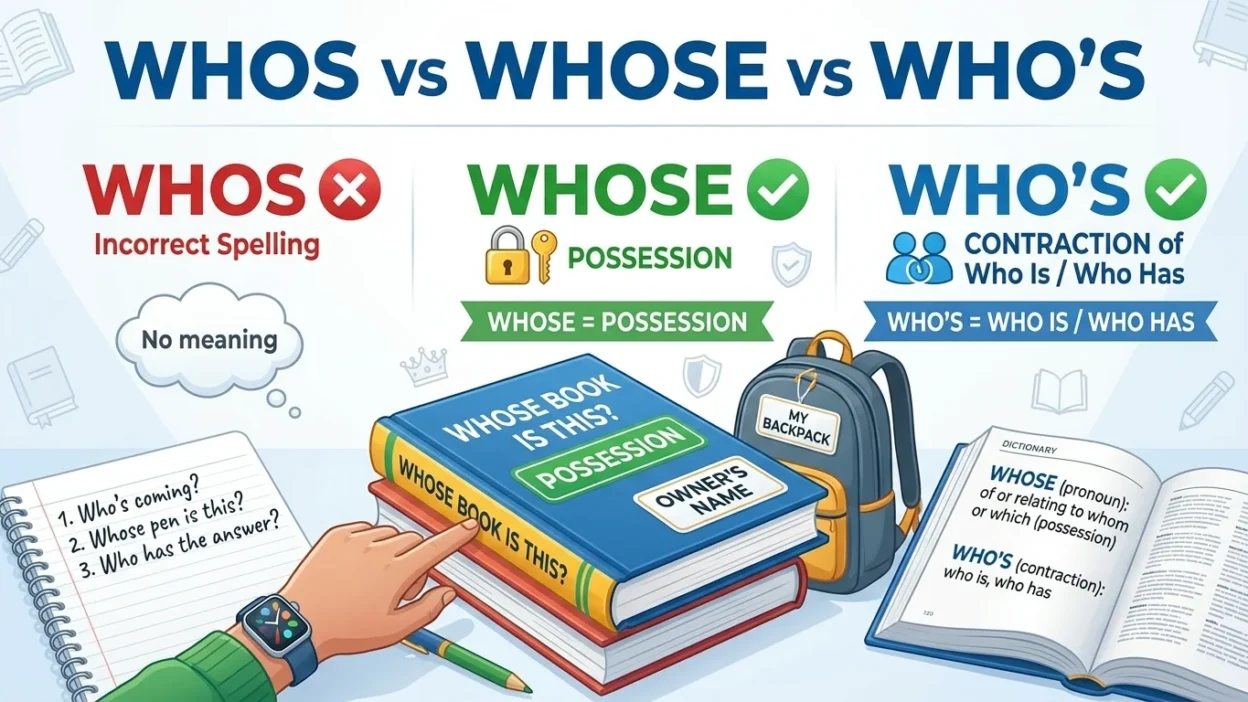
If you are confused about whos vs whose, the correct choice depends on the meaning you want. Whose is the standard word used to ask or show who something belongs to. Whos is generally incorrect in standard English because it is missing the apostrophe from who’s, which is a contraction of who is or who has. For example, “Whose book is this?” is correct, while “Whos book is this?” is incorrect.
The confusion happens because whose, who’s, and whos look and sound very similar. However, they have different grammatical functions. Whose relates to possession, while who’s combines who with is or has. Therefore, understanding the difference can help students, ESL learners, writers, and general readers avoid a common grammar mistake. Once you learn the simple distinction between possession and contraction, choosing the right form becomes much easier.
Quick Answer
Whose is used to ask or indicate who owns something. Who’s is a contraction meaning who is or who has. Whos without an apostrophe is generally incorrect in standard English. For example, “Whose bag is this?” asks about ownership, while “Who’s coming?” means “Who is coming?”
Why Do People Confuse It?
People often confuse whos, whose, and who’s because all three forms look and sound similar.
However, only two are standard forms:
- Whose → shows possession
- Who’s → contraction of who is or who has
- Whos → generally incorrect
For example:
“Whose phone is ringing?”
This asks who owns the phone.
On the other hand:
“Who’s calling?”
This means:
“Who is calling?”
Therefore, the key is to identify whether the sentence is asking about ownership or using a shortened form of who is/who has.
What Does the First Word Mean: Whos?
Is Whos Correct?
Whos without an apostrophe is generally not a standard English word.
For example:
❌ “Whos jacket is this?”
✅ “Whose jacket is this?”
Similarly:
❌ “Whos coming to the party?”
✅ “Who’s coming to the party?”
The correct form depends on the intended meaning.
Why Is Whos Incorrect?
English uses an apostrophe in the contraction who’s because it combines two words:
who + is = who’s
It can also represent:
who + has = who’s
Therefore, writing whos without the apostrophe removes an important grammatical marker.
What Does the Second Word Mean: Whose?
Definition of Whose
Whose is a possessive word used to ask or indicate who owns or is associated with something.
For example:
“Whose keys are these?”
The question asks who the keys belong to.
You can also use whose inside a statement:
“The student whose laptop broke went home.”
Here, whose connects the student with the laptop.
Whose in Questions
Whose commonly appears at the beginning of questions about ownership.
Examples:
“Whose coat is this?”
“Whose car is parked outside?”
“Whose idea was it?”
In each sentence, whose asks about the person connected with something.
Whose in Relative Clauses
Whose can also introduce a relative clause.
For example:
“I met a woman whose son is a doctor.”
Here, whose shows the relationship between the woman and her son.
Therefore, whose does not only appear in questions. It can also connect ideas within a sentence.
What Does Who’s Mean?
Definition of Who’s
Who’s is a contraction of either:
- who is
- who has
For example:
“Who’s at the door?”
means:
“Who is at the door?”
Similarly:
“Who’s finished the assignment?”
can mean:
“Who has finished the assignment?”
Therefore, the apostrophe is essential.
Who’s = Who Is
For example:
“Who’s ready?”
Expand it:
“Who is ready?”
Because the expanded sentence works, who’s is correct.
Who’s = Who Has
For example:
“Who’s taken my pen?”
Expand it:
“Who has taken my pen?”
Again, who’s is correct.
Whos vs Whose Comparison Table
| Word | Correct? | Main Meaning | Example |
|---|---|---|---|
| Whos | ❌ Generally no | Nonstandard form/misspelling | “Whos bag is this?” |
| Whose | ✅ Yes | Shows possession or relationship | “Whose bag is this?” |
| Who’s | ✅ Yes | Short for who is or who has | “Who’s coming?” |
| Who | ✅ Yes | Refers to a person or people | “Who called you?” |
When Should You Use Each?
When to Use Whose
Use whose when you are asking about ownership or showing a relationship.
For example:
“Whose phone is this?”
“The girl whose phone rang apologized.”
A useful question to ask yourself is:
Does the sentence involve ownership or belonging?
If yes, whose is usually the correct choice.
When to Use Who’s
Use who’s when you can replace it with who is or who has.
For example:
“Who’s coming?”
Replace it:
“Who is coming?”
The sentence still makes sense, so who’s is correct.
Another example:
“Who’s finished the work?”
Replace it:
“Who has finished the work?”
Again, the sentence works.
When to Use Whos
Avoid whos without an apostrophe in standard English.
Instead, decide whether you need:
whose = possession
or:
who’s = who is / who has
12 Examples of Whose
Example 1
Whose book is on the desk?
Example 2
Whose car is parked outside?
Example 3
Do you know whose phone this is?
Example 4
Whose idea was it?
Example 5
I found a wallet, but I do not know whose it is.
Example 6
The student whose bag was missing reported it to the teacher.
Example 7
Whose shoes are these?
Example 8
She is the writer whose book won the award.
Example 9
Whose responsibility is it?
Example 10
I met the man whose house was damaged.
Example 11
Whose turn is it?
Example 12
The company whose products we use has expanded.
10 Examples of Who’s
Example 1
Who’s coming to dinner?
Example 2
Who’s at the door?
Example 3
Do you know who’s responsible?
Example 4
Who’s ready to leave?
Example 5
I wonder who’s calling.
Example 6
Who’s been using my computer?
Example 7
Can you tell me who’s coming tomorrow?
Example 8
Who’s finished the project?
Example 9
Do you know who’s taken my pen?
Example 10
Who’s going to lead the team?
Common Mistakes
Mistake 1: Writing Whos Instead of Whose
Incorrect:
“Whos jacket is this?”
Correct:
“Whose jacket is this?”
The sentence asks about ownership, so use whose.
Mistake 2: Writing Whos Instead of Who’s
Incorrect:
“Whos coming with us?”
Correct:
“Who’s coming with us?”
Here, who’s means who is.
Mistake 3: Using Who’s for Possession
Incorrect:
“Who’s book is this?”
Correct:
“Whose book is this?”
The sentence asks who owns the book, so whose is required.
Mistake 4: Adding an Apostrophe to Whose
Incorrect:
“Who’s bag is this?”
Correct:
“Whose bag is this?”
This mistake happens because people often assume that an apostrophe always indicates possession. However, who’s is a contraction, not the possessive form of who.
Mistake 5: Forgetting That Who’s Can Mean Who Has
For example:
“Who’s finished the work?”
Here, who’s can mean who has.
Therefore, do not assume that who’s always means who is.
What Is an Easy Memory Trick?
Remember “Whose Owns”
A simple memory trick is:
WHOSE = WHOSE OWNERSHIP
If the sentence asks who something belongs to, use whose.
For example:
“Whose bag is this?”
Then remember:
WHO’S = WHO IS / WHO HAS
Try expanding who’s.
If you can replace it with who is or who has, the apostrophe belongs there.
For example:
“Who’s ready?”
→ “Who is ready?”
So:
Whose = possession
Who’s = who is / who has
Whos = generally incorrect
American vs British English
Is Whose Correct in American English?
Yes. Whose is the standard possessive form in American English.
“Whose car is this?”
Is Whose Correct in British English?
Yes. Whose is also standard in British English.
“Whose coat is this?”
Likewise, who’s is used as the contraction of who is or who has in both varieties.
Therefore, there is no American-versus-British spelling difference between whose and who’s.
Similar Words
Who
Who refers to a person or people.
“Who called you?”
Whom
Whom is traditionally used as the object form of who, especially in formal English.
“Whom did you invite?”
Which
Which is used when choosing between people or things from a specific group.
“Which book do you want?”
What
What asks about a thing, information, or action.
“What happened?”
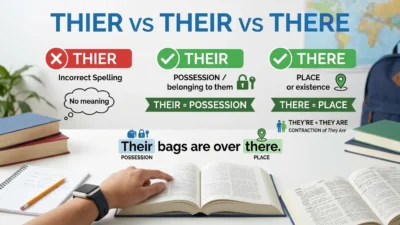
Their
Their is a possessive determiner referring to people or things previously mentioned.
“They forgot their keys.”
Whose
Whose expresses possession or association.
“Whose keys are these?”
These words can appear in similar questions, but each serves a different grammatical purpose.
What Is the Difference Between Whose and Who’s?
Whose vs Who’s
Whose indicates possession or relationship.
“Whose phone is ringing?”
Who’s means who is or who has.
“Who’s calling?”
Therefore, a simple test is to replace who’s with who is or who has.
If the replacement works, use who’s.
If you are asking who owns something, use whose.
What Is the Difference Between Whose and Whom?
Whose vs Whom
Whose shows possession.
“Whose book did you borrow?”
Whom traditionally refers to the person receiving an action.
“Whom did you invite?”
Therefore, these words have different grammatical functions and should not be treated as interchangeable.
Final Verdict
The answer to whos vs whose is straightforward: whose is the correct word when you are asking or showing who owns something or who is associated with something. Whos without an apostrophe is generally incorrect in standard English.
However, do not confuse whose with who’s. Who’s is a contraction of who is or who has. Therefore, use whose for possession and who’s when you can expand it to who is or who has.
Frequently Asked Questions
Is it whos or whose?
Whose is correct when you are asking about possession or ownership. Whos is generally incorrect.
Is whose the possessive form of who?
Yes. Whose is used to ask or indicate who something belongs to or who is associated with something.
Is whos ever correct?
Whos without an apostrophe is generally not standard English. Use whose for possession or who’s for who is or who has.
What is the difference between whose and who’s?
Whose shows possession or relationship. Who’s is a contraction meaning who is or who has.
How can I tell if I need whose or who’s?
Try expanding who’s to who is or who has. If the sentence still makes sense, use who’s. If the sentence asks about ownership, use whose.
Is whose the same in American and British English?
Yes. Whose is spelled and used the same way in standard American and British English.
Can whose be used in a statement?
Yes. Whose can appear in both questions and statements.
“She is the woman whose car was stolen.”
Does who’s always mean who is?
No. Who’s can mean either who is or who has, depending on the sentence.
Remember This
Whos ❌
Whose ✅ = possession
Who’s ✅ = who is / who has
Remember:
WHOSE = ownership
WHO’S = who is / who has
Conclusion
The difference between whos vs whose becomes much easier once you separate possession from contraction. Whose is the correct word when you want to ask who owns something or show a relationship between a person and something connected to them. Whos, without an apostrophe, is generally not correct in standard English.
At the same time, who’s is a valid contraction of who is or who has. Therefore, before choosing a word, expand who’s in your mind. If “who is” or “who has” works, use who’s. If you are asking about ownership, use whose. By remembering this simple distinction, you can avoid one of the most common English word-choice mistakes.