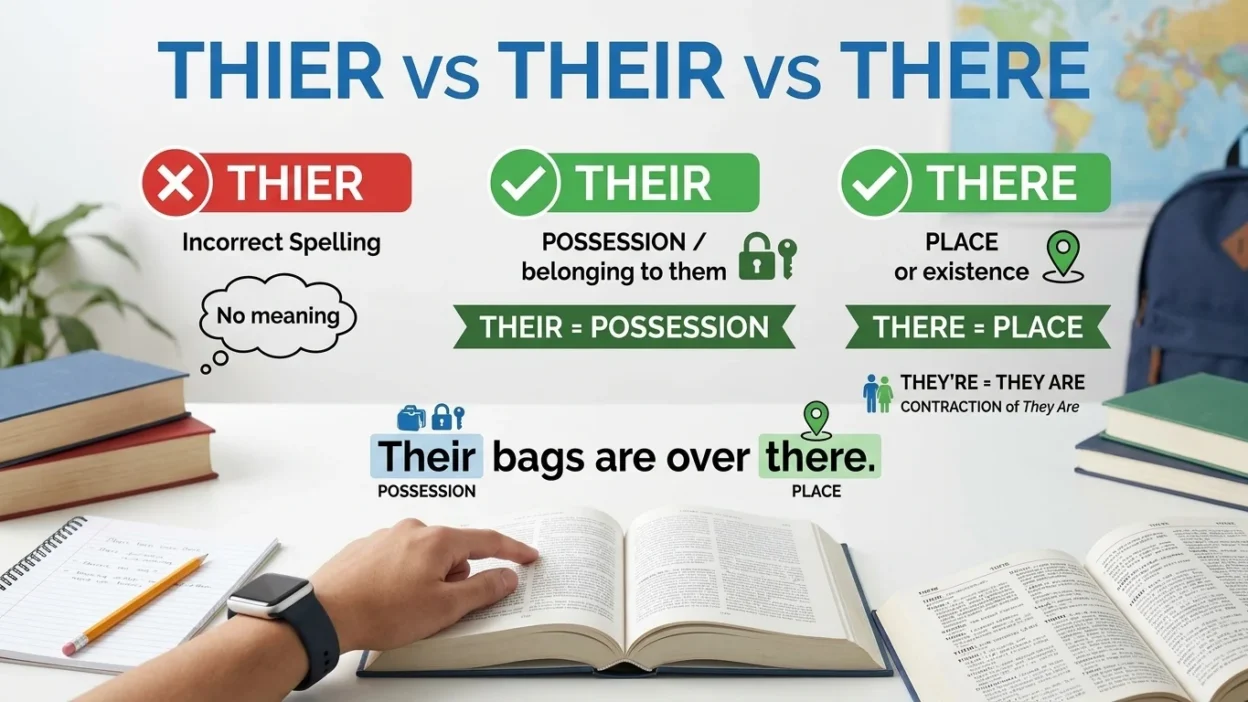
If you are confused about thier vs their vs there, the correct spelling is their, not thier. However, their and there have completely different meanings and grammatical roles. Their shows possession, while there usually refers to a place, points something out, or helps form sentences such as “There is a problem.” For example, “Their house is over there” correctly uses both words.
This confusion is common because their, there, and the misspelling thier sound similar in many varieties of English. Moreover, their and there are especially easy to mix up when writing quickly. Therefore, learning what each word does in a sentence is more useful than trying to remember the spelling alone. Once you connect their with possession and there with place or existence, you can choose the correct word much more confidently in schoolwork, emails, essays, conversations, and everyday writing.
Quick Answer
Their is the correct spelling when you mean possession or belonging to them. There refers to a place, points something out, or introduces existence. Thier is a common misspelling and should be avoided. For example, “Their bags are over there” uses their for ownership and there for location.
Why Do People Confuse It?
People often confuse thier, their, and there because the words look and sound very similar.
The three forms have different roles:
- Their = belonging to them
- There = a place, position, or existence
- Thier = incorrect spelling
For example:
“Their books are over there.”
In this sentence, their tells us who owns the books, while there tells us where the books are.
Therefore, instead of focusing only on pronunciation, focus on the meaning and function of the word.
What Does the First Word Mean: Thier?
Is Thier Correct?
Thier is generally an incorrect spelling. It is a common spelling mistake caused by reversing the e and i in their.
Incorrect:
“They left thier bags at school.”
Correct:
“They left their bags at school.”
The correct spelling is:
T-H-E-I-R
Not:
T-H-I-E-R
Why Do People Write Thier?
English spelling contains many words with similar letter patterns, so writers may accidentally place the i and e in the wrong order.
For example, a person may remember that the word contains th + e + i + r but accidentally write th + i + e + r.
Therefore, a simple memory trick can help:
Their = heir
Both their and heir contain ei.
What Does the Second Word Mean: Their?
Definition of Their
Their is a possessive word. It shows that something belongs to or is associated with them.
For example:
“They forgot their keys.”
The keys belong to the people represented by they.
Similarly:
“The students opened their books.”
Here, their tells us that the books belong to or are associated with the students.
Their in Everyday English
Use their before a noun when you want to show possession or association.
For example:
- their house
- their car
- their teacher
- their family
- their idea
- their project
- their children
You can also use their with a singular person when the person’s gender is unknown, irrelevant, or when they use they/them pronouns.
For example:
“Someone left their phone on the table.”
Therefore, their can refer to either a group or, in appropriate contexts, an individual.
What Does There Mean?
Definition of There
There commonly refers to a place or location.
For example:
“Put the box over there.”
Here, there identifies a location.
However, there has another important use. It can introduce a statement about something existing or happening.
For example:
“There is a problem.”
“There are three books on the desk.”
In these sentences, there does not mean a specific physical place. Instead, it introduces the existence of something.
There as a Place Word
Use there when referring to a location.
For example:
“The store is over there.”
“I left my shoes there.”
There to Show Existence
Use there in structures such as:
- there is
- there are
- there was
- there were
- there will be
For example:
“There are several students outside.”
Therefore, there can describe location or introduce something that exists.
Thier vs Their vs There Comparison Table
| Word | Correct? | Main Meaning | Example |
|---|---|---|---|
| Thier | ❌ No | Common misspelling of their | “They forgot thier books.” |
| Their | ✅ Yes | Shows possession or association | “They forgot their books.” |
| There | ✅ Yes | Refers to a place or introduces existence | “Their books are over there.” |
When Should You Use Each?
When to Use Their
Use their when something belongs to or is associated with them.
For example:
“Their house is beautiful.”
Ask yourself:
Does this mean belonging to them?
If yes, use their.
When to Use There
Use there when you are talking about a location or introducing something that exists.
For example:
“The children are playing there.”
Or:
“There are five children outside.”
Ask yourself:
Am I talking about a place or saying that something exists?
If yes, there is likely correct.
When to Use Thier
Do not use thier in standard English writing.
Instead, use:
their
For example:
❌ “Thier teacher is helpful.”
✅ “Their teacher is helpful.”
12 Examples of Their
Example 1
The students finished their homework.
Example 2
They brought their own lunch.
Example 3
The children cleaned their room.
Example 4
The players celebrated their victory.
Example 5
The company changed their policy.
Example 6
My friends invited me to their house.
Example 7
The teachers checked their students’ work.
Example 8
The family sold their old car.
Example 9
Someone forgot their umbrella.
Example 10
The birds returned to their nest.
Example 11
The workers discussed their plans.
Example 12
The students presented their project.
12 Examples of There
Example 1
The books are over there.
Example 2
Please put the chair there.
Example 3
I left my phone there.
Example 4
Look there!
Example 5
There is a problem with the computer.
Example 6
There are two cars outside.
Example 7
There was a loud noise last night.
Example 8
There were many people at the event.
Example 9
We can meet there tomorrow.
Example 10
Is anyone there?
Example 11
There will be a meeting next week.
Example 12
The restaurant is right over there.
Common Mistakes
Mistake 1: Writing Thier
Incorrect:
“They packed thier bags.”
Correct:
“They packed their bags.”
Remember that their contains ei, not ie.
Mistake 2: Using There for Possession
Incorrect:
“There car is new.”
Correct:
“Their car is new.”
The car belongs to them, so their is required.
Mistake 3: Using Their for a Place
Incorrect:
“Put the box over their.”
Correct:
“Put the box over there.”
The sentence refers to a location, so use there.
Mistake 4: Confusing There Is and Their
Incorrect:
“Their is a problem.”
Correct:
“There is a problem.”
The expression there is introduces something that exists.
Mistake 5: Choosing by Sound Alone
Their and there often sound similar, especially in casual speech. Therefore, listening alone may not help you distinguish them.
Instead, look at the sentence’s meaning.
If it shows possession:
their
If it refers to a place or existence:
there
What Is an Easy Memory Trick?
Remember “Their Has Heir”
A useful trick is:
Their = belonging to them
Think of heir, a person who receives property from someone. Both their and heir contain ei.
Another simple trick is:
There = here
Both there and here relate to places.
So remember:
- Their → possession
- There → place
- Thier → incorrect spelling
For example:
“Their dog is over there.”
The first word shows ownership, while the second word shows location.
American vs British English
Is Their Correct in American English?
Yes. Their is standard in American English for showing possession or association.
“They brought their books.”
Is Their Correct in British English?
Yes. Their is also standard in British English.
“They brought their books.”
Likewise, there has the same basic uses in both varieties.
Therefore, there is no American-versus-British spelling difference between their and there.
Similar Words
They’re
They’re is a contraction of they are.
“They’re happy.”
This means:
“They are happy.”
Them
Them is an object pronoun.
“I called them yesterday.”
Theirs
Theirs is a possessive pronoun meaning something belongs to them.
“That car is theirs.”
Here
Here refers to a location near the speaker.
“Come here.”
Where
Where asks about or refers to a location.
“Where are they?”
Their Own
Their own emphasizes possession or control.
“They have their own business.”
These words are related to their or there, but they perform different grammatical jobs.
What Is the Difference Between Their and There?
Their vs There
Their shows possession or association.
“Their house is large.”
There refers to a place or introduces existence.
“The house is over there.”
Therefore, a quick test is:
Their = belonging to them
There = place/existence
What Is the Difference Between Their and They’re?
Their vs They’re
Their shows possession.
“Their dog is friendly.”
They’re means they are.
“They’re friendly.”
Try expanding they’re to they are. If the sentence still makes sense, they’re is correct.
What Is the Difference Between There and They’re?
There vs They’re
There refers to a place or introduces existence.
“There is a dog outside.”
They’re means they are.
“They’re outside.”
Therefore, these words may sound similar but have completely different functions.
Final Verdict
The difference between thier vs their vs there becomes much easier when you focus on meaning. Their is the correct spelling for possession or association with them. There refers to a place or introduces something that exists. Thier is a common misspelling and should not be used in standard English.
In short, remember their = belonging to them, there = place or existence, and thier = incorrect. By learning these simple distinctions, you can avoid common spelling and grammar mistakes in essays, emails, school assignments, and everyday writing.
Frequently Asked Questions
Is it thier or their?
Their is correct. Thier is a common misspelling.
What is the difference between their and there?
Their shows possession or association, while there refers to a place or introduces something that exists.
Is thier a real word?
Thier is generally not a standard English word. It is usually an incorrect spelling of their.
What is the difference between their and they’re?
Their shows possession, while they’re is a contraction of they are.
“Their car is red.”
“They’re happy.”
How can I remember their vs there?
Remember:
Their = belonging to them
There = place
You can also connect there with here, because both can refer to locations.
Can their refer to one person?
Yes. Their can be used with a singular person when that person’s gender is unknown, irrelevant, or when the person uses singular they.
“Someone left their phone.”
Is there used for more than places?
Yes. There can introduce existence in sentences such as:
“There is a problem.”
“There are three books.”
Is their the same in American and British English?
Yes. Their has the same standard spelling and basic meaning in both American and British English.
Remember This
Thier ❌ = incorrect spelling
Their ✅ = belonging to them
There ✅ = place or existence
They’re ✅ = they are
Remember the simple rule:
Their = possession
There = place
They’re = they are
Conclusion
The difference between thier vs their vs there is mainly a matter of spelling and grammatical function. Thier is an incorrect spelling, while their and there are both correct words with different meanings. Use their when something belongs to or is connected with them, and use there when referring to a place or introducing something that exists.
Moreover, learning they’re alongside these words can make the distinction even clearer. They’re means they are, so it should not be confused with either their or there. By checking the meaning before choosing the word, you can quickly identify the correct form and make your writing clearer, more accurate, and more confident.