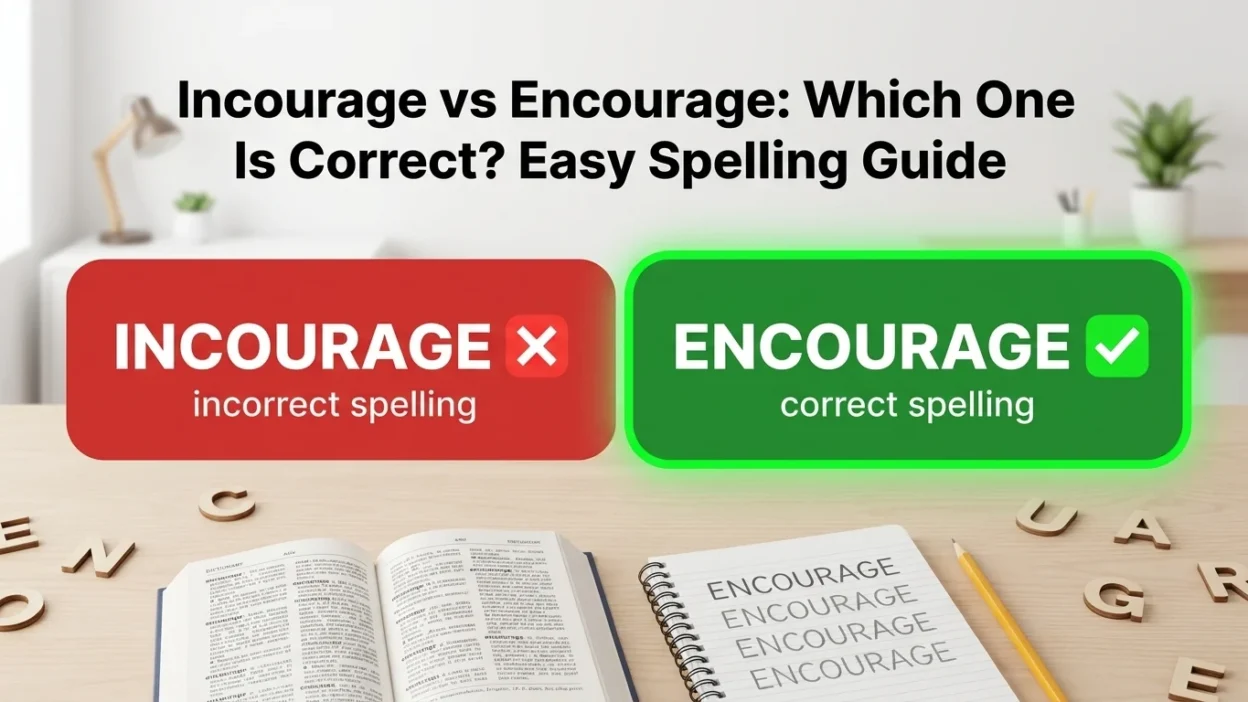
If you are wondering about incourage vs encourage, the correct spelling is encourage. Incourage is a common misspelling and is not the standard spelling of the verb. Encourage means to give someone support, confidence, hope, or motivation to do something. For example, “My teacher encouraged me to keep practicing” is correct.
The confusion often happens because the beginning of encourage sounds similar to other words that start with in-, and English spelling does not always follow pronunciation perfectly. However, the standard word begins with en-, not in-. Therefore, students, ESL learners, writers, and general readers should remember the spelling encourage when talking about supporting or motivating someone. Once you connect encourage with its related words encouragement and encouraging, the correct spelling becomes easier to recognize and use in everyday conversations, school assignments, professional writing, and personal messages.
Quick Answer
Encourage is the correct spelling, while incourage is incorrect. Encourage means to give someone support, confidence, or motivation to do something. For example, “Her parents encouraged her to study hard.” Remember the spelling as ENCOURAGE, not INCOURAGE.
Why Do People Confuse It?
People often confuse incourage and encourage because the words sound similar when spoken quickly.
The incorrect form begins with in-:
❌ incourage
The correct form begins with en-:
✅ encourage
Moreover, several English words begin with in-, so writers may naturally expect encourage to follow the same pattern.
However, the standard spelling is always:
E-N-C-O-U-R-A-G-E
Therefore, learning the word family can help:
- encourage
- encouraged
- encouraging
- encouragement
- encouragingly
What Does the First Word Mean: Incourage?
Is Incourage Correct?
Incourage is not the standard spelling of the English verb meaning to support or motivate someone.
For example:
❌ “My parents incourage me to work hard.”
Correct:
✅ “My parents encourage me to work hard.”
The incorrect form usually results from confusing the first vowel sound or remembering the word as beginning with in-.
Why Is Incourage Incorrect?
The standard English word is encourage.
It begins with:
EN
not:
IN
Therefore:
❌ incourage
✅ encourage
When writing the word, check the first two letters before continuing.
What Does the Second Word Mean: Encourage?
Definition of Encourage
Encourage means to give someone support, confidence, hope, or motivation.
For example:
“The coach encouraged the players to keep trying.”
The coach gave the players motivation and support.
You can encourage someone to:
- study
- practice
- try again
- speak confidently
- achieve a goal
- overcome a difficulty
- learn a new skill
Encourage Someone to Do Something
A common structure is:
encourage + someone + to + verb
For example:
“My teacher encouraged me to read more.”
“She encouraged her brother to apply for the job.”
“The coach encouraged the team to keep practicing.”
Therefore, learning this sentence pattern can help you use encourage naturally.
Encourage as Support
Encourage can describe emotional or practical support.
“Her friends encouraged her during a difficult time.”
Here, the friends helped her feel more confident.
Encourage as Motivation
The word can also mean motivating someone to take action.
“The teacher encouraged students to ask questions.”
The teacher motivated the students to participate.
Incourage vs Encourage Comparison Table
| Word | Correct? | Meaning | Example |
|---|---|---|---|
| Incourage | ❌ No | Incorrect spelling | “They incourage me.” |
| Encourage | ✅ Yes | Support or motivate someone | “They encourage me.” |
| Encouraged | ✅ Yes | Past tense of encourage | “She encouraged me.” |
| Encouragement | ✅ Yes | Support or motivation | “His encouragement helped.” |
When Should You Use Each?
When to Use Encourage
Use encourage when you mean to support, motivate, or give confidence to someone.
For example:
“I encourage you to keep trying.”
“Teachers encourage students to read.”
When to Use Encouraged
Use encouraged when talking about encouragement in the past.
For example:
“My parents encouraged me to follow my goals.”
When to Use Encouraging
Use encouraging when describing something that gives hope, confidence, or motivation.
For example:
“The results are encouraging.”
When to Use Incourage
Avoid incourage in standard English.
Instead, use:
encourage
For example:
❌ “We incourage everyone to participate.”
✅ “We encourage everyone to participate.”
12 Examples of Encourage
Example 1
My parents encourage me to study hard.
Example 2
The teacher encouraged the students to ask questions.
Example 3
Her friends encouraged her to apply for the job.
Example 4
The coach encouraged the players to keep trying.
Example 5
I want to encourage you to practice every day.
Example 6
Good teachers encourage their students to think independently.
Example 7
His kind words encouraged me to continue.
Example 8
The manager encouraged the team to share new ideas.
Example 9
She always encourages her children to read.
Example 10
The positive feedback encouraged him to improve.
Example 11
We should encourage young people to learn new skills.
Example 12
Her success encouraged others to follow their dreams.
Common Mistakes
Mistake 1: Writing Incourage
Incorrect:
“I want to incourage you.”
Correct:
“I want to encourage you.”
The word begins with en-.
Mistake 2: Using the Wrong First Vowel
Some writers remember the pronunciation but are unsure whether the word begins with en or in.
Therefore, memorize:
ENCOURAGE
not:
INCOURAGE
Mistake 3: Confusing Encourage and Courage
Courage means the ability to face difficulty or danger.
Encourage means to give someone confidence or support.
For example:
“She showed great courage.”
But:
“Her teacher encouraged her.”
The words are related in form and meaning, but they are not interchangeable.
Mistake 4: Using the Wrong Verb Pattern
A common structure is:
encourage + person + to + verb
For example:
“The teacher encouraged me to practice.”
Avoid leaving out the person or using an incorrect verb form when this structure is needed.
Mistake 5: Confusing Encourage and Discourage
Encourage means to support or motivate.
“Her parents encouraged her to continue.”
Discourage means to make someone less willing or confident about doing something.
“The bad weather discouraged us from traveling.”
Therefore, these words have opposite meanings in many contexts.
What Is an Easy Memory Trick?
Remember “EN” in Encourage
The easiest trick is to focus on the first two letters:
ENCOURAGE = EN
Think:
ENcouragement gives ENergy and confidence.
This is only a memory aid, but it can help you remember the spelling.
Another useful method is to connect the word with its family:
encourage → encouraged → encouraging → encouragement
All these words begin with encour-.
Therefore, if you remember encouragement, you can usually remember encourage.
American vs British English
Is Encourage Correct in American English?
Yes. Encourage is the standard spelling in American English.
“Teachers encourage students to participate.”
Is Encourage Correct in British English?
Yes. Encourage is also the standard spelling in British English.
“Teachers encourage students to participate.”
Therefore, there is no American-versus-British spelling difference for encourage.
The misspelling incourage should be avoided in both varieties.
Similar Words
Support
Support means helping someone emotionally, practically, or financially.
“Her family supported her decision.”
Motivate
Motivate means giving someone a reason or desire to take action.
“The coach motivated the team.”
Inspire
Inspire means making someone feel motivated or eager to do something.
“Her story inspired me.”
Cheer
Cheer can mean giving someone encouragement or showing support.
“The crowd cheered for the team.”
Urge
Urge means strongly encouraging someone to do something.
“I urged him to apply.”
Persuade
Persuade means convincing someone to do or believe something.
“She persuaded him to try again.”
These words are related to encourage, but their meanings are not exactly the same.
What Is the Difference Between Encourage and Support?
Encourage vs Support
Encourage focuses on giving someone confidence or motivation.
“Her teacher encouraged her to enter the competition.”
Support has a broader meaning and can involve practical, emotional, or financial help.
“Her family supported her during the competition.”
Therefore, encourage often focuses on motivation, while support can describe many forms of assistance.
What Is the Difference Between Encourage and Motivate?
Encourage vs Motivate
Encourage means giving someone confidence, hope, or support.
“My friends encouraged me to continue.”
Motivate means giving someone a reason or desire to take action.
“The reward motivated him to work harder.”
The two words overlap, but they can emphasize different aspects of helping someone act.
Final Verdict
The answer to incourage vs encourage is simple: encourage is the correct spelling, while incourage is incorrect. Encourage means to support, motivate, or give someone confidence to do something.
Therefore, remember the spelling E-N-C-O-U-R-A-G-E. You can also connect it with encouraged, encouraging, and encouragement, which all use the same encour- beginning. By remembering this word family, you can avoid the common incourage spelling mistake and use encourage confidently in academic, professional, and everyday English.
Frequently Asked Questions
Is it incourage or encourage?
Encourage is correct. Incourage is an incorrect spelling.
What does encourage mean?
Encourage means to give someone support, confidence, hope, or motivation to do something.
How do you spell encourage?
The correct spelling is:
E-N-C-O-U-R-A-G-E
Is incourage a real word?
Incourage is generally not a standard English word. It is usually a misspelling of encourage.
What is the difference between encourage and courage?
Courage is the ability to face difficulty or danger. Encourage means giving someone support or confidence.
“She showed courage.”
“Her teacher encouraged her.”
What is the noun form of encourage?
The noun form is encouragement.
“Her encouragement helped me continue.”
What is the past tense of encourage?
The past tense is encouraged.
“My teacher encouraged me to practice.”
Is encourage spelled the same in American and British English?
Yes. Encourage has the same standard spelling in American and British English.
Remember This
Incourage ❌
Encourage ✅
Remember:
ENCOURAGE = E-N-C-O-U-R-A-G-E
Also remember the word family:
encourage → encouraged → encouraging → encouragement
If you mean support, motivate, or give confidence, choose encourage.
Conclusion
The difference between incourage vs encourage is a spelling issue rather than a difference in meaning. Encourage is the correct standard English word, while incourage is a common misspelling. Use encourage when you want to describe giving someone support, confidence, hope, or motivation.
Moreover, remembering the related forms encouraged, encouraging, and encouragement can make the correct spelling easier to recall. All of them begin with encour-. Therefore, whenever you are unsure, remember ENCOURAGE, not INCOURAGE. This simple spelling habit can help you write more accurately in school assignments, workplace communication, emails, and everyday conversations.