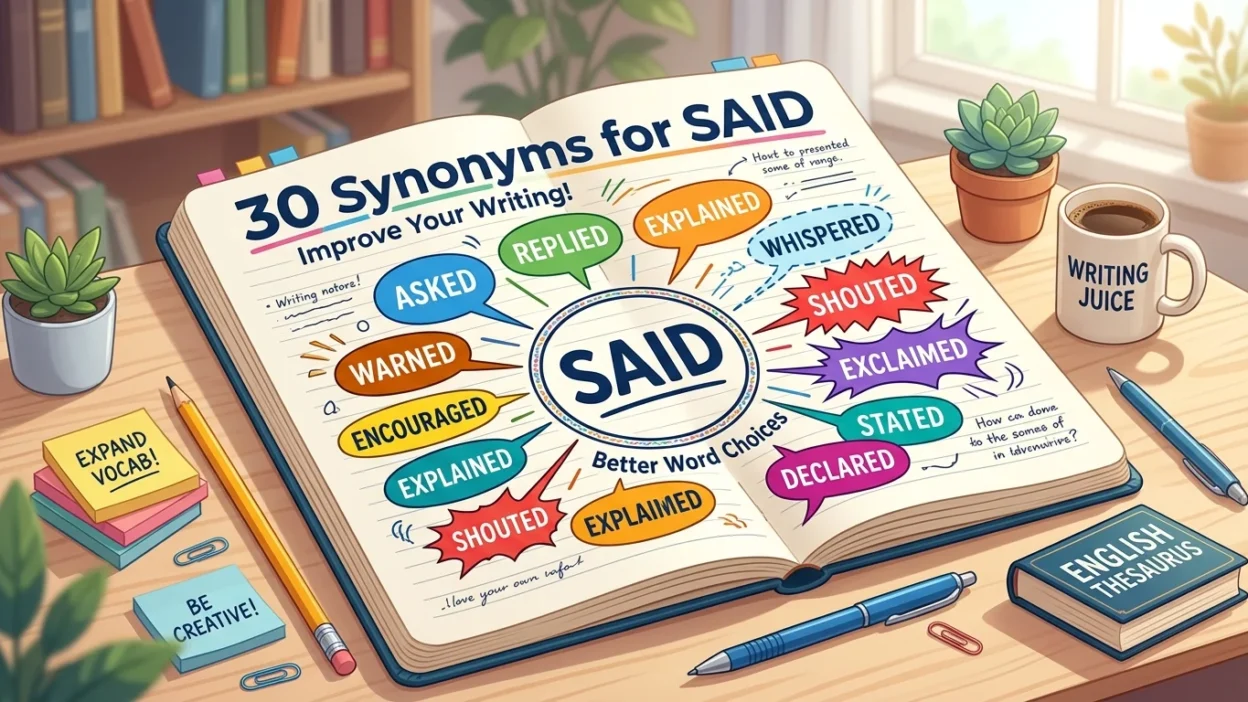
When writing stories, essays, articles, or conversations, many people rely heavily on the word “said.” While there is nothing wrong with using it, repeating the same word too often can make writing feel repetitive and less engaging. Learning different synonyms for said helps writers create stronger dialogue, show emotions more clearly, and keep readers interested.
If you are a student, ESL learner, content creator, or professional writer, expanding your vocabulary can make your communication more effective. Different alternatives to “said” can express excitement, sadness, anger, confidence, or uncertainty without needing extra explanation.
In this guide, you’ll learn the meaning of “said,” discover 30 useful synonyms, see examples of each word in context, and understand when to use them correctly.
What Does “Said” Mean?
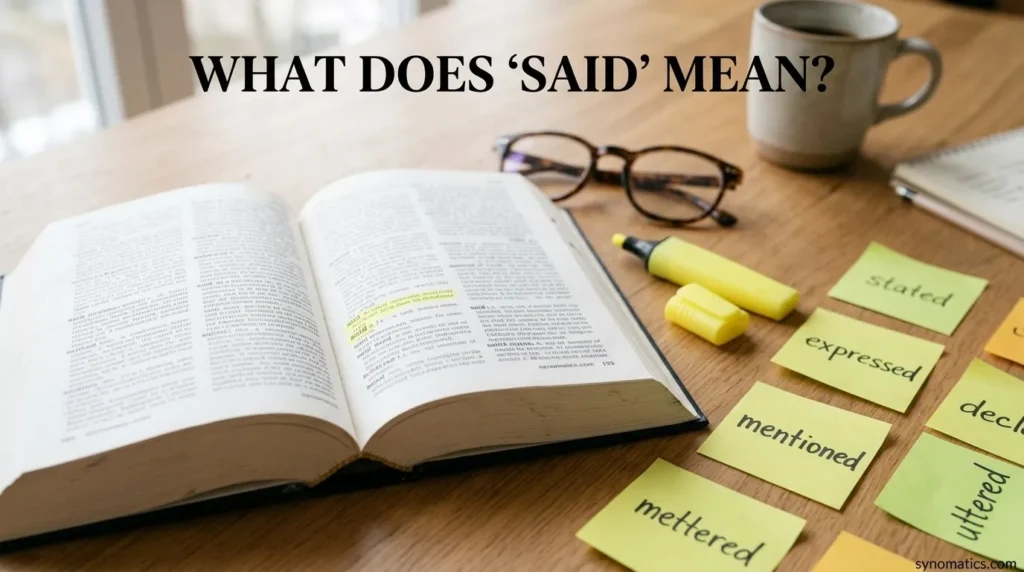
The word said is the past tense of say. It is used to report what someone has spoken or communicated.
Example:
“I will be there tomorrow,” Sarah said.
While “said” is simple and effective, writers often choose more specific words to show how something was spoken.
Why Learn Synonyms for Said?
Using different synonyms for said can help you:
- Make dialogue more interesting
- Show emotions without extra description
- Improve storytelling
- Enhance academic and creative writing
- Expand English vocabulary
- Avoid repetitive sentence structures
However, it is important not to replace every instance of “said.” The best writers choose alternatives only when they add meaning.
30 Synonyms for Said
1. Asked
Meaning: To request information.
Example: “Where are you going?” she asked.
Best Usage Context: Questions and inquiries.
2. Replied
Meaning: To answer someone.
Example: “I’m heading home,” he replied.
Best Usage Context: Responses in conversations.
3. Answered
Meaning: To respond to a question.
Example: “The test is tomorrow,” the teacher answered.
Best Usage Context: Direct responses.
4. Explained
Meaning: To make something clear.
Example: She explained the rules carefully.
Best Usage Context: Giving details or instructions.
5. Stated
Meaning: To express something clearly and formally.
Example: The manager stated the company’s policy.
Best Usage Context: Formal writing and reports.
6. Mentioned
Meaning: To briefly refer to something.
Example: He mentioned the meeting during lunch.
Best Usage Context: Casual references.
7. Added
Meaning: To include extra information.
Example: “Don’t forget your passport,” she added.
Best Usage Context: Continuing a statement.
8. Noted
Meaning: To point out or observe.
Example: The professor noted an important detail.
Best Usage Context: Academic and professional writing.
9. Commented
Meaning: To express an opinion.
Example: She commented on the weather.
Best Usage Context: Observations and opinions.
10. Announced
Meaning: To make something public.
Example: The company announced a new product.
Best Usage Context: News and formal communication.
11. Declared
Meaning: To state something strongly.
Example: He declared his intention to run for office.
Best Usage Context: Confident statements.
12. Claimed
Meaning: To say something is true.
Example: She claimed she saw the event.
Best Usage Context: Statements requiring proof.
13. Suggested
Meaning: To offer an idea.
Example: He suggested taking a break.
Best Usage Context: Recommendations.
14. Admitted
Meaning: To confess something.
Example: She admitted her mistake.
Best Usage Context: Honesty and confession.
15. Confessed
Meaning: To reveal something personal or wrong.
Example: He confessed the truth.
Best Usage Context: Emotional admissions.
16. Whispered
Meaning: To speak very quietly.
Example: She whispered a secret.
Best Usage Context: Private conversations.
17. Murmured
Meaning: To speak softly and unclearly.
Example: He murmured under his breath.
Best Usage Context: Quiet speech.
18. Mumbled
Meaning: To speak unclearly.
Example: She mumbled an apology.
Best Usage Context: Nervous or unclear speaking.
19. Shouted
Meaning: To speak very loudly.
Example: “Watch out!” he shouted.
Best Usage Context: Emergencies or strong emotions.
20. Yelled
Meaning: To speak loudly in anger or excitement.
Example: She yelled across the room.
Best Usage Context: Strong emotional situations.
21. Exclaimed
Meaning: To speak suddenly with emotion.
Example: “That’s amazing!” she exclaimed.
Best Usage Context: Surprise or excitement.
22. Cried
Meaning: To call out loudly.
Example: “Help!” the child cried.
Best Usage Context: Distress or urgency.
23. Insisted
Meaning: To state firmly.
Example: He insisted he was correct.
Best Usage Context: Strong opinions.
24. Argued
Meaning: To express disagreement.
Example: She argued her point confidently.
Best Usage Context: Debates and discussions.
25. Protested
Meaning: To object strongly.
Example: He protested the decision.
Best Usage Context: Objections.
26. Warned
Meaning: To advise about danger.
Example: The guide warned the hikers.
Best Usage Context: Safety information.
27. Encouraged
Meaning: To give support or confidence.
Example: She encouraged her friend.
Best Usage Context: Motivation.
28. Assured
Meaning: To make someone feel certain.
Example: He assured us everything was fine.
Best Usage Context: Reassurance.
29. Promised
Meaning: To commit to doing something.
Example: She promised to help.
Best Usage Context: Commitments.
30. Boasted
Meaning: To talk proudly about achievements.
Example: He boasted about his success.
Best Usage Context: Pride or self-promotion.
Quick Comparison Table: When to Use Different Synonyms for Said
| Synonym | Emotion/Tone | Best Situation |
|---|---|---|
| Asked | Curious | Questions |
| Replied | Neutral | Responses |
| Explained | Helpful | Clarification |
| Whispered | Quiet | Secrets |
| Shouted | Loud | Emergencies |
| Exclaimed | Excited | Surprise |
| Warned | Serious | Danger |
| Encouraged | Positive | Motivation |
| Declared | Strong | Formal announcements |
| Admitted | Honest | Confessions |
How to Choose the Right Synonym for Said
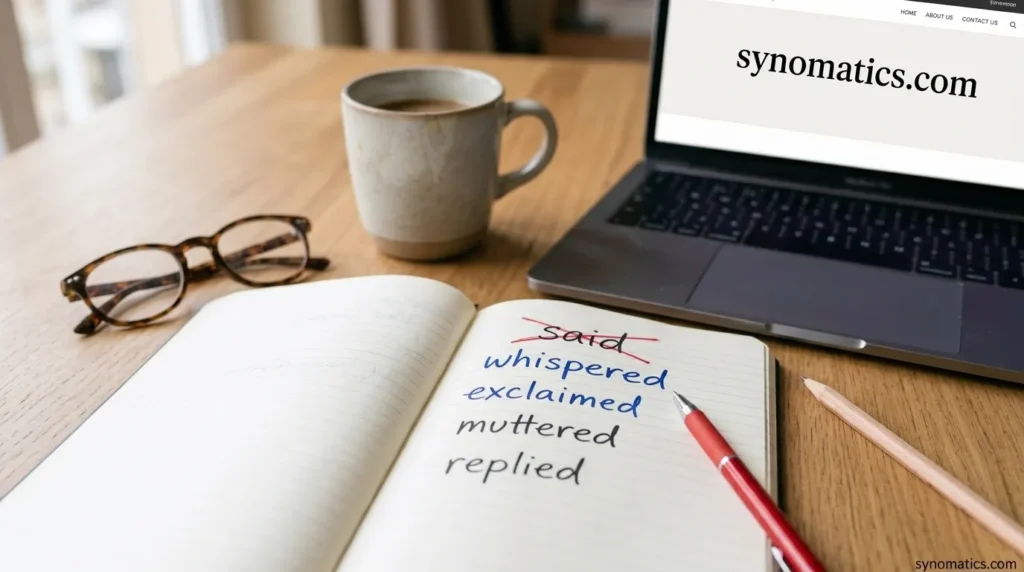
Choosing the right alternative depends on the speaker’s emotion and purpose.
For Neutral Conversations
Use:
- Said
- Replied
- Answered
- Mentioned
- Added
These work well in everyday dialogue.
For Strong Emotions
Use:
- Exclaimed
- Shouted
- Yelled
- Cried
- Declared
These help readers understand emotional intensity.
For Quiet Speech
Use:
- Whispered
- Murmured
- Mumbled
These create a softer tone.
For Formal Writing
Use:
- Stated
- Noted
- Announced
- Explained
These are common in academic and professional content.
For Disagreement or Debate
Use:
- Argued
- Protested
- Insisted
- Claimed
These highlight opposing views.
For Support and Reassurance
Use:
- Encouraged
- Assured
- Promised
These communicate positivity and confidence.
Common Mistakes When Using Synonyms for Said
1. Using Fancy Words Too Often
Not every sentence needs a replacement for “said.” Sometimes the simple word works best.
2. Choosing the Wrong Emotion
Make sure the synonym matches the speaker’s feelings.
Incorrect: “I love this!” he protested.
Correct: “I love this!” he exclaimed.
3. Overcomplicating Dialogue
Simple and clear language is usually more effective than constantly changing dialogue tags.
Benefits of Learning Synonyms for Said
By learning alternatives to “said,” you can:
- Improve storytelling skills
- Create realistic dialogue
- Increase vocabulary
- Write more naturally
- Enhance essays and assignments
- Keep readers engaged
A strong vocabulary allows writers to communicate emotions and intentions more accurately.
Conclusion
Learning useful synonyms for said can significantly improve your writing. While “said” remains one of the most effective dialogue tags, alternatives such as replied, explained, whispered, shouted, encouraged, and declared can add clarity and emotion when used correctly.
The key is choosing words that match the speaker’s tone and purpose. If you’re a student, ESL learner, novelist, blogger, or content creator, expanding your vocabulary will help you write more naturally and communicate ideas more effectively. Practice using these synonyms in everyday writing, and you’ll soon notice stronger, more engaging dialogue.