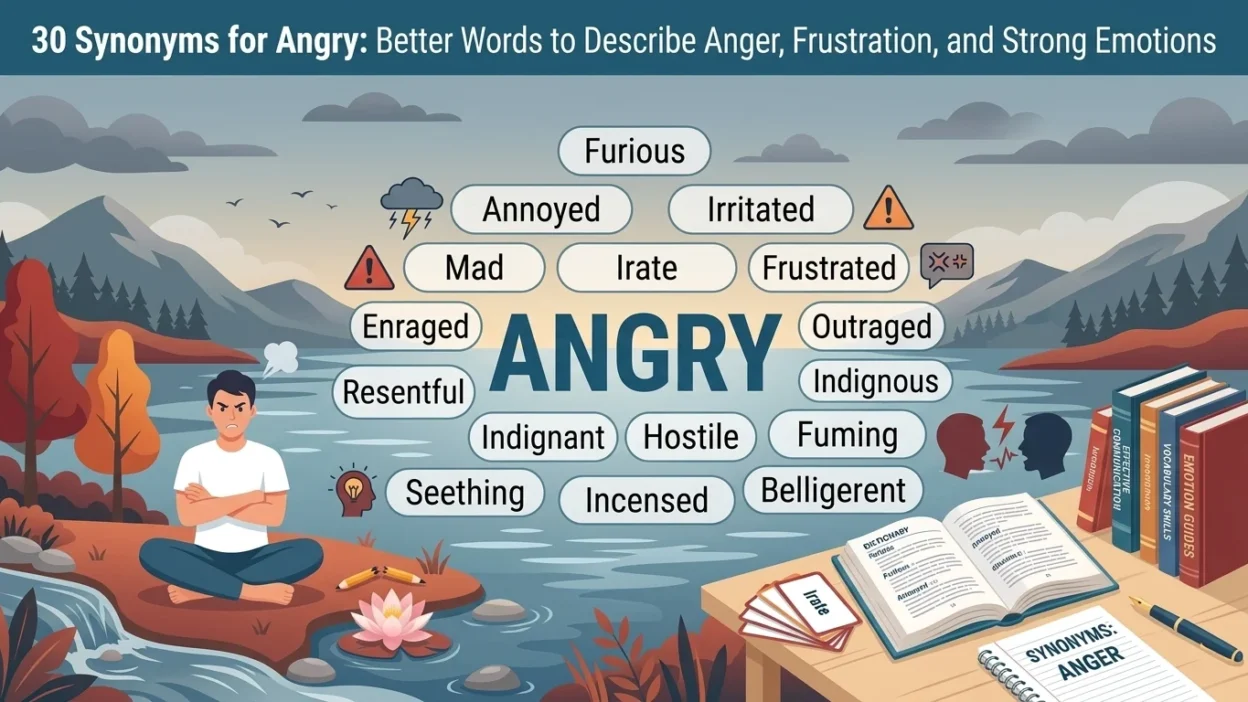
The word angry is one of the most common ways to describe someone who feels upset, annoyed, or frustrated. It can refer to emotions caused by unfair situations, disagreements, disappointment, or conflict. Depending on the context, angry may describe anything from mild irritation to intense rage.
Learning synonyms for angry helps students, ESL learners, writers, and content creators express different levels of emotion more accurately. Instead of repeating the word angry, you can choose alternatives that better match the intensity and tone of a situation.
In this guide, you will learn the meaning of angry, explore 30 useful synonyms, and understand when each word works best.
What Does “Angry” Mean?
The word angry describes a feeling of strong displeasure, frustration, or annoyance. It can refer to temporary irritation or deep emotional upset.
Examples:
- She was angry about the mistake.
- He became angry after hearing the news.
- They had an angry argument.
The meaning depends on the context. Angry can describe feelings, facial expressions, voices, or reactions.
30 Synonyms for Angry
1. Mad
Meaning: Angry or upset.
Example Sentence: He was mad about the delay.
Best Usage Context: Everyday conversations.
2. Furious
Meaning: Extremely angry.
Example Sentence: She was furious after the accident.
Best Usage Context: Strong emotions.
3. Irate
Meaning: Very angry.
Example Sentence: The customer became irate.
Best Usage Context: Formal writing.
4. Annoyed
Meaning: Slightly angry or irritated.
Example Sentence: I was annoyed by the noise.
Best Usage Context: Minor frustrations.
5. Irritated
Meaning: Feeling bothered.
Example Sentence: She looked irritated by the interruption.
Best Usage Context: Daily conversations.
6. Frustrated
Meaning: Upset because something is difficult.
Example Sentence: He felt frustrated with the slow progress.
Best Usage Context: Work and studies.
7. Enraged
Meaning: Filled with extreme anger.
Example Sentence: The unfair decision enraged the crowd.
Best Usage Context: Serious situations.
8. Outraged
Meaning: Angry because something seems unfair.
Example Sentence: Citizens were outraged by the news.
Best Usage Context: Social issues.
9. Resentful
Meaning: Angry because of unfair treatment.
Example Sentence: She became resentful after being ignored.
Best Usage Context: Relationships.
10. Offended
Meaning: Hurt and angry because of someone’s words or actions.
Example Sentence: He felt offended by the comment.
Best Usage Context: Personal conversations.
11. Cross
Meaning: Slightly angry.
Example Sentence: She sounded cross this morning.
Best Usage Context: British English.
12. Agitated
Meaning: Nervous and angry.
Example Sentence: The discussion made him agitated.
Best Usage Context: Emotional situations.
13. Bitter
Meaning: Angry over a long period.
Example Sentence: He remained bitter about the loss.
Best Usage Context: Personal experiences.
14. Hostile
Meaning: Showing anger and opposition.
Example Sentence: The crowd became hostile.
Best Usage Context: Conflicts.
15. Heated
Meaning: Full of strong emotions.
Example Sentence: They had a heated debate.
Best Usage Context: Arguments.
16. Indignant
Meaning: Angry because something is unfair.
Example Sentence: She was indignant about the accusation.
Best Usage Context: Formal writing.
17. Upset
Meaning: Emotionally disturbed.
Example Sentence: He was upset after the meeting.
Best Usage Context: General situations.
18. Exasperated
Meaning: Extremely annoyed.
Example Sentence: The teacher became exasperated.
Best Usage Context: Frustrating situations.
19. Fuming
Meaning: Very angry.
Example Sentence: She was fuming after the argument.
Best Usage Context: Informal conversations.
20. Seething
Meaning: Quietly full of anger.
Example Sentence: He sat there seething.
Best Usage Context: Creative writing.
21. Wrathful
Meaning: Filled with intense anger.
Example Sentence: The king gave a wrathful command.
Best Usage Context: Literature.
22. Temperamental
Meaning: Easily becoming angry.
Example Sentence: He has a temperamental personality.
Best Usage Context: Personality descriptions.
23. Displeased
Meaning: Not satisfied and slightly angry.
Example Sentence: The manager looked displeased.
Best Usage Context: Formal communication.
24. Provoked
Meaning: Made angry by someone.
Example Sentence: His words provoked the audience.
Best Usage Context: Conflict.
25. Vexed
Meaning: Annoyed or worried.
Example Sentence: She looked vexed by the delay.
Best Usage Context: Formal writing.
26. Stormy
Meaning: Full of anger or conflict.
Example Sentence: They had a stormy relationship.
Best Usage Context: Relationships.
27. Incensed
Meaning: Extremely angry.
Example Sentence: The unfair rule incensed everyone.
Best Usage Context: Strong reactions.
28. Testy
Meaning: Easily annoyed.
Example Sentence: He became testy under pressure.
Best Usage Context: Personality.
29. Cranky
Meaning: Bad-tempered and easily annoyed.
Example Sentence: She felt cranky after a long day.
Best Usage Context: Informal conversations.
30. Belligerent
Meaning: Aggressive and ready to argue.
Example Sentence: His belligerent attitude caused problems.
Best Usage Context: Formal writing and conflict.
Comparison Table: When to Use Different Synonyms for Angry
| Synonym | Meaning Focus | Best Use |
|---|---|---|
| Annoyed | Mild irritation | Everyday situations |
| Frustrated | Difficulty or failure | Work and studies |
| Furious | Extreme anger | Strong emotions |
| Indignant | Anger about unfairness | Formal writing |
| Resentful | Long-term anger | Relationships |
| Hostile | Open opposition | Conflicts |
| Upset | Emotional discomfort | General conversations |
| Belligerent | Aggressive behavior | Formal contexts |
How to Choose the Right Synonym for Angry
For Mild Anger
Use:
- Annoyed
- Irritated
- Cross
- Cranky
These describe small frustrations.
For Strong Anger
Use:
- Furious
- Enraged
- Incensed
- Wrathful
These show powerful emotions.
For Unfair Situations
Use:
- Indignant
- Outraged
- Resentful
- Offended
These are useful when someone feels mistreated.
For Formal Writing
Use:
- Irate
- Belligerent
- Vexed
- Displeased
These fit academic and professional contexts.
Why Learning Synonyms for Angry Matters
Learning different alternatives helps you avoid repetition and express emotions more accurately. Each synonym describes a different level or type of anger, making your writing more natural and expressive.
For students, ESL learners, writers, and content creators, expanding your vocabulary improves both written and spoken communication.
Conclusion
Learning synonyms for angry helps you describe frustration, irritation, and strong emotions with greater precision. Words like furious, annoyed, resentful, and indignant allow you to choose the right expression for every situation.
A richer vocabulary makes your writing more engaging, expressive, and effective.