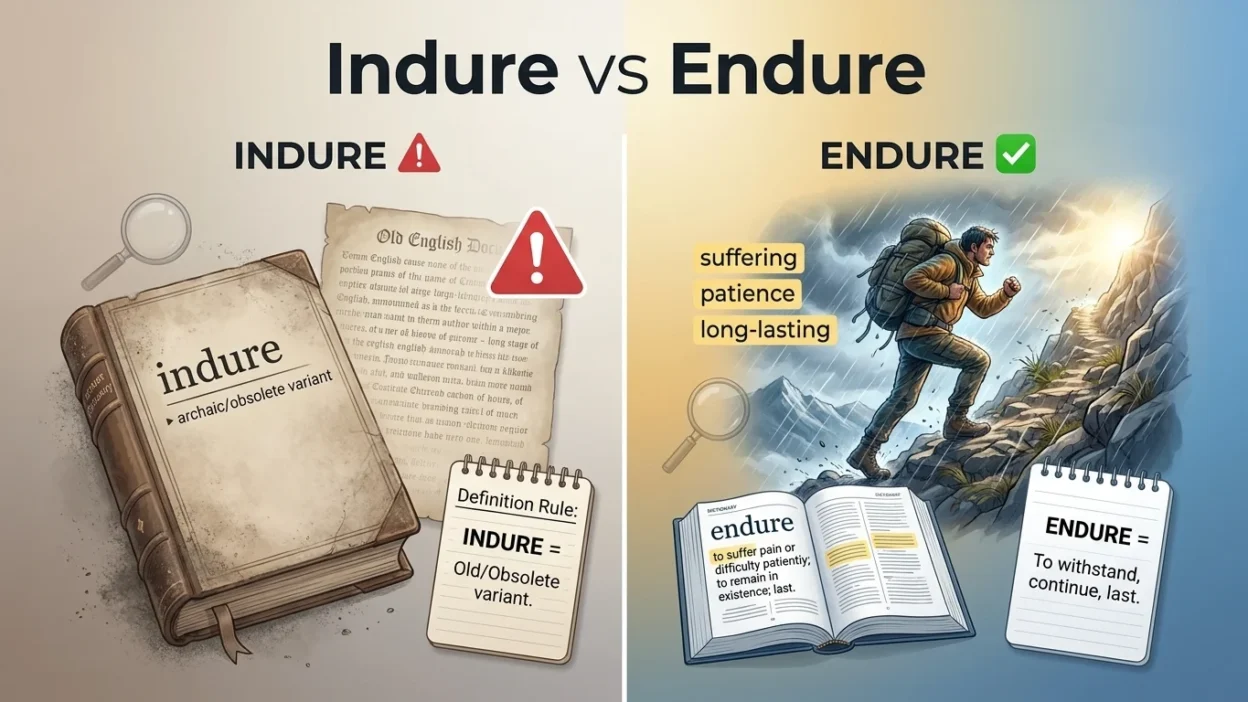
If you are confused about indure vs endure, the correct and commonly used modern English word is endure. It means to experience something difficult and continue through it, or to last for a long time. For example, “She endured many challenges” is correct. Indure is an archaic or obsolete variant that you are unlikely to need in modern English.
The confusion comes from the similar spelling and pronunciation of the two forms. In older English, indure appeared as a variant of endure, but modern standard English overwhelmingly uses endure. Therefore, students, ESL learners, writers, and general readers should normally choose endure in contemporary writing. Moreover, learning the difference helps you avoid an outdated spelling and use the word naturally in sentences about hardship, patience, suffering, durability, and long-lasting situations.
Quick Answer
Endure is the correct modern English word for experiencing something difficult and continuing despite it, or for lasting over time. Indure is an obsolete or archaic variant of endure. In modern English writing, use endure, not indure.
Why Do People Confuse It?
People confuse indure and endure because both forms have appeared in English and look almost identical.
The main difference is the first vowel:
- Endure ✅ — standard modern English
- Indure ⚠️ — archaic or obsolete variant
Historical dictionaries and older texts may contain indure, which explains why learners sometimes encounter it.
However, modern English has settled on endure as the normal form. Therefore, if you are writing an essay, email, article, school assignment, or everyday message, endure is the safe and natural choice.
What Does the First Word Mean: Indure?
Is Indure Correct?
Indure is a historical form of endure. It has appeared in older English, but it is not normally used in contemporary standard English.
For example, you might encounter it in an old literary text, historical document, or dictionary entry.
In modern writing, however, write:
“They had to endure difficult conditions.”
rather than:
“They had to indure difficult conditions.”
Therefore, although indure can be found as an English word in historical contexts, it should not normally replace endure today.
Why Does Indure Appear in Older Texts?
English spelling and vocabulary have changed considerably over time. Different forms of words sometimes existed side by side before one became dominant.
Indure was one such historical variant. As modern English developed, endure became the established standard form.
As a result, seeing indure in an old text does not necessarily mean the writer made a spelling mistake. Instead, the word may reflect the spelling conventions of that period.
What Does the Second Word Mean: Endure?
Definition of Endure
Endure is a verb meaning to experience something difficult, unpleasant, or painful and continue despite it.
For example:
“He endured many hardships during the journey.”
It can also mean to last or continue for a long time.
For example:
“The building was designed to endure extreme weather.”
Therefore, endure has two closely related ideas:
- continuing through difficulty
- continuing to exist or last
Endure as “Suffer Through”
When endure describes a difficult experience, it suggests that someone tolerates or survives something unpleasant.
For example:
“She endured years of uncertainty.”
Similarly:
“The workers endured difficult conditions.”
In these examples, the focus is on continuing despite hardship.
Endure as “Last”
Endure can also describe something that continues to exist or remain effective.
For example:
“Their friendship endured for many years.”
Here, endured means that the friendship continued despite the passage of time or possible difficulties.
Indure vs Endure Comparison Table
| Word | Modern Usage | Meaning | Example |
|---|---|---|---|
| Indure | ❌ Archaic/obsolete | Historical variant of endure | “The old text used indure.” |
| Endure | ✅ Standard | Continue through difficulty or last over time | “She endured the hardship.” |
| Endured | ✅ Standard | Past tense of endure | “He endured many challenges.” |
| Enduring | ✅ Standard | Continuing for a long time or lasting | “They formed an enduring friendship.” |
When Should You Use Each?
When to Use Endure
Use endure when you mean to tolerate, survive, or continue through something difficult.
For example:
“The team endured a difficult season.”
You can also use it when something lasts:
“The tradition has endured for centuries.”
When to Use Indure
In modern English, you generally should not use indure.
The word may appear in historical or literary sources, but it is not the normal choice for contemporary writing.
Therefore, if you are unsure, choose endure.
When to Use Endured
Use endured when you need the past tense or past participle.
For example:
“They endured several difficult months.”
When to Use Enduring
Use enduring when describing something that continues or lasts.
For example:
“She has an enduring interest in history.”
12 Examples of Endure
Example 1
She had to endure several difficult challenges.
Example 2
The soldiers endured harsh weather conditions.
Example 3
He could not endure the constant noise.
Example 4
The family endured many hardships together.
Example 5
The bridge was built to endure heavy traffic.
Example 6
Their friendship endured despite the distance.
Example 7
Some plants can endure extremely cold temperatures.
Example 8
The athlete endured intense training.
Example 9
We must endure this difficult period patiently.
Example 10
The old building has endured for hundreds of years.
Example 11
She endured the long journey without complaining.
Example 12
Their enduring partnership continued for decades.
These examples show that endure can describe both difficult experiences and things that continue over time.
Common Mistakes
Mistake 1: Using Indure in Modern Writing
Incorrect for normal contemporary writing:
“She had to indure the pain.”
Correct:
“She had to endure the pain.”
Although indure has historical usage, endure is the modern standard form.
Mistake 2: Confusing Endure With Enjoy
Endure does not mean to enjoy something.
For example:
“He endured the long meeting.”
This means the meeting was difficult, unpleasant, or tiring, and he continued through it.
Therefore, endure often carries a sense of difficulty.
Mistake 3: Confusing Endure With Survive
Endure and survive can overlap, but they emphasize different ideas.
Survive means to remain alive or continue to exist after danger or difficulty.
Endure emphasizes continuing through something difficult or unpleasant.
For example:
“The patient survived the illness.”
“The patient endured months of treatment.”
Mistake 4: Using Endure for Every Long-Lasting Situation
Although endure can mean “last,” it often suggests persistence despite difficulty or pressure.
For simple duration, words such as last, continue, or remain may sound more natural.
For example:
“The meeting lasted two hours.”
This is usually more natural than:
“The meeting endured two hours.”
What Is an Easy Memory Trick?
Remember “Endure = Experience and Continue”
A simple memory trick is:
Endure = experience something difficult and continue.
Think of the word end inside endure. When you endure something, you keep going instead of giving up.
For example:
“She endured the difficult journey.”
You can also remember:
ENDURE = tolerate + continue
This makes it easier to recall both the meaning and spelling.
American vs British English
Is Endure Correct in American English?
Yes. Endure is the standard spelling and usage in American English.
For example:
“They endured difficult conditions.”
Is Endure Correct in British English?
Yes. Endure is also the standard form in British English.
For example:
“The tradition has endured for generations.”
Is Indure Used in American or British English?
Indure is not a normal modern spelling in either variety. It may appear in historical texts or discussions of older English usage.
Therefore, there is no meaningful American-versus-British spelling difference here. Modern writers should use endure.
Similar Words
Tolerate
Tolerate means to accept or put up with something unpleasant or difficult.
“She tolerated the noise for several hours.”
Withstand
Withstand means to resist or remain strong against pressure, damage, or difficulty.
“The building can withstand strong winds.”
Survive
Survive means to continue living or existing after danger or hardship.
“The plant survived the winter.”
Persist
Persist means to continue despite difficulty or opposition.
“She persisted despite several setbacks.”
Last
Last means to continue for a period of time.
“The battery lasted all day.”
Bear
Bear can mean to tolerate or accept something difficult.
“He could barely bear the pain.”
Sustain
Sustain can mean to maintain or continue something over time.
“The organization sustained its growth.”
Persevere
Persevere means to continue making an effort despite difficulties.
“She persevered despite repeated failures.”
These words overlap with endure, but each one emphasizes a slightly different aspect of difficulty, persistence, resistance, or duration.
What Is the Difference Between Endure and Tolerate?
Endure vs Tolerate
Both endure and tolerate can describe dealing with something unpleasant.
However, endure often suggests continuing through a difficult or painful experience.
“She endured years of hardship.”
Tolerate often means accepting something you dislike without necessarily taking action against it.
“I cannot tolerate loud music.”
Therefore, endure often sounds stronger and more focused on persistence.
What Is the Difference Between Endure and Survive?
Endure vs Survive
Endure emphasizes experiencing and continuing through difficulty.
“They endured a long period of uncertainty.”
Survive emphasizes remaining alive or continuing to exist after danger or hardship.
“They survived the accident.”
As a result, you should choose the word based on whether you want to emphasize persistence through difficulty or remaining alive/existing.
Final Verdict
The answer to indure vs endure is straightforward for modern English: endure is the standard word you should use. It means to tolerate or continue through something difficult, or to last over time.
Indure is an archaic or obsolete variant that may appear in historical texts. Therefore, unless you are specifically discussing older English or quoting a historical source, avoid using it.
The easiest rule is simple: Use endure in modern English. Whether you are writing about hardship, pain, difficult conditions, long-lasting relationships, traditions, or durable materials, endure is the correct choice.
Frequently Asked Questions
Is indure or endure correct?
Endure is the correct and standard choice in modern English. Indure is an archaic or obsolete variant.
What does endure mean?
Endure means to experience something difficult and continue despite it. It can also mean to last or continue for a long time.
Is indure a real word?
Yes, indure has historical usage as a variant of endure. However, it is not normally used in contemporary standard English.
Is endure a verb?
Yes. Endure is a verb.
For example:
“She endured the difficult conditions.”
What is the past tense of endure?
The past tense and past participle of endure is endured.
For example:
“They endured many challenges.”
What is the adjective form of endure?
The related adjective is enduring, meaning lasting for a long time.
For example:
“They have an enduring friendship.”
What is a synonym for endure?
Depending on context, synonyms include tolerate, withstand, survive, bear, persist, and persevere.
Is endure the same as tolerate?
They can have similar meanings, but endure often emphasizes continuing through something difficult, while tolerate emphasizes putting up with something unpleasant.
Remember This
Indure ⚠️ — archaic or obsolete variant
Endure ✅ — standard modern English
Remember:
Endure = tolerate, survive, or continue through difficulty.
For modern writing, choose ENDURE.
Conclusion
The difference between indure vs endure mainly comes down to modern versus historical usage. Endure is the standard English word used today when someone continues through hardship, pain, difficulty, or an unpleasant experience. It can also describe something that lasts over a long period.
Meanwhile, indure is an older variant that may appear in historical English texts. Although it has a place in discussions of language history, it is not the appropriate choice for most modern writing. Therefore, students, ESL learners, writers, and everyday English users should remember one simple rule: use endure in contemporary English.
In short, choose endure whenever you mean “to tolerate,” “to withstand,” “to continue despite difficulty,” or “to last.” By connecting the word with the idea of continuing through something challenging, you can remember both its meaning and its correct modern spelling.