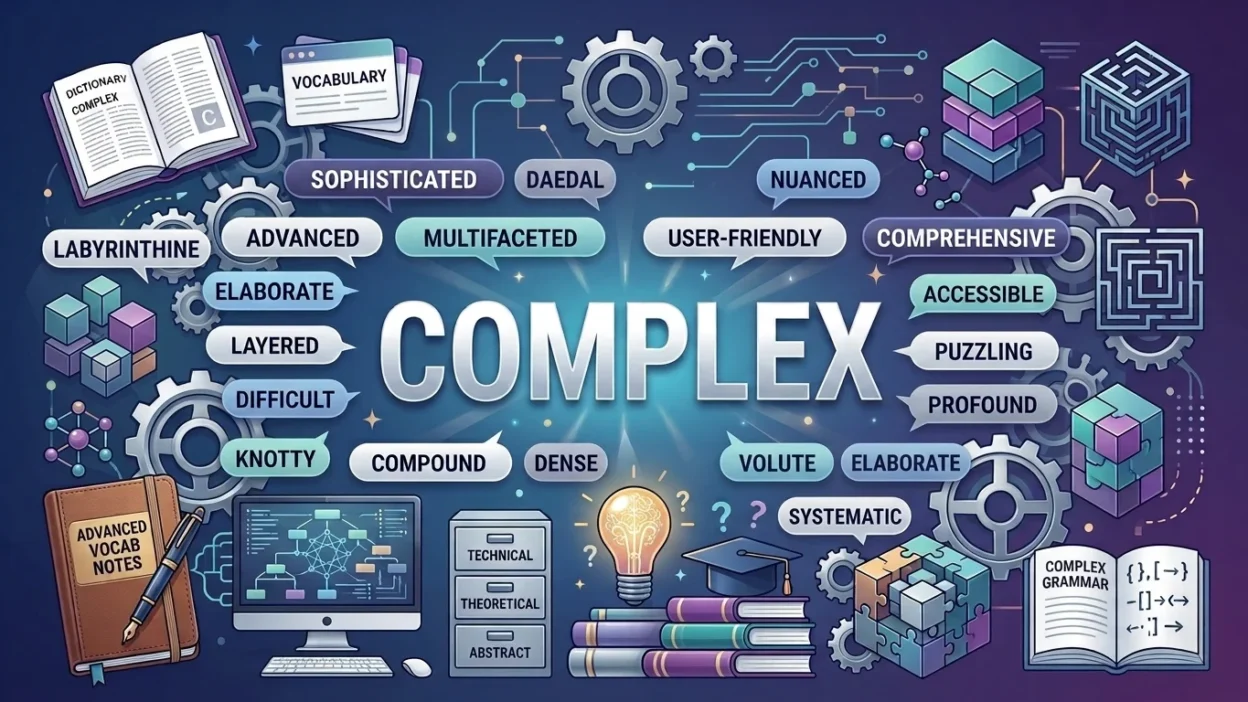
The word complex is commonly used to describe something that has many parts, details, or layers. It can refer to ideas, problems, systems, emotions, relationships, or tasks that are not easy to understand. While complex is a useful word, using different synonyms can make your writing more accurate and engaging.
Learning synonyms for complex helps students, ESL learners, writers, and content creators improve their vocabulary. Different synonyms highlight difficulty, sophistication, depth, or structure, allowing you to choose the most suitable word for every situation.
In this guide, you’ll learn the meaning of complex, explore 30 useful alternatives, understand when each synonym works best, and improve your English with simple explanations and practical examples.
What Does “Complex” Mean?
Meaning and Usage
The word complex means made up of many connected parts or difficult to understand because of its details. It can describe ideas, machines, emotions, instructions, or situations that require careful thought.
Examples:
- The engineer solved a complex problem.
- Human emotions can be complex.
- This software has a complex interface.
The best synonym depends on whether you want to emphasize difficulty, detail, structure, or sophistication.
30 Synonyms for Complex
1. Complicated
Meaning: Difficult because it has many parts.
Example Sentence: The instructions were complicated.
Best Usage Context: Everyday conversation.
2. Intricate
Meaning: Full of small details.
Example Sentence: The artist created an intricate pattern.
Best Usage Context: Art and design.
3. Sophisticated
Meaning: Highly developed or advanced.
Example Sentence: The company uses sophisticated technology.
Best Usage Context: Technology and business.
4. Detailed
Meaning: Containing a lot of information.
Example Sentence: She wrote a detailed report.
Best Usage Context: Writing and research.
5. Advanced
Meaning: More developed than basic.
Example Sentence: This is an advanced course.
Best Usage Context: Education and technology.
6. Multifaceted
Meaning: Having many different aspects.
Example Sentence: The issue is multifaceted.
Best Usage Context: Formal writing.
7. Elaborate
Meaning: Carefully planned with many details.
Example Sentence: They prepared an elaborate presentation.
Best Usage Context: Events and writing.
8. Layered
Meaning: Having several levels or meanings.
Example Sentence: The novel has a layered storyline.
Best Usage Context: Literature.
9. Involved
Meaning: Requiring careful attention because it is detailed.
Example Sentence: The process is quite involved.
Best Usage Context: Procedures.
10. Challenging
Meaning: Difficult but possible to complete.
Example Sentence: The puzzle was challenging.
Best Usage Context: Learning and work.
11. Difficult
Meaning: Not easy to understand or do.
Example Sentence: It was a difficult decision.
Best Usage Context: General English.
12. Technical
Meaning: Related to specialized knowledge.
Example Sentence: The manual contains technical terms.
Best Usage Context: Science and engineering.
13. Comprehensive
Meaning: Including many details.
Example Sentence: The guide is comprehensive.
Best Usage Context: Education.
14. Extensive
Meaning: Covering a large amount of information.
Example Sentence: They conducted extensive research.
Best Usage Context: Academic writing.
15. Nuanced
Meaning: Having subtle differences or meanings.
Example Sentence: Her argument was nuanced.
Best Usage Context: Discussions and analysis.
16. Profound
Meaning: Deep and meaningful.
Example Sentence: The book offers profound insights.
Best Usage Context: Philosophy and literature.
17. Dense
Meaning: Difficult because of a large amount of information.
Example Sentence: The textbook is dense.
Best Usage Context: Academic content.
18. Interconnected
Meaning: Connected in many ways.
Example Sentence: The systems are interconnected.
Best Usage Context: Science and business.
19. Compound
Meaning: Made of several parts.
Example Sentence: The scientist studied a compound structure.
Best Usage Context: Science.
20. Knotty
Meaning: Hard to solve.
Example Sentence: It was a knotty legal issue.
Best Usage Context: Formal discussions.
21. Puzzling
Meaning: Difficult to understand.
Example Sentence: His reaction was puzzling.
Best Usage Context: Everyday English.
22. Confusing
Meaning: Hard to understand clearly.
Example Sentence: The explanation was confusing.
Best Usage Context: General communication.
23. Convoluted
Meaning: Overly complicated.
Example Sentence: The plot became convoluted.
Best Usage Context: Writing and criticism.
24. Tangled
Meaning: Mixed together in a difficult way.
Example Sentence: They faced tangled legal issues.
Best Usage Context: Problems and relationships.
25. Byzantine
Meaning: Extremely complicated and difficult.
Example Sentence: The organization had Byzantine rules.
Best Usage Context: Formal writing.
26. Sophisticate
Meaning: Highly refined or developed.
Example Sentence: They built a sophisticate security system.
Best Usage Context: Advanced discussions.
27. Elaborated
Meaning: Explained in greater detail.
Example Sentence: She elaborated on the proposal.
Best Usage Context: Communication.
28. Systematic
Meaning: Organized with many connected steps.
Example Sentence: They followed a systematic process.
Best Usage Context: Research and planning.
29. Structured
Meaning: Organized into connected parts.
Example Sentence: The course has a structured format.
Best Usage Context: Education and business.
30. Complex
Meaning: Having many connected parts or details.
Example Sentence: Climate change is a complex issue.
Best Usage Context: General use.
Comparison Guide
When to Use Different Synonyms for Complex
| Synonym | Main Meaning | Best Use |
|---|---|---|
| Complicated | Hard to understand | Everyday English |
| Intricate | Full of details | Art and design |
| Sophisticated | Highly advanced | Technology |
| Multifaceted | Many aspects | Formal writing |
| Nuanced | Subtle meanings | Analysis |
| Comprehensive | Complete and detailed | Education |
| Dense | Information-heavy | Academic writing |
| Convoluted | Too complicated | Criticism |
How to Choose the Right Synonym
For Everyday Situations
Use:
- Complicated
- Difficult
- Challenging
- Confusing
- Puzzling
These are natural and commonly used.
For Academic and Professional Writing
Use:
- Comprehensive
- Multifaceted
- Nuanced
- Extensive
- Sophisticated
These sound more formal and precise.
For Science and Technology
Use:
- Technical
- Structured
- Systematic
- Compound
- Interconnected
These fit technical and specialized topics.
For Creative and Descriptive Writing
Use:
- Intricate
- Layered
- Elaborate
- Profound
- Convoluted
These add depth and vivid description.
Why Learning Synonyms for Complex Matters
Using different synonyms instead of repeating complex makes your writing richer and more precise. Each synonym highlights a different aspect, such as difficulty, detail, organization, or depth, helping you communicate your ideas more effectively.
A broader vocabulary also improves essays, blog posts, presentations, reports, creative writing, and professional communication.
Conclusion
Learning synonyms for complex helps you describe detailed ideas, advanced systems, difficult situations, and sophisticated concepts with greater accuracy. Whether you choose complicated, intricate, multifaceted, nuanced, or sophisticated, selecting the right synonym makes your writing clearer and more engaging.
The more synonyms you learn, the more confidently you can express yourself in both spoken and written English.