
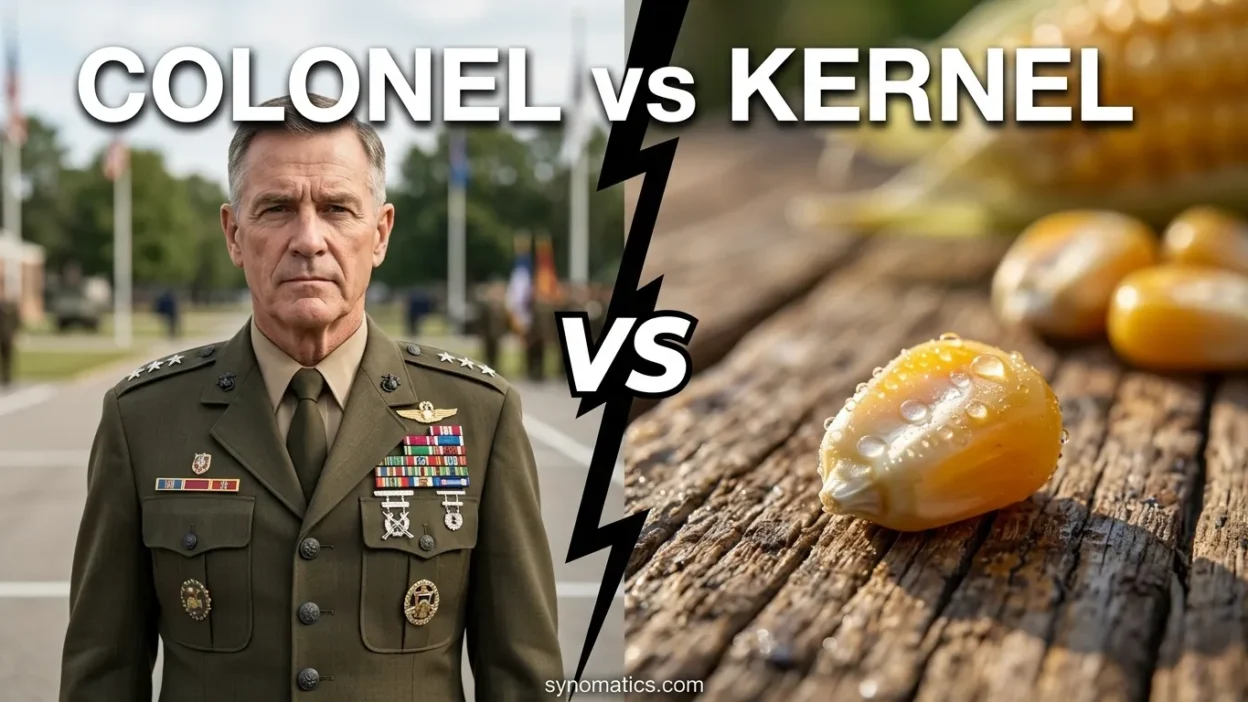
Have you ever seen the words colonel and kernel and wondered why they sound exactly the same? Although their spelling looks completely different, these two words share the same pronunciation in English. However, their meanings, uses, and contexts are very different. Understanding the difference between colonel vs kernel can help you improve your vocabulary, spelling, reading, and everyday communication.
The word colonel refers to a military officer who holds a senior rank. In contrast, kernel usually means the inner part of a seed, grain, or nut. It can also refer to the central or most important part of something, or to the core component of an operating system in computing. Both words are pronounced like “KUR-nuhl,” which explains why people sometimes confuse them when speaking or listening. In this guide, you will learn what each word means, how to pronounce it, when to use it, and how to remember the difference with simple examples.
Quick Answer: Colonel vs Kernel
Colonel and kernel are pronounced the same way, but they have different meanings and spellings. A colonel is a senior military officer, while a kernel is the inner part of a seed, grain, or nut. Kernel can also mean the central part of an idea or the core of a computer operating system.
Why Do People Confuse Colonel and Kernel?
People often confuse these words because they are homophones. Homophones are words that sound alike but have different meanings and spellings.
Both colonel and kernel are pronounced /ˈkɝː.nəl/ in American English, approximately “KUR-nuhl.” In British English, the pronunciation is also similar, with a slightly different vowel sound.
The confusion comes from three main factors:
- Identical pronunciation: You cannot usually tell which word someone means just by hearing it.
- Different spelling patterns: Colonel has an unusual spelling that does not match its modern pronunciation.
- Different contexts: One word is primarily associated with the military, while the other is associated with seeds, ideas, and computing.
The surrounding sentence usually makes the intended meaning clear.
What Does Colonel Mean?
A colonel is a senior commissioned officer in the armed forces. In many military systems, the rank is above lieutenant colonel and below brigadier general or an equivalent rank, although exact rank structures vary between countries.
Colonel is a noun used when discussing military personnel, ranks, careers, and official titles.
Examples of Colonel in Sentences
- The colonel addressed the soldiers before the mission.
- My uncle served as a colonel in the army.
- The colonel reviewed the training schedule.
- She was promoted to colonel after years of military service.
- The colonel attended the official ceremony.
How Do You Pronounce Colonel?
Colonel is pronounced “KUR-nuhl,” not “co-lo-nel.”
Its spelling may look as though it should have three syllables, but its standard pronunciation has two. The unusual spelling developed through the historical evolution of the word and its military usage.
Easy tip: When you see colonel in a military context, think of an officer or military rank.
What Does Kernel Mean?
A kernel is the inner part of a seed, grain, or nut. The word can also describe the central or essential part of something.
In computing, a kernel is the central component of an operating system. It manages important tasks such as communication between software and hardware, memory, and system resources.
Kernel is a noun used in agriculture, food, technology, mathematics, and general discussion.
Examples of Kernel in Sentences
- A kernel of corn fell onto the floor.
- The squirrel cracked a nut to reach its kernel.
- The farmer examined each kernel of wheat.
- There is a kernel of truth in her statement.
- The computer’s kernel manages essential system operations.
How Do You Pronounce Kernel?
Kernel is pronounced “KUR-nuhl,” just like colonel.
It has two syllables: ker-nel. The spelling is much closer to its pronunciation than the spelling of colonel.
Easy tip: When you see kernel, think of the inside of a seed or the core of something.
Colonel vs Kernel: Comparison Table
| Feature | Colonel | Kernel |
|---|---|---|
| Part of speech | Noun | Noun |
| Pronunciation | KUR-nuhl | KUR-nuhl |
| Main meaning | A senior military officer | The inner part of a seed, grain, or nut |
| Other meanings | A military rank or title | The central part of something; an operating system component |
| Common contexts | Army, military, official titles | Food, farming, ideas, computing |
| Example | The colonel led the briefing. | The corn kernel was small. |
| Common mistake | Pronouncing it as “co-lo-nel” | Confusing it with the military rank |
The key difference is simple: colonel refers to a person or military rank, while kernel refers to an inner part or core.
When Should You Use Colonel or Kernel?
Choosing the correct word depends on the meaning of your sentence.
Use Colonel When Talking About the Military
Choose colonel when referring to a military officer, rank, or person holding that rank.
Examples:
- The colonel inspected the military base.
- A colonel attended the meeting.
- The colonel received an award for his service.
- The report was sent to Colonel Davis.
When used as part of a person’s formal title before their name, Colonel is commonly capitalized. When referring to the rank generally, use lowercase colonel unless it begins a sentence.
Use Kernel When Talking About Seeds or Grains
Choose kernel when referring to the inner part of a grain, seed, or nut.
Examples:
- One kernel of corn remained in the bowl.
- The wheat kernels were ready for processing.
- The recipe requires several kernels of roasted corn.
Use Kernel for an Essential Part or Computing Component
Kernel also has figurative and technical meanings.
Examples:
- Every good story contains a kernel of truth.
- The kernel of his argument was easy to understand.
- The Linux kernel manages essential operating system functions.
Remember that colonel is associated with military rank, while kernel can refer to a physical object, an essential idea, or a computing component.
12 Examples of Colonel vs Kernel in Sentences
These examples show how context determines which spelling is correct.
- Colonel: The colonel inspected the soldiers during the morning parade.
- Kernel: A single kernel of corn was stuck between my teeth.
- Colonel: The colonel gave instructions before the operation began.
- Kernel: Each kernel of popcorn expanded when heated.
- Colonel: The colonel attended a meeting with other senior officers.
- Kernel: The bird picked up a kernel of wheat from the ground.
- Colonel: Colonel Ahmed spoke at the military ceremony.
- Kernel: The farmer stored the corn kernels in a dry container.
- Colonel: The colonel reviewed the soldiers’ performance.
- Kernel: There is a kernel of truth in that explanation.
- Colonel: The colonel received a promotion after many years of service.
- Kernel: The operating system kernel controls essential computer processes.
Notice that both words sound alike in all 12 examples. Their meanings and the surrounding words determine which spelling belongs in each sentence.
Common Mistakes With Colonel and Kernel
Even fluent English speakers can make spelling mistakes with homophones. Here are some common errors to avoid.
Mistake 1: Writing Kernel When You Mean a Military Officer
Incorrect: The kernel addressed the soldiers.
Correct: The colonel addressed the soldiers.
Why? The sentence refers to a military officer, so colonel is the correct word.
Mistake 2: Writing Colonel When You Mean a Seed
Incorrect: I found a colonel of corn on the floor.
Correct: I found a kernel of corn on the floor.
Why? The sentence refers to a piece of corn, not a military officer.
Mistake 3: Pronouncing Colonel as It Is Spelled
Incorrect pronunciation: “CO-lo-nel.”
Correct pronunciation: “KUR-nuhl.”
Why? Colonel has an unusual historical spelling and a pronunciation that differs from its appearance.
Mistake 4: Assuming Similar Sounds Mean Similar Meanings
Incorrect assumption: Colonel and kernel are interchangeable because they sound alike.
Correct understanding: They are homophones, but their meanings are unrelated in ordinary modern usage.
Mistake 5: Forgetting the Technical Meaning of Kernel
Incorrect: The colonel manages the computer’s operating system core.
Correct: The kernel manages essential operating system functions.
Why? In computing, kernel refers to a core software component, not a military officer.
Memory Trick: How to Remember Colonel vs Kernel
Use these simple memory tricks to choose the correct word.
- Colonel = Commander: Both begin with C, and colonel refers to a military officer.
- Kernel = Corn: Both words are associated with the inner part of a grain or seed.
- Kernel = Core: A kernel can represent the central part of an idea or computer system.
- Same sound, different meaning: Both words sound like “KUR-nuhl,” so focus on the sentence rather than pronunciation.
Here is a quick test:
- “The ___ inspected the troops.” → Colonel
- “The popcorn ___ burst open.” → Kernel
- “There is a ___ of truth in the story.” → Kernel
If the sentence describes an officer, choose colonel. If it describes a seed, a core, or an essential part, choose kernel.
American vs British English: Colonel and Kernel
The meanings and spellings of colonel and kernel remain essentially the same in American and British English.
| Feature | American English | British English |
|---|---|---|
| Spelling | Colonel / Kernel | Colonel / Kernel |
| Colonel pronunciation | Approximately KUR-nuhl | Approximately KER-nuhl, with a British vowel sound |
| Kernel pronunciation | Approximately KUR-nuhl | Approximately KER-nuhl, with a British vowel sound |
| Military meaning | Senior military officer | Senior military officer |
| Seed or core meaning | Inner part or essential component | Inner part or essential component |
The pronunciation guides are approximate because accents vary across regions and speakers. In both varieties of English, colonel and kernel are homophones for most speakers.
The spelling distinction does not change between American and British English. You should use colonel for the military rank and kernel for the inner part of a seed or the core of something.
Similar Words to Colonel and Kernel
Learning related terms can help you understand these words more clearly.
Words Related to Colonel
- Officer: A person who holds an official position of authority in the armed forces or another organization.
- Lieutenant colonel: A military rank generally below colonel.
- Brigadier general: A general-officer rank above colonel in many military systems.
- Commander: A person who leads or directs a group, unit, or operation.
These words relate to military ranks, leadership, and authority, although they are not exact synonyms for colonel.
Words Related to Kernel
- Core: The central or most important part of something.
- Seed: The part of a plant that can grow into a new plant.
- Grain: A small, hard seed, especially from cereal crops such as wheat or rice.
- Nucleus: The central part of an object or structure; the precise meaning depends on the subject.
- Essence: The fundamental nature or most important quality of something.
Core and essence can sometimes replace kernel in figurative expressions, but they are not interchangeable in every sentence.
FAQs:
1. Is colonel or kernel the correct spelling?
Both spellings are correct, but they have different meanings. Colonel refers to a senior military officer, while kernel refers to the inner part of a seed, grain, or nut, or the central part of something.
2. Why are colonel and kernel pronounced the same?
Their pronunciations developed through different historical paths. Colonel’s spelling reflects an older form influenced by the history of military terminology, while its modern pronunciation reflects the word’s development in English. Kernel developed differently but came to share the same pronunciation.
3. How do you pronounce colonel?
Colonel is pronounced “KUR-nuhl” in American English. It has two syllables, despite its unusual spelling. It is not normally pronounced as “co-lo-nel.”
4. What is the plural of colonel?
The plural of colonel is colonels.
Example: The colonels attended a meeting with the commanding officer.
5. What is the plural of kernel?
The plural of kernel is kernels.
Example: The kernels of corn were collected after the harvest.
6. Can kernel mean the main idea of something?
Yes. Kernel can refer to the central or essential part of an idea, statement, or argument. For example, “There is a kernel of truth in the rumor” means that the rumor contains some truth.
7. Is a colonel a higher rank than a lieutenant colonel?
Yes. In many military rank systems, colonel is above lieutenant colonel and below brigadier general or an equivalent rank. The exact structure and titles depend on the country’s armed forces.
8. Are colonel and kernel homophones?
Yes. They are homophones because they share the same pronunciation but have different spellings and meanings.
Remember This
- Colonel: A senior military officer.
- Kernel: The inner part of a seed, grain, or nut; also the core of an idea or computer operating system.
- Pronunciation: Both words sound like “KUR-nuhl” in American English.
- Spelling rule: Use the meaning and context to choose the correct word.
Conclusion
The difference between colonel and kernel becomes easy to understand once you focus on their meanings. Although both words sound alike, colonel refers to a senior military officer, while kernel describes the inner part of a seed or the central part of something. Their unusual spelling and identical pronunciation make them easy to confuse, especially when writing from memory.
To remember the difference, connect colonel with a commander and kernel with corn or a core. Read the whole sentence before choosing the spelling, and pay attention to whether it describes a person, a seed, an idea, or a computer system. With practice, you will be able to use both words accurately and confidently.