
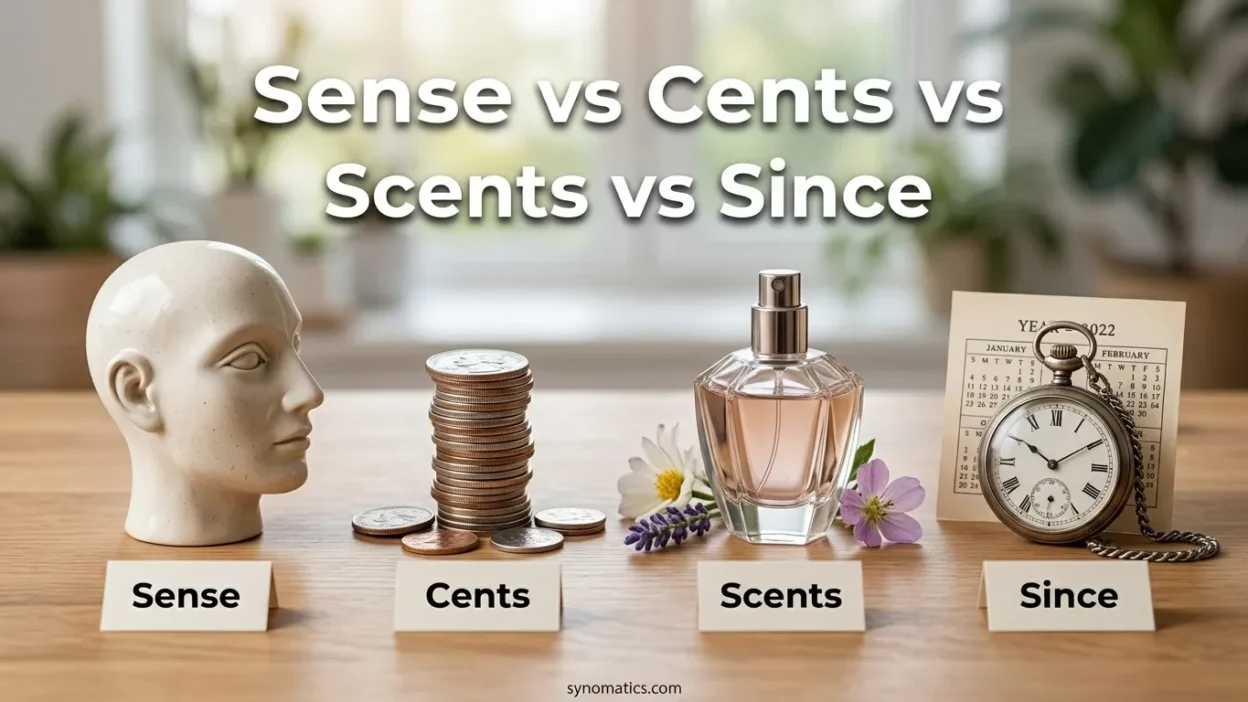
The English words sense, cents, scents, and since can be confusing because they sound similar in many varieties of English, but they have different meanings and uses. If you are learning English, writing an essay, sending a message, or improving your vocabulary, understanding the difference between these four words can help you avoid common spelling and grammar mistakes.
Although these words may sound alike, they belong to different parts of speech and serve different purposes in sentences. Sense refers to understanding, judgment, or a physical ability. Cents refers to units of money. Scents means smells or fragrances. Since is used to describe time or explain a reason. Learning their meanings, recognizing their contexts, and practicing with simple examples will make it easier to choose the correct word whenever you write or speak English.
Quick Answer: Sense vs Cents vs Scents vs Since
Sense means understanding, judgment, or a physical ability. Cents are monetary units, usually one-hundredth of a dollar. Scents are smells or fragrances. Since refers to a point in time or introduces a reason. Although these words sound similar, their meanings, spellings, and grammatical uses are different.
Why Do People Confuse Sense, Cents, Scents, and Since?
People often confuse these four words because of their similar pronunciation, especially when speaking quickly. In many English accents, sense, cents, and scents are homophones, meaning they sound alike but have different meanings and spellings.
The word since has a slightly different vowel sound in many accents, but it can still be confused with the other words by English learners.
Another reason for confusion is that each word appears in everyday conversation. People talk about common sense, prices in cents, pleasant scents, and events that happened since a particular time.
The easiest way to distinguish them is to focus on the meaning of the sentence rather than the sound alone.
1. What Does Sense Mean?
Sense is a noun or verb that refers to understanding, judgment, meaning, or the ability to experience something through the senses.
As a noun, it often describes the ability to understand situations or make reasonable decisions. It can also refer to the five physical senses: sight, hearing, smell, taste, and touch.
As a verb, sense means to notice, feel, or recognize something.
Examples of Sense
- You should use your common sense before making a decision.
- I have a good sense of direction.
- She has a strong sense of responsibility.
- This sentence makes sense.
- I sensed that something was wrong.
Common Expressions With Sense
- Common sense: The ability to make reasonable decisions.
- Sense of humor: The ability to recognize or enjoy what is funny.
- Sense of direction: The ability to understand where you are and where to go.
- Make sense: To be understandable or logical.
- Sense something: To notice or recognize something.
Remember: Use sense when discussing understanding, judgment, meaning, or awareness.
2. What Does Cents Mean?
Cents is the plural form of cent, a unit of money. In the United States and several other countries, one cent equals one-hundredth of a dollar.
For example, 100 cents equal one US dollar. The word also appears in the monetary systems of other countries, such as Canada and Australia.
Examples of Cents
- This candy costs 50 cents.
- I found three cents on the floor.
- The price increased by ten cents.
- She saved every cent she earned.
- The toy costs 99 cents.
Common Expressions With Cents
- A few cents: A small amount of money.
- Save your cents: Save small amounts of money.
- Two cents: An informal expression for someone’s opinion, as in “Let me give you my two cents.”
- Every cent counts: Every small amount of money matters.
Remember: Use cents when talking about money, prices, or monetary amounts.
3. What Does Scents Mean?
Scents is the plural form of scent. It refers to smells or fragrances, which can be pleasant, unpleasant, natural, or artificial.
The word scent can also refer to a smell that helps someone or an animal identify or follow something.
Examples of Scents
- The scents of fresh flowers filled the garden.
- I love the scents of vanilla and cinnamon.
- These candles come in different scents.
- The dog followed the scents along the path.
- The scents of freshly baked bread made everyone hungry.
Common Expressions With Scents
- Pleasant scents: Enjoyable smells.
- Floral scents: Smells associated with flowers.
- Fresh scents: Clean or refreshing smells.
- Natural scents: Smells that come from nature.
- Follow a scent: Track something by its smell.
Remember: Use scents when referring to smells, fragrances, perfumes, or odors.
4. What Does Since Mean?
Since is a conjunction, preposition, or adverb. It is commonly used to describe when something started or to explain why something happens.
Since for Time
Use since with a starting point in time when something began in the past and continues or remains relevant.
Examples:
- I have lived here since 2020.
- She has been busy since Monday.
- We have known each other since childhood.
- It has been raining since this morning.
In these examples, since identifies the starting point of an event or situation.
Since for Reason
Since can also mean because or as when introducing a reason.
Examples:
- Since it was raining, we stayed inside.
- Since you are already here, let’s begin.
- Since everyone agrees, we can move forward.
Remember: Use since when referring to a starting point in time or introducing a reason.
Sense vs Cents vs Scents vs Since: Comparison Table
| Word | Meaning | Part of Speech | Example |
|---|---|---|---|
| Sense | Understanding, judgment, or awareness | Noun or verb | Use your common sense. |
| Cents | Units of money | Noun | The cookie costs 25 cents. |
| Scents | Smells or fragrances | Noun | The flowers have lovely scents. |
| Since | From a past time or because | Conjunction, preposition, or adverb | I have been here since noon. |
The key difference is meaning: sense concerns understanding, cents concerns money, scents concerns smells, and since concerns time or reasons.
When Should You Use Each Word?
Choosing the correct word becomes easier when you identify what your sentence is describing.
Use Sense When Talking About Understanding
Choose sense when discussing logic, judgment, awareness, or physical perception.
- Your explanation makes sense.
- He has a good sense of humor.
- I sensed danger nearby.
Use Cents When Talking About Money
Choose cents when discussing prices, coins, or small monetary amounts.
- The notebook costs 75 cents.
- I need a few more cents.
- The price went up by five cents.
Use Scents When Talking About Smells
Choose scents when discussing fragrances, flowers, perfumes, or other smells.
- The shop sells scented candles in several scents.
- The scents of roses filled the room.
- I prefer fresh, clean scents.
Use Since When Talking About Time or Reasons
Choose since when explaining how long something has continued or why something happens.
- I have studied English since January.
- Since you are tired, you should rest.
- She has worked here since last year.
12 Examples of Sense vs Cents vs Scents vs Since
These examples show how each word works in everyday English.
- Sense: It makes sense to save money for emergencies.
- Cents: This bottle of water costs 80 cents.
- Scents: The scents of fresh flowers spread through the house.
- Since: I have been learning English since last summer.
- Sense: She has a good sense of humor.
- Cents: He found 20 cents in his jacket pocket.
- Scents: The store offers scents such as lavender and lemon.
- Since: Since it is getting late, we should leave.
- Sense: My sense of direction is not very good.
- Cents: The price dropped by 15 cents.
- Scents: I enjoy the natural scents of the forest.
- Since: They have been friends since school.
Examples Using All Four Words
- Sense: It makes sense to compare prices before shopping.
- Cents: The difference is only a few cents.
- Scents: The shop also sells candles with floral scents.
- Since: Since you are already there, check the prices.
These examples demonstrate that the correct spelling depends on the meaning you want to communicate.
Common Mistakes to Avoid
Even experienced English writers can confuse words that sound alike. Here are some mistakes to watch for.
Mistake 1: Using Cents Instead of Sense
Incorrect: You should use your common cents.
Correct: You should use your common sense.
Common sense is a fixed expression referring to good judgment.
Mistake 2: Using Sense Instead of Scents
Incorrect: The scents of the flowers were wonderful, but I could not smell their sense.
Correct: The scents of the flowers were wonderful.
Use scents for smells, not sense.
Mistake 3: Using Scents Instead of Cents
Incorrect: The pen costs 50 scents.
Correct: The pen costs 50 cents.
Prices require cents, not scents.
Mistake 4: Using Since Incorrectly for a Duration
Incorrect: I have lived here since five years.
Correct: I have lived here for five years.
Use since with a starting point, such as since 2021. Use for with a duration, such as for five years.
Mistake 5: Confusing Since With Sense
Incorrect: I have known her sense Monday.
Correct: I have known her since Monday.
Use since to identify when a situation began.
Memory Trick: How to Remember the Difference
Try these simple associations to remember each word.
- Sense = Smarts: Think about understanding, logic, and common sense.
- Cents = Cash: The letter C can remind you of coins and currency.
- Scents = Smells: Remember perfumes, flowers, and fragrances.
- Since = Starting point: Think about when something began or why something happened.
You can also remember this sentence:
“Use your sense to count your cents, enjoy the scents, and remember when it all began since yesterday.”
The sentence connects all four words to their meanings and makes them easier to recall.
American vs British English
The meanings of sense, cents, scents, and since are generally the same in American and British English. The main differences involve the use of monetary terms and, sometimes, pronunciation.
| Word | American English | British English |
|---|---|---|
| Sense | Understanding or judgment | Understanding or judgment |
| Cents | Commonly used for dollars and other currencies | Used for currencies divided into cents, such as the euro; British pounds are divided into pence |
| Scents | Smells or fragrances | Smells or fragrances |
| Since | Used for time and reasons | Used for time and reasons |
In both varieties, sense and scents are commonly pronounced alike, while cents generally shares their pronunciation. The exact vowel sounds can vary by accent, and since is usually pronounced differently.
One important distinction is that British currency uses pence rather than cents for amounts smaller than one pound. For example, a British price might be written as 50p, while an American price might be written as 50¢.
Similar Words You Should Know
Understanding related words can help expand your vocabulary and prevent additional spelling mistakes.
Sense vs Sensible
- Sense: Understanding or judgment.
- Sensible: Showing good judgment.
Example: She used her sense and made a sensible decision.
Cent vs Penny
- Cent: A monetary unit used in currencies such as the US dollar.
- Penny: A coin worth one cent in the United States or one penny in British currency, depending on the context.
Example: I found a penny worth one US cent.
Scent vs Smell
- Scent: A particular smell, often pleasant, though it can also refer to a trace of odor.
- Smell: A general term for an odor or the ability to detect odors.
Example: The scent of roses filled the room.
Since vs For
- Since: Identifies when something began.
- For: Identifies how long something has lasted.
Example: I have worked here since 2022. I have worked here for four years.
Final Verdict: Sense vs Cents vs Scents vs Since
The four words have different meanings, even though three are pronounced identically in many English accents.
- Sense means understanding, judgment, or awareness.
- Cents means monetary units.
- Scents means smells or fragrances.
- Since refers to a starting point in time or introduces a reason.
To choose correctly, consider the context of your sentence. If you are talking about logic, use sense. If you mean money, use cents. If you mean smells, use scents. If you are explaining time or a reason, use since.
FAQs:
1. What is the difference between sense, cents, scents, and since?
Sense means understanding or judgment, cents refers to money, scents means smells or fragrances, and since refers to a starting point in time or a reason.
2. Are sense, cents, and scents homophones?
Yes. In many English accents, sense, cents, and scents are homophones because they have the same pronunciation but different meanings and spellings.
3. Is since a homophone of sense?
Not usually. Since generally has a different vowel sound from sense, cents, and scents. However, pronunciation can vary by accent, and English learners may confuse the words.
4. How do you use sense in a sentence?
Use sense to describe understanding, judgment, or awareness. For example, “It makes sense to check your work before submitting it.”
5. What does cents mean in English?
Cents is the plural of cent, a unit of money. In the United States, 100 cents equal one dollar. For example, “The candy costs 25 cents.”
6. What is the difference between scent and scents?
Scent is singular and refers to one smell or fragrance. Scents is plural and refers to more than one smell or fragrance. For example, “This candle has a pleasant scent” and “The shop sells several scents.”
7. When should I use since instead of for?
Use since with the time when something started, such as “since Monday.” Use for with the length of time, such as “for three days.” For example, “I have been here since Monday” and “I have been here for three days.”
8. What is an easy way to remember these four words?
Associate sense with understanding, cents with cash, scents with smells, and since with time or reasons. Checking the meaning of your sentence will usually help you select the correct word.
Remember This
- Sense = Understanding or judgment.
- Cents = Money.
- Scents = Smells or fragrances.
- Since = Time or reason.
The spelling you choose should match the meaning you want to express. When in doubt, read the entire sentence and ask yourself whether you are talking about understanding, money, smells, or time.
Conclusion
Understanding the difference between sense, cents, scents, and since is a simple but valuable step toward better English writing. Although these words can sound similar, each has a distinct meaning. Remember that sense relates to understanding, cents refers to money, scents describes smells, and since connects ideas involving time or reasons.
With regular practice, you can recognize the correct word more quickly and avoid common spelling errors in everyday conversations, school assignments, and professional writing. Use the examples and memory tricks in this guide whenever you need a quick reminder, and focus on the meaning of your sentence to make the right choice.