
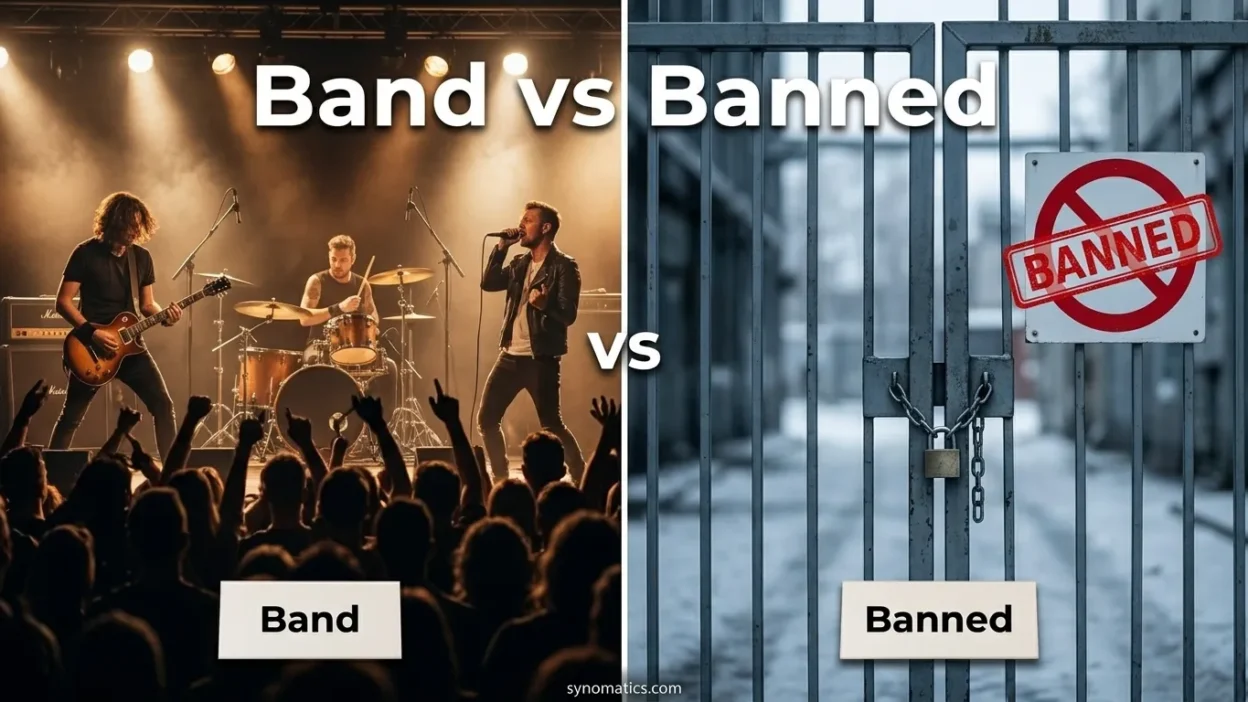
Have you ever wondered if to write band or banned? These two words sound exactly the same, but they have completely different meanings. Understanding the difference between band vs banned can help you avoid spelling mistakes and make your writing clearer. Both words are common in everyday English, so learning when to use each one is useful for students, professionals, and English learners.
The main difference is that band usually refers to a group of musicians, a group of people, or a strip of material. Banned is the past tense and past participle of the verb ban, meaning to officially prohibit or forbid something. For example, a music band performs songs, while a person who is banned from a website is no longer allowed to use it. Although these words have the same pronunciation, their spelling and meanings are different. In this guide, you will learn their definitions, grammatical uses, practical examples, common mistakes, and simple ways to remember which word to choose.
Quick Answer
Band is a noun that usually means a group of musicians, a group of people, or a strip of material. Banned is the past tense and past participle of ban, meaning prohibited or not allowed. Both words sound the same, but their meanings differ. Example: “The band performed last night” and “Smoking was banned.”
Why Do People Confuse Band and Banned?
People often confuse band and banned because they are homophones. Homophones are words that sound alike but have different meanings and spellings.
Both words are pronounced /bænd/, rhyming with hand, sand, and land. When speaking, you cannot hear a difference between them. You must understand the context to determine which word is correct.
Their spelling also gives you a useful clue:
- Band contains the letter combination and and is often associated with music or groups.
- Banned contains ann followed by ed and describes something that has been prohibited.
For example:
- Correct: The band played three songs.
- Correct: The song was banned from the radio station.
The first sentence refers to a musical group. The second describes an action that prevented something from being allowed.
What Does Band Mean?
Band is a noun with several meanings. Its exact meaning depends on the situation in which it is used.
1. Band as a Musical Group
The most familiar meaning of band is a group of musicians who perform together.
Examples:
- My favorite band released a new album.
- The school band played at the ceremony.
- We watched a rock band perform live.
2. Band as a Strip or Ring
A band can also mean a strip of material that surrounds, holds, or connects something.
Examples:
- She wore a gold band on her finger.
- He tied the package with a rubber band.
- The watch has a black band.
3. Band as a Group of People
The word can describe a group of people who share an activity or purpose.
Examples:
- A band of explorers traveled through the forest.
- A band of volunteers helped clean the park.
- The story follows a band of young adventurers.
4. Band as a Range or Category
In certain contexts, band refers to a range, level, or category.
Examples:
- The employee received a salary increase after moving to a higher pay band.
- The radio operates on a different frequency band.
- The school grouped students into different ability bands.
Grammar tip: The plural of band is bands.
Example: Several local bands performed at the festival.
What Does Banned Mean?
Banned is the past tense and past participle of the verb ban. It means that something was officially prohibited or that someone was not allowed to do something.
The verb ban is commonly used when authorities, organizations, schools, websites, or other groups establish a rule against an activity or item.
1. Banned as a Past-Tense Verb
Use banned when describing a prohibition that happened in the past.
Examples:
- The school banned mobile phones during examinations.
- The city banned fireworks in certain areas.
- The website banned the account last week.
2. Banned as an Adjective
Banned can also describe something that is prohibited or not permitted.
Examples:
- The book is banned in some schools.
- Banned substances are not allowed in the competition.
- The player used a banned piece of equipment.
3. Banned in Online Communities
The word is common in discussions about social media, online games, and websites.
Examples:
- My account was banned for breaking the rules.
- The player was banned from the online game.
- The website banned users who repeatedly violated its policies.
Grammar tip: The base verb is ban, the past tense is banned, and the present participle is banning.
Examples: “They ban dangerous activities,” “They banned the activity,” and “They are banning the activity.”
Band vs Banned: Comparison Table
| Feature | Band | Banned |
|---|---|---|
| Part of speech | Usually a noun | Past-tense verb, past participle, or adjective |
| Main meaning | A group, strip, or range | Prohibited or forbidden |
| Pronunciation | /bænd/ | /bænd/ |
| Spelling | One “n” | Two “n” letters |
| Verb form | Not normally a verb in these examples | Past form of ban |
| Common context | Music, jewelry, groups, radio | Rules, restrictions, accounts, activities |
| Example | The band played well. | The song was banned. |
When Should You Use Band or Banned?
Choose band when you are talking about a musical group, a strip of material, a ring, or a group of people.
Choose banned when you mean that someone prohibited an activity, item, person, or action.
Compare these sentences:
- The band performed at the concert.
A group of musicians performed. - The concert was banned by the authorities.
The event was prohibited. - She bought a fitness band.
The word refers to a piece of equipment. - The fitness band was banned from the competition.
The equipment was not permitted.
A simple test is to replace the word with a related expression. If group or strip makes sense, you probably need band. If prohibited or forbidden makes sense, you probably need banned.
12 Examples of Band vs Banned in Sentences
These examples show how the two words work in everyday English.
- Band: The band performed my favorite song at the concert.
- Banned: The school banned students from using phones during the exam.
- Band: He plays the guitar in a local band.
- Banned: The player was banned from the tournament.
- Band: She wore a silver band around her wrist.
- Banned: The government banned the sale of the product.
- Band: A band of hikers reached the mountain summit.
- Banned: The website banned the account after repeated violations.
- Band: My watch has a comfortable leather band.
- Banned: Certain chemicals are banned in this competition.
- Band: Several bands performed at the music festival.
- Banned: The school has banned smoking on its grounds.
Band vs Banned in Questions
You may also see these words in questions:
- Band: Which band is playing tonight?
- Banned: Why was the movie banned?
- Band: Does your watch have a metal band?
- Banned: Is this substance banned in professional sports?
The meaning becomes clear when you look at the rest of the sentence.
Common Mistakes to Avoid
Even though band and banned sound alike, they are not interchangeable.
Mistake 1: Using Band Instead of Banned
Incorrect: The school band smoking on campus.
Correct: The school banned smoking on campus.
The correct word is banned because the sentence describes a prohibition.
Mistake 2: Using Banned Instead of Band
Incorrect: My favorite banned released a new album.
Correct: My favorite band released a new album.
The correct word is band because the sentence refers to a musical group.
Mistake 3: Writing Banned With One N
Incorrect: The website baned the account.
Correct: The website banned the account.
When forming the past tense of ban, double the final n before adding -ed.
Mistake 4: Confusing Banned With Ban
Incorrect: The city ban fireworks last year.
Correct: The city banned fireworks last year.
Use banned when describing a completed action in the past.
Mistake 5: Forgetting the Word’s Context
Incorrect: The band from the competition.
This phrase may be correct if it refers to a musical group, but if you mean that the group was prohibited from competing, write:
Correct: The band was banned from the competition.
Always check the intended meaning before choosing the spelling.
Memory Trick: How to Remember Band vs Banned
Use these simple tricks to remember the difference.
- Band = Bandmates: Both words begin with band, and a music band has bandmates.
- Banned = Not allowed: Think of banned as another way to say forbidden.
- Double N = Prohibition: The extra n in banned can remind you of the action of banning something.
Remember these two sentences:
- The band played at the party.
- The band was banned from playing at the party.
The first sentence identifies a musical group. The second explains that the group was not permitted to perform.
Band vs Banned in American and British English
The distinction between band and banned is the same in American and British English.
Both varieties pronounce the words alike and use them with the same basic meanings.
| Word | American English | British English |
|---|---|---|
| Band | A musical group or strip | A musical group or strip |
| Banned | Prohibited or forbidden | Prohibited or forbidden |
The spelling rules are also the same. Both American and British English double the final n in ban before adding -ed.
Examples:
- American English: The school banned the activity.
- British English: The school banned the activity.
There is no regional spelling difference between these two words.
Similar Words to Band and Banned
Learning related words can help you understand the difference more clearly.
Words Related to Band
- Group: A collection of people or things.
- Ensemble: A group of musicians or performers.
- Ring: A circular object or band.
- Strip: A long, narrow piece of material.
- Bracelet: Jewelry worn around the wrist.
Example: The musical ensemble performed beautifully.
Words Related to Banned
- Prohibited: Officially not allowed.
- Forbidden: Not permitted.
- Barred: Prevented from entering or participating.
- Restricted: Limited by rules or conditions.
- Disallowed: Not accepted or permitted.
Example: Photography is prohibited inside the building.
These words are related in meaning, but they are not always interchangeable. For instance, restricted often means limited rather than completely forbidden.
FAQs:
1. Is it band or banned?
Both spellings are correct, but they have different meanings. Band refers to a group or strip, while banned means prohibited. The correct choice depends on the context.
2. What is the difference between band and banned?
Band is usually a noun referring to a musical group, a strip of material, or a collection of people. Banned is the past tense or past participle of ban, meaning to prohibit something.
3. Are band and banned pronounced the same?
Yes. Band and banned are homophones in standard American and British English. Both are pronounced /bænd/, like the word hand.
4. Why does banned have two n’s?
The word banned has two n’s because the verb ban doubles its final consonant before the suffix -ed. This follows the spelling rule used for many short verbs ending in a consonant preceded by a vowel.
Other examples include planned from plan and stopped from stop.
5. What is the plural of band?
The plural of band is bands. For example, “Three bands performed at the festival.” The word banned does not have a plural form because it is a verb form or adjective, not a plural noun.
6. Can banned be used as an adjective?
Yes. Banned can describe something that is prohibited or not permitted. For example, “The banned book was removed from the library’s approved reading list.”
7. What is the past tense of ban?
The past tense of ban is banned. For example, “The organization banned the practice last year.” The past participle is also banned, as in “The practice has been banned.”
Remember This
- Band = a musical group, a strip, or a collection of people.
- Banned = prohibited or not allowed.
- Both words sound the same but have different meanings.
- Band has one n, while banned has two.
- Use the context of the sentence to choose the correct word.
Conclusion
Understanding the difference between band vs banned will help you write more accurately and avoid common spelling mistakes. Although both words sound identical, their meanings are very different. A band can be a musical group, a ring, or a strip of material, while banned describes something that has been prohibited.
The easiest way to remember the distinction is to connect band with a group and banned with something forbidden. With regular practice and attention to context, you can use both words confidently in conversations, school assignments, emails, and everyday writing.