Using different smart synonyms provides better alternatives and avoids repeated use of the same words in writing. These terms can be grouped by strength, context, and purpose. Some describe knowledge, while others focus on creativity, awareness, and the ability to make good choices through strong decision making. Different types of intelligence show different skills, including being clever, bright, sharp, and wise.
A capable or skilled person often has strong mental ability and developed cognitive skills. These include reasoning, logical thinking, and proper usage of knowledge. Understanding the right words creates a better tone and improves communication. When learning new vocabulary, focusing on the smart meaning instead of only memorizing definitions helps improve understanding and language skills. These forms of intelligence show that being smart is not only about knowing facts but also about applying knowledge in practical ways.
What Does “Smart” Mean?
The word smart means having the ability to learn, think, understand, or make good decisions. It can describe intelligence, skills, appearance, or practical choices.
Examples:
- She is a smart student who learns quickly.
- He made a smart decision.
- This is a smart solution to the problem.
The meaning of smart can change depending on the context. A smart person may be intelligent, clever, creative, or wise.
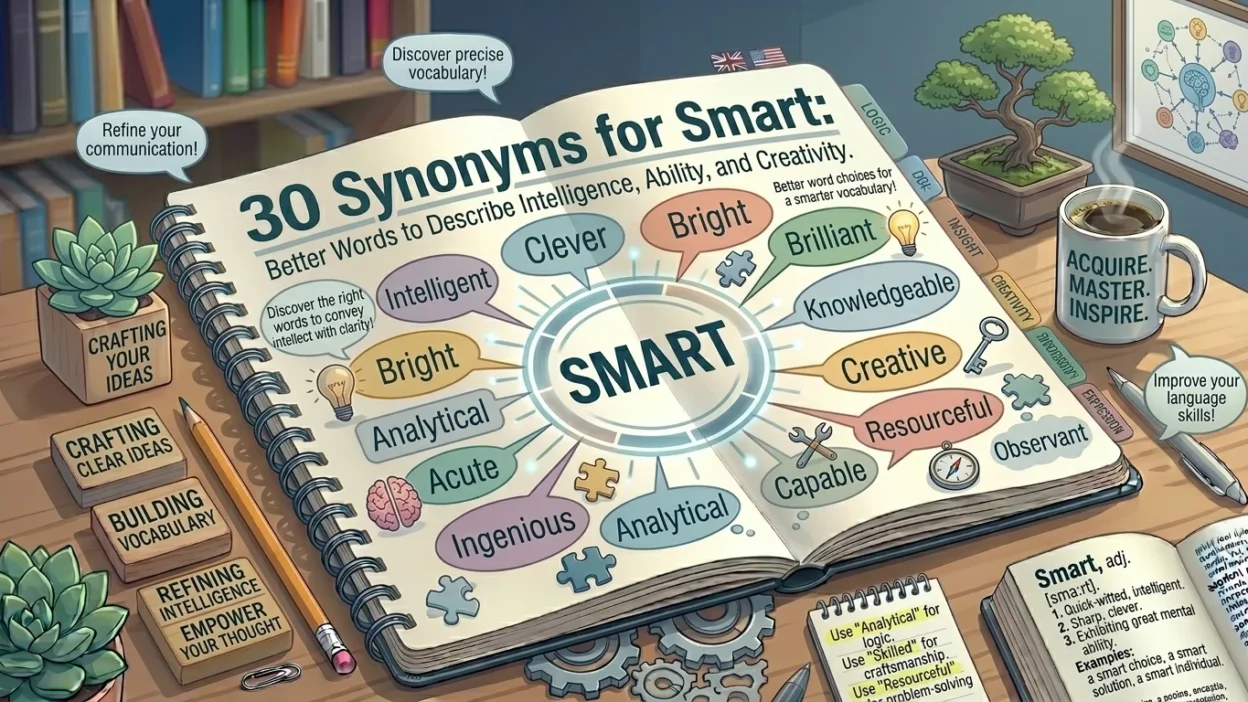
30 Synonyms for Smart
1. Intelligent
Meaning: Having a strong ability to learn and understand.
Example Sentence: She is an intelligent student with excellent ideas.
Best Usage Context: Academic and professional writing.
2. Clever
Meaning: Able to solve problems quickly and creatively.
Example Sentence: He found a clever way to fix the issue.
Best Usage Context: Problem-solving situations.
3. Bright
Meaning: Quick to learn and understand things.
Example Sentence: The bright student answered every question.
Best Usage Context: Education and learning.
4. Wise
Meaning: Having good judgment based on knowledge and experience.
Example Sentence: Her wise advice helped me choose correctly.
Best Usage Context: Life experience and decisions.
5. Sharp
Meaning: Quick in thinking and understanding.
Example Sentence: He has a sharp mind and notices small details.
Best Usage Context: Thinking ability.
6. Brilliant
Meaning: Extremely intelligent or talented.
Example Sentence: She had a brilliant idea for the project.
Best Usage Context: Exceptional ability.
7. Knowledgeable
Meaning: Having a lot of information about a subject.
Example Sentence: The teacher is knowledgeable about science.
Best Usage Context: Expertise and education.
8. Capable
Meaning: Having the ability to do something successfully.
Example Sentence: She is a capable leader.
Best Usage Context: Skills and performance.
9. Skilled
Meaning: Having strong ability in a particular area.
Example Sentence: He is a skilled writer.
Best Usage Context: Professions and talents.
10. Talented
Meaning: Naturally good at something.
Example Sentence: The talented artist created beautiful work.
Best Usage Context: Creativity and abilities.
11. Gifted
Meaning: Having special natural ability.
Example Sentence: The gifted child showed excellent creativity.
Best Usage Context: Exceptional skills.
12. Genius
Meaning: A person with extremely high intelligence.
Example Sentence: The scientist was considered a genius.
Best Usage Context: Very high intelligence.
13. Brilliant-minded
Meaning: Having an excellent ability to think.
Example Sentence: She is a brilliant-minded researcher.
Best Usage Context: Formal descriptions.
14. Insightful
Meaning: Showing deep understanding.
Example Sentence: He gave an insightful answer.
Best Usage Context: Ideas and opinions.
15. Creative
Meaning: Able to produce new and original ideas.
Example Sentence: She is a creative problem solver.
Best Usage Context: Art and innovation.
16. Logical
Meaning: Able to think clearly using reason.
Example Sentence: His logical approach solved the problem.
Best Usage Context: Analysis and decisions.
17. Analytical
Meaning: Able to examine information carefully.
Example Sentence: She has strong analytical skills.
Best Usage Context: Research and business.
18. Quick-witted
Meaning: Able to think and respond quickly.
Example Sentence: He is quick-witted during conversations.
Best Usage Context: Communication and humor.
19. Educated
Meaning: Having knowledge gained through learning.
Example Sentence: She is an educated professional.
Best Usage Context: Formal writing.
20. Competent
Meaning: Having enough skill or ability.
Example Sentence: He is a competent manager.
Best Usage Context: Work and skills.
21. Astute
Meaning: Very good at understanding situations.
Example Sentence: The astute businessman noticed the opportunity.
Best Usage Context: Business and decisions.
22. Perceptive
Meaning: Able to notice and understand things quickly.
Example Sentence: She made a perceptive observation.
Best Usage Context: People and analysis.
23. Resourceful
Meaning: Able to find solutions using available resources.
Example Sentence: He is resourceful in difficult situations.
Best Usage Context: Problem-solving.
24. Strategic
Meaning: Good at planning and making smart choices.
Example Sentence: They created a strategic plan.
Best Usage Context: Business and planning.
25. Practical
Meaning: Able to make sensible decisions.
Example Sentence: She has a practical approach to problems.
Best Usage Context: Real-life situations.
26. Experienced
Meaning: Having knowledge from practice.
Example Sentence: The experienced teacher explained the topic well.
Best Usage Context: Skills and careers.
27. Brainy
Meaning: Very intelligent.
Example Sentence: He is known as a brainy student.
Best Usage Context: Informal conversations.
28. Thoughtful
Meaning: Showing careful thinking.
Example Sentence: She gave a thoughtful response.
Best Usage Context: Ideas and opinions.
29. Competent
Meaning: Able to perform tasks effectively.
Example Sentence: He is competent in his role.
Best Usage Context: Professional settings.
30. Clever-minded
Meaning: Having a quick and intelligent way of thinking.
Example Sentence: The clever-minded inventor created a new device.
Best Usage Context: Creative descriptions.
Comparison Table: When to Use Different Synonyms for Smart
| Synonym | Tone | Best Used For |
| Intelligent | Formal | Academic writing |
| Clever | Neutral | Problem solving |
| Bright | Friendly | Students |
| Wise | Experienced | Advice |
| Sharp | Casual | Quick thinking |
| Brilliant | Strong | Exceptional ideas |
| Analytical | Professional | Research |
| Creative | Positive | Innovation |
| Resourceful | Practical | Solutions |
| Strategic | Business | Planning |
How to Choose the Right Synonym for Smart
For Learning Ability
Use:
- Intelligent
- Bright
- Brainy
- Knowledgeable
These describe someone who learns and understands quickly.
For Problem Solving
Use:
- Clever
- Resourceful
- Logical
- Analytical
These describe thinking skills.
For Experience and Judgment
Use:
- Wise
- Insightful
- Thoughtful
- Practical
These show good decisions and understanding.
For Professional Skills
Use:
- Capable
- Skilled
- Competent
- Strategic
These work well in professional writing.
Common Mistakes When Using Synonyms for Smart
Using “Genius” Too Often
“Genius” describes extremely high intelligence, so it should not be used for normal smart behavior.
Confusing Knowledge With Creativity
A person can be smart because they know many things, or because they create new ideas. Choose the word that matches the meaning.
Ignoring Context
A smart student, smart decision, and smart business strategy may need different synonyms.
Why Learn Synonyms for Smart?
Learning alternatives helps you:
- Improve vocabulary
- Avoid repetition
- Make writing more engaging
- Describe intelligence accurately
- Communicate ideas clearly
A wider vocabulary allows you to express different forms of intelligence instead of using one general word.
Conclusion
Learning synonyms for smart helps you describe intelligence, creativity, knowledge, and decision-making skills more effectively. Words like intelligent, clever, bright, wise, sharp, capable, and analytical allow you to choose the right expression for every situation.
For students, ESL learners, writers, and content creators, understanding these differences can improve communication and make writing more precise.