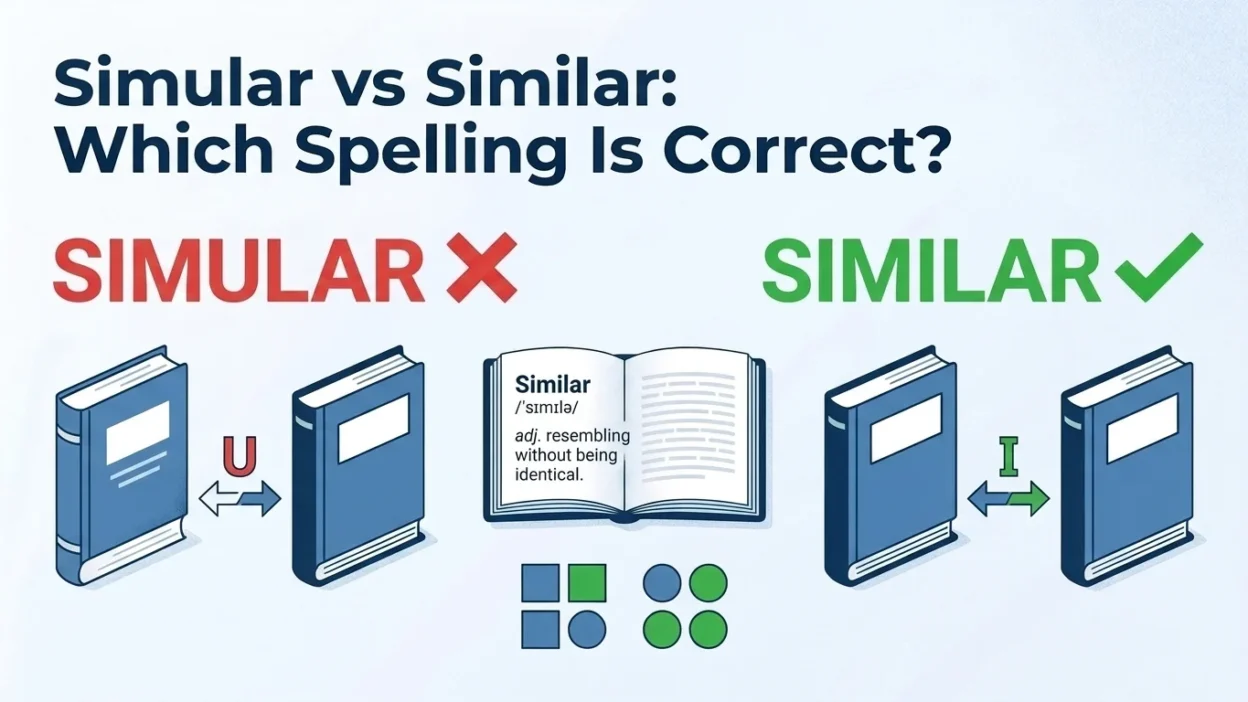
Are you unsure whether to write simular or similar? The correct spelling in standard English is similar, with an “i” in the middle. Simular is a common spelling mistake when people intend to use the word similar. Similar means almost the same as something else, although small differences may exist.
Understanding the difference between simular and similar can help you improve your spelling and communicate more clearly in school assignments, emails, articles, and everyday conversations. For example, you might say that two books have similar stories or that two people have similar interests. However, writing “simular interests” is incorrect in standard English. Since the two spellings look and sound alike, it is easy to make this mistake when typing quickly. In this guide, you will learn the correct spelling, meaning, common uses, example sentences, and helpful memory tricks so you can use similar confidently.
Quick Answer: Simular or Similar?
Similar is the correct spelling in standard English. It means alike or nearly the same, but not necessarily identical. Simular is a misspelling when used with this intended meaning. For example, “The two students have similar interests.” Remember to write similar, with an “i” after the “m.”
Why Do People Confuse Simular and Similar?
People often confuse these words because they look almost identical and sound similar when spoken quickly. The main difference is one vowel: similar contains an “i” in the middle, while the incorrect form simular uses a “u.”
This mistake can happen when someone relies on pronunciation instead of remembering the correct spelling. English vowels do not always sound exactly as learners expect, which can make unfamiliar words difficult to spell.
Common reasons for the confusion include:
- Similar appearance: Both forms have nearly the same letters.
- Pronunciation: The middle vowel may be unclear when spoken quickly.
- Typing errors: Writers may accidentally choose “u” instead of “i.”
- Unfamiliar vocabulary: English learners may not have memorized the correct spelling.
Therefore, remember that similar is the correct word whenever you want to describe things that are alike or share certain qualities.
First Word: Simular
Simular is not the standard English spelling of the word meaning alike or nearly the same. In ordinary English writing, it is considered a misspelling of similar.
Meaning of Simular
When people write simular, they usually intend to say similar. However, you should correct the spelling rather than use it in formal or everyday English.
For example:
- Incorrect: The two designs are simular.
- Correct: The two designs are similar.
- Incorrect: We have simular opinions.
- Correct: We have similar opinions.
- Incorrect: These words have simular meanings.
- Correct: These words have similar meanings.
The intended message is understandable, but the standard spelling is similar.
Should You Ever Use Simular?
If you are writing in standard English and mean “alike” or “nearly the same,” do not use simular. Choose similar instead.
You might encounter simular in online posts, informal messages, or text containing spelling errors. However, its appearance does not make it an accepted substitute for similar.
Second Word: Similar
Similar is the correct English adjective used to describe people, objects, ideas, or situations that share qualities or characteristics.
Meaning of Similar
The word similar means alike, resembling one another, or having some features in common. It does not mean that two things are exactly the same.
For example:
- The sisters have similar personalities.
- These two phones have similar features.
- Our opinions are similar, but not identical.
- The students submitted similar answers.
In each sentence, the things share one or more characteristics, but they may still have differences.
How Is Similar Used in Everyday English?
The word similar is useful in many situations:
- People: They have similar interests.
- Objects: The two bags have similar designs.
- Ideas: The students suggested similar solutions.
- Experiences: We had similar experiences at school.
- Writing: These paragraphs contain similar information.
- Products: The two laptops offer similar features.
For example, “These two dresses are similar” means they look alike in some ways, but they are not necessarily identical.
How to Use Similar Correctly
Similar is often followed by the preposition to when comparing one thing with another.
Examples:
- Her writing style is similar to mine.
- This design is similar to the original.
- Their approach is similar to ours.
You can also use similar before a noun, as in “similar ideas,” “similar results,” or “similar problems.”
Simular vs Similar: Comparison Table
| Feature | Simular | Similar |
|---|---|---|
| Correct standard spelling? | No | Yes |
| Meaning | Usually intended to mean alike | Alike or sharing characteristics |
| Part of speech | Misspelling in this context | Adjective |
| Middle vowel | Incorrectly uses “u” | Correctly uses “i” |
| Formal writing | Avoid | Appropriate |
| Example | Simular designs (incorrect) | Similar designs (correct) |
| Best choice | Do not use for this meaning | Use this spelling |
The main difference is spelling. If you want to describe two things that share qualities, similar is the correct word.
When to Use Simular vs Similar
Because simular is a misspelling in standard English for this meaning, the choice is straightforward: use similar.
Use Similar When Comparing People
Use similar to describe people who share interests, habits, personalities, or experiences.
Examples:
- The two friends have similar hobbies.
- My brother and I have similar tastes in music.
- The students have similar learning styles.
These sentences show that the people share certain qualities without necessarily being identical.
Use Similar When Comparing Objects
You can use similar to describe products, clothes, designs, or other physical things.
Examples:
- The two phones have similar features.
- I bought a similar jacket last winter.
- These paintings have similar colors.
The word helps explain that objects resemble one another in some way.
Use Similar When Comparing Ideas or Situations
Similar is also common when discussing thoughts, results, experiences, and problems.
Examples:
- The researchers reached similar conclusions.
- We faced similar challenges at work.
- Both stories have similar themes.
These examples are useful in academic writing, professional communication, and everyday conversation.
Avoid Simular in Standard English
Whenever you mean “alike” or “nearly the same,” write similar.
Incorrect: The two answers are simular.
Correct: The two answers are similar.
Simular vs Similar: 12 Example Sentences
The following examples show how to use similar correctly in different contexts.
- The two students have similar interests.
- My new phone has features similar to those of my old phone.
- Their opinions are similar, but they are not exactly the same.
- We had similar experiences during our first year at college.
- The two houses have similar designs.
- Her writing style is similar to her teacher’s style.
- The researchers found similar results in both studies.
- These words have similar meanings.
- The brothers have similar personalities.
- Our plans are similar, although the details are different.
- The two restaurants offer similar menus.
- The teacher noticed similar mistakes in several assignments.
Here are a few common spelling corrections:
- Incorrect: These two bags look simular.
- Correct: These two bags look similar.
- Incorrect: Their ideas are simular.
- Correct: Their ideas are similar.
- Incorrect: This problem is simular to the previous one.
- Correct: This problem is similar to the previous one.
These examples reinforce the correct spelling and show how naturally similar fits into everyday English.
Common Mistakes With Simular and Similar
Even a familiar word can be misspelled when you type quickly. Avoid these common mistakes to improve your writing.
Mistake 1: Replacing I With U
Incorrect: The two pictures look simular.
Correct: The two pictures look similar.
The standard spelling contains an “i” after the “m.”
Mistake 2: Thinking Similar Means Identical
Similar means alike in some ways, not exactly the same.
For example, two phones may have similar screens and cameras but different prices and battery lives.
Use identical when two things are exactly alike in the relevant respects.
Mistake 3: Using the Wrong Preposition
In many comparisons, similar is followed by to, not “with.”
- Preferred: This design is similar to the original.
- Less natural in this construction: This design is similar with the original.
Learning the phrase “similar to” can help you write more naturally.
Mistake 4: Confusing Similar With Same
These words are related but have different meanings.
- Similar: Alike in some ways.
- Same: Identical or not different in the relevant context.
For example, two students can have similar answers without giving the same answer.
Memory Trick: How to Remember Similar
A simple memory trick can help you spell similar correctly every time.
Remember: Similar starts with “sim,” just like “similarity.” Both words use an “i,” not a “u,” in the middle.
You can also repeat this short reminder:
“Similar things share similarities.”
Notice that similar and similarities contain the same spelling pattern. Connecting related words can make the correct spelling easier to remember.
Before submitting an essay, email, or assignment, check that you have written similar, not simular.
American vs British English: Simular or Similar?
There is no American-versus-British spelling difference for this word. Both American and British English use similar as the correct spelling.
| English variety | Correct spelling | Example |
|---|---|---|
| American English | Similar | The two products are similar. |
| British English | Similar | The two products are similar. |
| Australian English | Similar | Their experiences were similar. |
| Standard international English | Similar | These words have similar meanings. |
Therefore, you do not need to change the spelling based on your audience’s location. Use similar in school assignments, professional documents, and everyday English.
Similar Words Related to Similar
Several English words describe things that are alike or share characteristics. However, each word has a slightly different meaning.
1. Alike
Meaning: Similar to each other or having the same characteristics.
Example: The twins look alike.
Use alike when comparing two or more people or things.
2. Resembling
Meaning: Looking like or sharing characteristics with something else.
Example: The new building resembles the old library.
Use resembling when emphasizing appearance or shared features.
3. Comparable
Meaning: Similar enough to be compared fairly or meaningfully.
Example: The two products offer comparable performance.
Use comparable when the things can reasonably be evaluated against each other.
4. Nearly Identical
Meaning: Almost exactly the same, with only minor differences.
Example: The two documents are nearly identical.
Use this phrase when the similarities are very strong.
5. Equivalent
Meaning: Equal in value, function, meaning, or effect, even if not identical in form.
Example: These two expressions have equivalent meanings in this context.
Use equivalent when two things serve the same purpose or have the same value.
6. Related
Meaning: Connected in some way.
Example: The two topics are related, but they are not the same.
Use related when things have a connection without necessarily being alike.
7. Corresponding
Meaning: Matching or having a relationship with something else.
Example: Please compare the figures with their corresponding entries.
Use corresponding when matching one item to another within a set.
Final Verdict: Simular or Similar?
Similar is the correct standard English spelling. It means alike or sharing certain characteristics, although the things being compared may still have differences. Simular is a common misspelling and should be avoided in school assignments, professional documents, and everyday English writing.
To remember the correct form, focus on the “i” in similar and connect it with similarity. Whether you are comparing people, products, ideas, or experiences, choose similar to communicate clearly and accurately.
Frequently Asked Questions
1. Is simular or similar correct?
Similar is the correct spelling in standard English. Simular is a misspelling when used to mean alike or nearly the same. Use similar in essays, emails, and everyday communication.
2. What does similar mean?
Similar means alike or sharing some characteristics. Two things can be similar without being exactly the same. For example, two cars may have similar designs but different engines.
3. Why is simular incorrect?
In standard English, the word is spelled similar, with an “i” after the “m.” The spelling simular uses the wrong vowel for this word and is considered a spelling mistake.
4. How do you spell similar correctly?
The correct spelling is S-I-M-I-L-A-R. Remember the “i” after the “m” to avoid writing simular.
5. Is similar the same as identical?
No. Similar means alike in certain ways, while identical means exactly the same in the relevant respects. Two similar products may still have different features, sizes, or prices.
6. What is a synonym for similar?
Common synonyms include alike, comparable, resembling, and equivalent. However, each has a slightly different meaning, so choose the word that best fits your sentence.
7. Should I say similar to or similar with?
In standard English, similar to is the usual construction when comparing things. For example, “Her answer is similar to mine.” This is the natural choice in most everyday and formal contexts.
Remember This
- Similar is the correct English spelling.
- Simular is a misspelling when you mean alike.
- Similar means sharing characteristics, not necessarily being identical.
- Remember the “i” after the “m.”
- Use similar to when comparing things.
- American and British English use the same spelling.
Conclusion
The difference between simular vs similar is simple: similar is the correct English word, while simular is a spelling mistake when used to mean alike or nearly the same. The word similar is useful when comparing people, objects, ideas, experiences, and situations that share certain characteristics.
To avoid this mistake, remember the “i” in similar and practice using it in everyday sentences. Whether you are writing an assignment, sending an email, or describing two related ideas, choosing the correct spelling will make your English clearer and more accurate.