
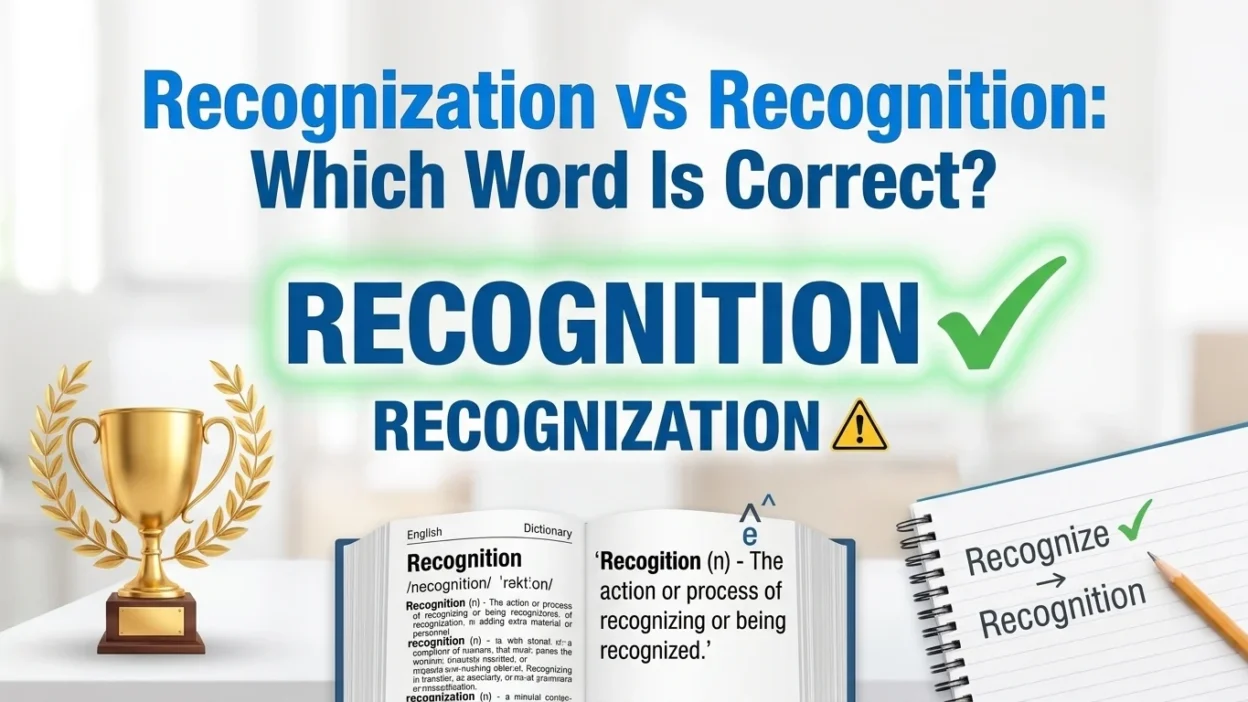
If you are wondering whether recognization or recognition is correct, recognition is the standard and much more common English word. It means identifying someone or something, accepting something as true or important, or giving someone credit for an achievement. For example, “She received recognition for her hard work.”
The confusion comes from the verb recognize, which naturally makes recognization seem like a possible noun form. However, English commonly uses recognition instead. The word is widely used in everyday, academic, business, and formal English. While recognization can be found occasionally, it is uncommon and is generally not the preferred choice in standard modern writing. For students, ESL learners, and professional writers, recognition is the safest and most natural form to use.
Quick Answer
Recognition is the standard and preferred English word. Recognization is a rare and uncommon form that is generally avoided in normal modern writing. Use recognition when you mean identifying someone or something, accepting something, or giving credit for an achievement. For example, “The employee received recognition for her work.”
Why Do People Confuse It?
People often confuse recognization and recognition because the verb recognize appears to suggest that its noun form should be recognization.
For example:
- recognize → ?
- recognize + -ation → recognization
This pattern seems logical, but English does not always form nouns by simply adding -ation to a verb.
The established noun is:
recognize → recognition
For example:
The scientist gained international recognition.
Therefore, although recognization may occasionally appear, recognition is the normal word expected in standard English.
First Word: Recognization
Recognization is an uncommon noun related to the idea of recognizing something.
It can occasionally be found in written sources, but it is not the normal choice for contemporary English. Most readers will expect recognition instead.
For example, instead of writing:
The award gave her public recognization.
write:
The award gave her public recognition.
Because recognization is uncommon, using it can make a sentence sound unnatural or awkward.
For students, formal writing, business communication, and general English, recognition is the better choice.
Second Word: Recognition
Recognition is the standard and widely accepted noun.
It can have several related meanings.
1. Identifying someone or something
Facial recognition technology identified the person.
2. Accepting something as true or important
The policy led to the recognition of workers’ rights.
3. Giving credit or praise
She received recognition for her achievements.
4. Realizing who or what someone is
I knew him immediately, but he did not show any recognition.
The exact meaning depends on the context, but recognition is the natural noun form in all of these uses.
Recognization vs Recognition: Comparison Table
| Word | Usage | Meaning | Example |
|---|---|---|---|
| recognition | ✅ Standard and preferred | Identifying, accepting, noticing, or giving credit | She received recognition for her work. |
| recognization | ⚠️ Rare and uncommon | Related to the act of recognizing | Recognition is the preferred form. |
For normal modern English, choose recognition.
When to Use Each
When to Use “Recognition”
Use recognition when talking about:
- identifying a person or object
- acknowledging something
- accepting something as valid or important
- giving praise or credit
- awards and achievements
- technology that identifies people or objects
Examples:
He received recognition for his contribution.
The software uses facial recognition.
The organization gained international recognition.
When to Use “Recognization”
Recognization is uncommon and is generally not the word you should choose in ordinary modern English.
If you are writing an essay, report, article, email, application, or professional document, use recognition instead.
This makes your writing more natural and easier for readers to understand.
10+ Examples of Recognition
- She received recognition for her excellent work.
- The actor gained international recognition.
- Facial recognition technology is widely used.
- The award was given in recognition of his achievements.
- The company received public recognition for its service.
- Early recognition of the problem helped prevent further damage.
- The teacher praised the student in recognition of her effort.
- The discovery brought the scientist widespread recognition.
- His face was familiar, but I could not place it at first because I had no immediate recognition.
- The organization received official recognition from the government.
- The program improves speech recognition.
- The award is presented in recognition of outstanding performance.
These examples show that recognition works naturally in everyday, academic, professional, and technical contexts.
Common Mistakes
The most common mistake is forming the noun directly from recognize as recognization.
Less natural:
She received recognization for her achievements.
Natural and standard:
She received recognition for her achievements.
Another mistake is thinking that every verb ending in -ize must form a noun ending in -ization.
English has many different noun-forming patterns, so it is important to learn common forms individually.
For example:
- recognize → recognition
- organize → organization
- modernize → modernization
- realize → realization
This is why recognization may look reasonable even though recognition is the established form most speakers and writers use.
Memory Trick
Use this simple memory trick:
Recognize → Recognition
The ending changes from -ize to -ition.
Think:
RECOGNIZE → RECOGNITION
You can also remember:
Recognition is the word you recognize.
So write:
RECOGNITION ✅
rather than:
RECOGNIZATION ⚠️
When you are unsure, choose recognition.
American vs British English
Recognition is the standard spelling in both American and British English.
There is no major difference in spelling between the two varieties.
For example:
The scientist received international recognition.
Both American and British readers use and understand recognition in this way.
The less common form recognization is not a standard alternative that you need to use in British English or American English. For general modern writing, recognition remains the natural choice.
Similar Words
Several words can be related to recognition, depending on the context.
Acknowledgment
Acknowledgment means showing that something has been noticed, accepted, or appreciated.
She received an acknowledgment for her contribution.
Identification
Identification means determining who or what someone or something is.
The police confirmed the identification of the suspect.
Appreciation
Appreciation means recognition of the value or quality of something.
The employee received appreciation for her dedication.
Awareness
Awareness means knowledge or understanding of something.
The campaign increased awareness of the issue.
Acceptance
Acceptance means recognizing or agreeing to something as valid or acceptable.
The policy gained acceptance among employees.
Praise
Praise means expressing approval or admiration.
The teacher gave the student praise for her effort.
These words overlap with recognition in some contexts, but they do not have exactly the same meaning.
Final Verdict
Recognition is the standard and preferred English word.
Recognization is an uncommon form and is generally not the best choice for normal modern English writing.
Remember:
RECOGNITION ✅
RECOGNIZATION ⚠️ uncommon
If you are writing an essay, article, report, email, or professional document, choose recognition.
The easiest way to remember it is:
Recognize → Recognition
Frequently Asked Questions
Is it recognization or recognition?
Recognition is the standard and preferred word. Recognization is rare and uncommon in modern English.
Is recognization a real word?
Recognization can be found occasionally, but it is uncommon. In normal modern English, recognition is the natural and widely accepted choice.
Why is recognition used instead of recognization?
English does not always form nouns by simply adding -ation to a verb. The established noun corresponding to recognize is recognition.
What does recognition mean?
Recognition can mean identifying someone or something, accepting something as important or valid, or giving someone credit for an achievement.
What is an example of recognition?
A simple example is: “She received recognition for her outstanding performance.”
Is recognition the same in American and British English?
Yes. Recognition is the standard spelling and usage in both American and British English.
What is the adjective form of recognition?
The adjective is commonly recognizable or recognised/recognized, depending on the intended meaning and variety of English.
What is another word for recognition?
Depending on the context, alternatives include acknowledgment, identification, appreciation, awareness, acceptance, and praise.
Remember This
Recognition = standard and preferred ✅
Recognization = rare and uncommon ⚠️
Remember the word pair:
Recognize → Recognition
Do not automatically add -ization to every verb ending in -ize.
For standard modern English, choose recognition.
Conclusion
The difference between recognization vs recognition is mainly about standard usage. Although recognization may occasionally be encountered, recognition is the established and widely preferred noun in modern English.
Use recognition when discussing identification, acknowledgment, acceptance, appreciation, awards, achievements, or recognition technology. The word works naturally in academic, professional, everyday, and technical writing. For clear and polished English, recognition is the form to remember and use.