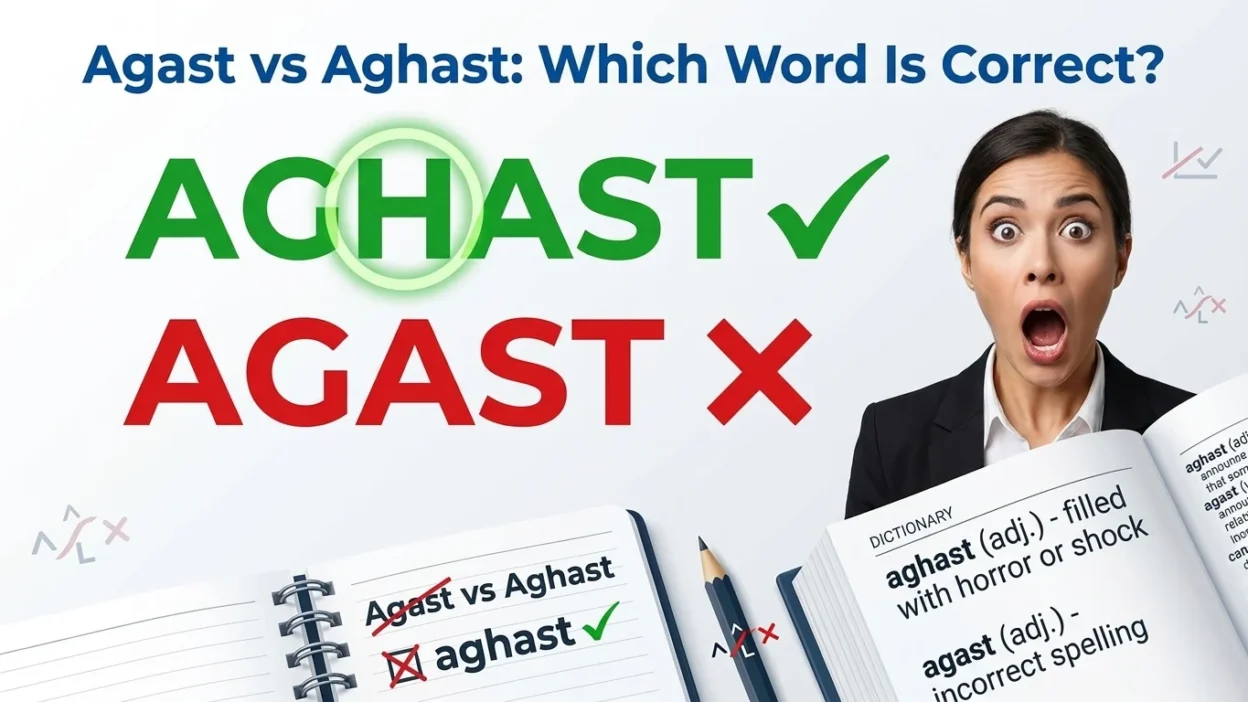
If you are wondering whether agast or aghast is correct, aghast is the standard English spelling. Agast is a misspelling. The adjective aghast means extremely shocked, frightened, or horrified by something unexpected or disturbing. For example, “She was aghast when she heard the news.”
The confusion usually happens because the h in aghast is not strongly pronounced, so it is easy to leave it out when writing. However, the correct spelling includes h: aghast. The word is often used when someone reacts with strong shock, horror, or disbelief. Learning this spelling is especially useful for students, ESL learners, writers, and anyone who wants to describe a powerful emotional reaction accurately.
Quick Answer
Aghast is the correct spelling. Agast is a misspelling. Aghast is an adjective meaning extremely shocked, horrified, or frightened by something surprising or disturbing. For example, “The audience was aghast at the sudden announcement.” Remember the h: A-G-H-A-S-T.
Why Do People Confuse It?
People often confuse agast and aghast because the h in aghast is not pronounced as a separate sound in modern English.
When spoken, aghast sounds roughly like “uh-GAST,” which can make the spelling agast seem reasonable.
However, the standard spelling is:
AGHAST ✅
The extra h is part of the correct spelling even though it is not pronounced like the h in words such as house or happy.
This is similar to other English words where spelling and pronunciation do not match perfectly.
First Word: Agast
Agast is not the standard spelling of the word meaning extremely shocked or horrified.
If you want to describe someone who is deeply shocked, do not write:
She looked agast at the accident.
Write:
She looked aghast at the accident.
The missing h makes agast an incorrect spelling in standard modern English.
Second Word: Aghast
Aghast is the correct standard English word.
It is an adjective used to describe someone who is extremely shocked, horrified, frightened, or disturbed.
For example:
He was aghast at the unexpected news.
The word is usually connected with a strong emotional reaction. It can describe someone’s facial expression, reaction, or state of mind.
Common phrases include:
- look aghast
- stare aghast
- stand aghast
- be aghast
- remain aghast
- appear aghast
Agast vs Aghast: Comparison Table
| Word | Correct? | Meaning | Example |
|---|---|---|---|
| aghast | ✅ Yes | Extremely shocked, horrified, or frightened | She was aghast at the news. |
| agast | ❌ No | Misspelling of aghast | Do not write “agast.” |
The correct spelling is aghast, with an h.
When to Use Each
When to Use “Aghast”
Use aghast when someone experiences a very strong reaction of shock, horror, or disbelief.
For example:
The family was aghast at the damage.
She stood aghast when she saw what had happened.
The word is stronger than simply saying someone was surprised.
When to Use “Agast”
Do not use agast as a spelling of aghast.
If you are writing an essay, story, article, email, or formal document, always use aghast.
10+ Examples of Aghast
- She was aghast when she heard the shocking news.
- The students looked aghast at the unexpected result.
- He stood aghast after seeing the damage.
- The audience was aghast at the sudden announcement.
- They were aghast to discover what had happened.
- Her parents were aghast at the enormous bill.
- The witness looked aghast during the investigation.
- He stared aghast at the broken window.
- Everyone was aghast when the lights suddenly went out.
- The manager was aghast at the serious mistake.
- She remained aghast after hearing the accusation.
- The crowd stood aghast as the unexpected event unfolded.
These examples show that aghast is normally used for an intense emotional response.
Common Mistakes
Mistake 1: Leaving out the H
Incorrect:
He was agast at the news.
Correct:
He was aghast at the news.
Always remember the h.
Mistake 2: Using “aghast” for ordinary surprise
Aghast describes a strong emotional reaction. It is more intense than simply being surprised.
For example:
I was surprised by the result.
This does not necessarily mean:
I was aghast at the result.
The second sentence suggests shock, horror, or strong distress.
Mistake 3: Confusing aghast with afraid
Although aghast can involve fear, its meaning focuses more on intense shock, horror, or dismay.
Someone can be aghast because of something shocking even if they are not personally in danger.
Memory Trick
Use this simple trick:
Aghast has an H because the shock is “heavy.”
Remember:
A-G-H-A-S-T ✅
Not:
A-G-A-S-T ❌
You can also break the spelling into two parts:
AGH + AST
The important thing is not to forget the H.
American vs British English
Aghast is spelled the same way in both American and British English.
There is no standard American/British spelling difference for this word.
For example:
She was aghast at the unexpected news.
This spelling is correct in both varieties of English.
The word may sound somewhat formal or literary in everyday conversation, but it remains a standard English adjective.
Similar Words
Several words are related to aghast, but each has a slightly different meaning.
Shocked
Shocked means strongly surprised or emotionally affected by something unexpected.
She was shocked by the news.
Horrified
Horrified means extremely frightened, disgusted, or shocked by something terrible.
He was horrified by the scene.
Appalled
Appalled means extremely shocked or disturbed, often because something is unacceptable or unpleasant.
She was appalled by their behavior.
Stunned
Stunned means extremely surprised or shocked.
He was stunned by the announcement.
Dismayed
Dismayed means upset or disappointed by something unexpected or undesirable.
They were dismayed by the result.
Astonished
Astonished means extremely surprised.
She was astonished by the discovery.
These words can overlap with aghast, but aghast often carries a stronger sense of horror, shock, or alarm.
Final Verdict
Aghast is the correct spelling.
Agast is a misspelling and should not be used in standard English.
Remember:
AGHAST ✅
AGAST ❌
The easiest way to remember the difference is to keep the H in aghast. Use the word when someone is extremely shocked, horrified, frightened, or disturbed by something unexpected.
Frequently Asked Questions
Is it agast or aghast?
Aghast is correct. Agast is a misspelling.
What does aghast mean?
Aghast means extremely shocked, horrified, frightened, or disturbed by something unexpected.
How do you spell aghast?
The correct spelling is A-G-H-A-S-T: aghast.
Is agast a word?
Agast is not the standard spelling of the adjective aghast. Use aghast instead.
Is aghast a formal word?
Aghast can sound somewhat formal or literary, especially in everyday conversation, but it is a standard English word.
What is an example of aghast?
A simple example is: “She was aghast when she heard the news.”
Is aghast the same in American and British English?
Yes. Aghast has the same spelling and meaning in both American and British English.
What is another word for aghast?
Depending on the context, alternatives include shocked, horrified, appalled, stunned, dismayed, and astonished.
Remember This
AGHAST = correct ✅
AGAST = incorrect ❌
Remember the H:
A-G-H-A-S-T
Use aghast when describing an intense reaction of shock, horror, or alarm.
Conclusion
The correct spelling is aghast, not agast. The word describes someone who is extremely shocked, horrified, frightened, or disturbed by something unexpected. Although the h is not pronounced as a separate sound, it is an essential part of the standard spelling.
For students, ESL learners, and writers, the easiest rule is simple: always keep the H in aghast. If you want to describe an intense emotional reaction, use aghast rather than the misspelled form agast.