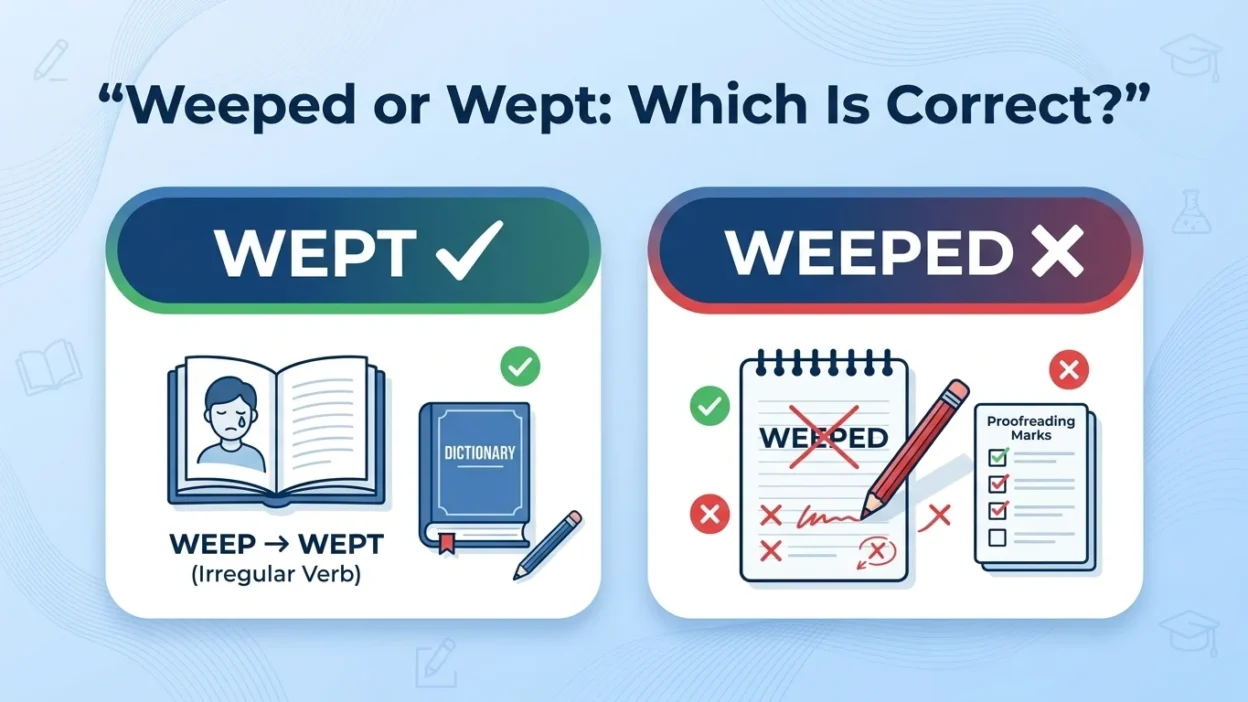
If you are wondering whether weeped or wept is correct, the standard past tense and past participle of weep is wept. Weeped is generally not used as the standard form in modern English. For example, “She wept after hearing the sad news” is correct. The verb weep means to cry, especially quietly or because of sadness, grief, or strong emotion.
The confusion happens because many English verbs form their past tense by adding -ed. However, weep is an irregular verb, so its past form does not follow that regular pattern. Instead, weep changes to wept. Learning this irregular form can help students, ESL learners, writers, and general readers use the verb naturally in stories, essays, literature, and everyday communication.
Quick Answer
Wept is the correct past tense and past participle of weep. Weeped is not the standard form used in modern English. Use weep for the present tense and wept for the past. For example, “She weeps when she is sad” becomes “She wept when she heard the news.”
Why Do People Confuse It?
People often confuse weeped and wept because many English verbs form their past tense by adding -ed.
For example:
- walk → walked
- talk → talked
- laugh → laughed
- cry → cried
Because of this common pattern, it may seem logical to write:
weep → weeped
However, weep is an irregular verb. Its past form changes instead of simply taking -ed:
weep → wept
This is similar to other irregular verbs:
- sleep → slept
- keep → kept
- feel → felt
- leave → left
Therefore, wept is the form you should use when talking about an action that happened in the past.
First Word: Weeped
Weeped is not the standard past-tense form of weep in modern English.
The usual mistake is treating weep as a regular verb and adding -ed:
She weeped after hearing the news.
The standard form is:
She wept after hearing the news.
Although weeped may occasionally appear in historical, dialectal, experimental, or nonstandard usage, it is not the normal form expected in standard modern English.
Second Word: Wept
Wept is the correct past tense and past participle of weep.
The verb weep means to cry, often quietly or because of sadness, grief, pain, or strong emotion. Wept describes this action when it happened in the past.
Examples:
- She wept quietly.
- He wept with sadness.
- They wept after hearing the news.
- The character wept at the end of the story.
The basic forms are:
weep → wept → wept
The first form is the present/base form, while wept serves as both the past tense and past participle.
Weeped vs Wept: Comparison Table
| Word | Correct? | Meaning | Example |
|---|---|---|---|
| weeped | ❌ No | Nonstandard/incorrect regularized form of weep | She weeped after the news. |
| wept | ✅ Yes | Past tense and past participle of weep | She wept after the news. |
The key point is that weep is an irregular verb, so its past form is wept, not weeped.
When to Use Each
When to Use “Weeped”
In standard modern English, do not use weeped as the normal past tense of weep.
Instead, use wept.
When to Use “Wept”
Use wept when describing an act of crying that happened in the past.
For example:
He wept when he learned the truth.
You can also use wept as a past participle:
She had wept for hours.
Common expressions include:
- wept quietly
- wept bitterly
- wept with sadness
- wept with joy
- wept uncontrollably
- wept after hearing the news
- wept over a loss
10+ Examples of Wept
- She wept after hearing the sad news.
- He wept quietly in his room.
- The child wept when her toy broke.
- They wept during the emotional farewell.
- She wept with joy when she saw her family.
- He wept after losing his closest friend.
- The character wept at the end of the story.
- She wept silently during the ceremony.
- The audience wept during the emotional scene.
- He had wept for several hours before falling asleep.
- She wept when she finally received the good news.
- They wept together after the difficult experience.
These examples show that wept is used for a completed or past action involving crying.
Common Mistakes
The most common mistake is treating weep like a regular verb.
Incorrect:
She weeped after hearing the news.
Correct:
She wept after hearing the news.
Another mistake is using wept when the sentence requires the present form weep.
Present:
Some people weep when they are deeply moved.
Past:
Some people wept when they heard the speech.
Remember that the verb changes according to the tense.
The three important forms are:
- weep — present/base form
- wept — past tense
- wept — past participle
Memory Trick
A simple way to remember the correct form is:
Weep sounds like sleep, and sleep becomes slept.
Compare:
weep → wept
sleep → slept
You can also remember the short pattern:
EEP → EPT
So:
WEEP → WEPT
This helps you remember that you should not add -ed to form the past tense.
American vs British English
There is no standard spelling difference between American and British English for weep or wept.
Both varieties use:
weep — present form
wept — past tense and past participle
And weeped is not the standard modern past form in either variety.
The verb can sound somewhat literary or formal compared with cry, but its spelling and basic grammatical forms remain the same.
Similar Words
Several words are related to weep, although they have slightly different meanings.
Cry
Cry is the most common everyday word for producing tears or expressing strong emotion.
She cried after hearing the news.
Sob
Sob means to cry with short, uncontrolled breaths.
He sobbed after the accident.
Tear Up
Tear up means to begin producing tears, often because of emotion.
She began to tear up during the speech.
Bawl
Bawl means to cry or shout loudly.
The baby bawled throughout the night.
Mourn
Mourn means to express deep sadness, especially after someone’s death or a serious loss.
The family mourned their loss.
Lament
Lament means to express deep sadness, regret, or grief, and it often sounds more formal or literary.
The poem laments the loss of a loved one.
These words can overlap with weep, but they are not exact replacements in every situation.
Final Verdict
The correct form is wept.
Weeped is not the standard modern English past tense of weep. Because weep is an irregular verb, its forms are:
weep → wept → wept
For example:
Correct: She wept after hearing the news.
Incorrect: She weeped after hearing the news.
If you are unsure, remember the similar pattern sleep → slept. This can help you recall weep → wept.
Frequently Asked Questions
Is it weeped or wept?
The correct standard form is wept. Weeped is not the normal modern English past tense of weep.
What is the past tense of weep?
The past tense of weep is wept.
She wept after hearing the news.
Is weeped ever used?
Weeped can occasionally appear in nonstandard, historical, dialectal, or creative usage, but wept is the standard form in modern English.
What is the past participle of weep?
The past participle is also wept.
She had wept before anyone arrived.
Is weep a regular or irregular verb?
Weep is an irregular verb because its past form changes to wept instead of being formed by simply adding -ed.
What is the difference between weep and cry?
Weep means to cry and often has a more literary or formal tone. Cry is much more common in everyday English.
Is wept used in American English?
Yes. Wept is the standard past tense and past participle of weep in American English.
Is wept used in British English?
Yes. Wept is also the standard past tense and past participle of weep in British English.
Remember This
Wept = correct ✅
Weeped = not the standard form ❌
Remember:
WEEP → WEPT → WEPT
You can also connect it with:
SLEEP → SLEPT
So, when you need the past tense of weep, do not add -ed. Use wept.
Conclusion
The difference between weeped or wept comes down to an irregular verb form. Wept is the standard past tense and past participle of weep, while weeped is not the normal form used in modern standard English. The verb weep means to cry, often with a literary or emotional tone.
The easiest way to remember the correct form is to learn weep → wept → wept as a complete pattern. You can also connect it with the similar irregular verb sleep → slept. Once you remember this pattern, choosing wept instead of weeped becomes much easier.