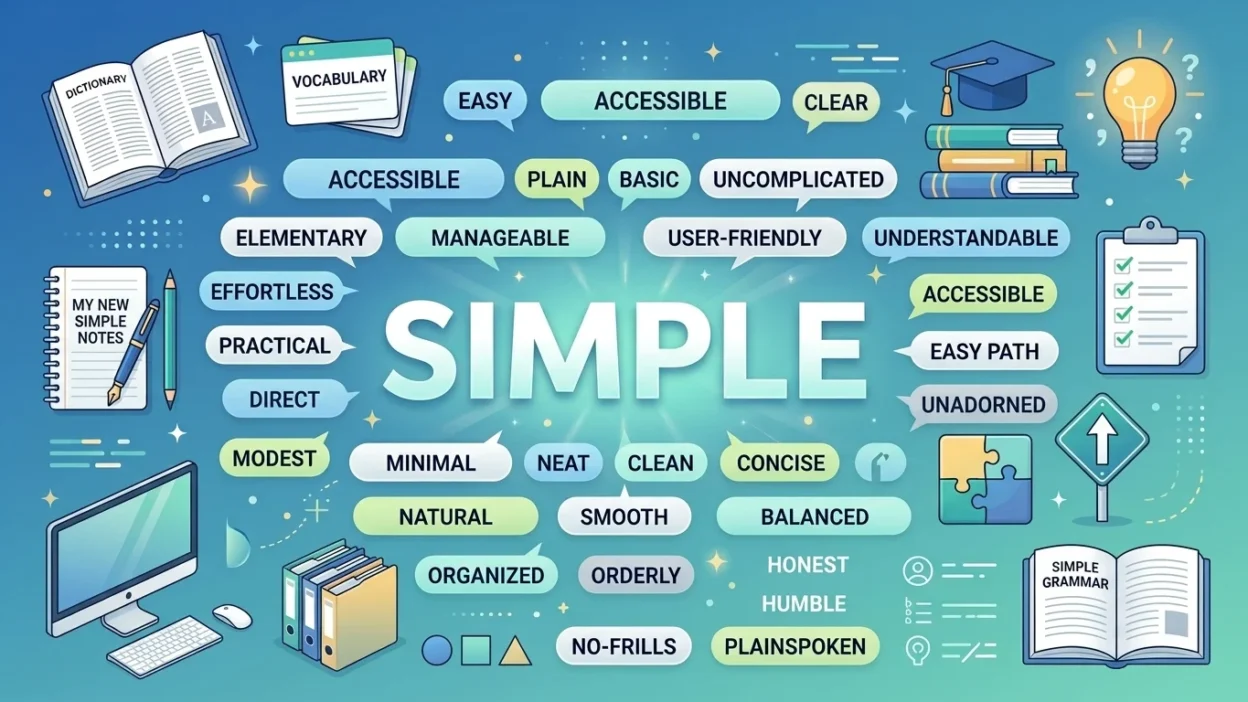
The word simple is commonly used to describe something that is easy to understand, do, or explain. It can refer to instructions, language, designs, ideas, solutions, or everyday tasks. While simple is useful in many situations, using different synonyms can make your writing more natural and precise.
Learning synonyms for simple helps students, ESL learners, writers, and content creators expand their vocabulary. Different synonyms can express clarity, ease, simplicity, or a lack of complexity, allowing you to choose the best word for every context.
In this guide, you’ll learn the meaning of simple, explore 30 useful alternatives, understand when each synonym works best, and improve your English with beginner-friendly explanations and examples.
What Does “Simple” Mean?
Meaning and Usage
The word simple means easy to understand, uncomplicated, or not difficult. It can describe instructions, writing, designs, explanations, lifestyles, or solutions that are clear and straightforward.
Examples:
- The teacher gave a simple explanation.
- This recipe is simple to follow.
- She prefers a simple lifestyle.
The best synonym depends on whether you want to emphasize clarity, ease, or a lack of complexity.
30 Synonyms for Simple
1. Easy
Meaning: Not difficult to do or understand.
Example Sentence: The test was easy.
Best Usage Context: Everyday conversation.
2. Straightforward
Meaning: Clear and uncomplicated.
Example Sentence: The directions were straightforward.
Best Usage Context: Instructions and guides.
3. Clear
Meaning: Easy to understand.
Example Sentence: She gave a clear explanation.
Best Usage Context: Communication and teaching.
4. Plain
Meaning: Simple without extra decoration.
Example Sentence: He wore a plain white shirt.
Best Usage Context: Appearance and writing.
5. Basic
Meaning: Containing only the most important parts.
Example Sentence: Start with the basic concepts.
Best Usage Context: Education.
6. Uncomplicated
Meaning: Free from unnecessary difficulty.
Example Sentence: The process is uncomplicated.
Best Usage Context: Formal writing.
7. Elementary
Meaning: Very simple and easy to learn.
Example Sentence: These are elementary math skills.
Best Usage Context: Learning.
8. Effortless
Meaning: Requiring very little effort.
Example Sentence: She made the presentation look effortless.
Best Usage Context: Skills and performance.
9. Manageable
Meaning: Easy to control or complete.
Example Sentence: The workload is manageable.
Best Usage Context: Work and projects.
10. User-Friendly
Meaning: Easy for people to use.
Example Sentence: The software is user-friendly.
Best Usage Context: Technology.
11. Understandable
Meaning: Easy to understand.
Example Sentence: His explanation was understandable.
Best Usage Context: Communication.
12. Accessible
Meaning: Easy for people to reach or understand.
Example Sentence: The book is accessible to beginners.
Best Usage Context: Education.
13. Practical
Meaning: Useful and easy to apply.
Example Sentence: She offered practical advice.
Best Usage Context: Daily life.
14. Modest
Meaning: Simple and not showy.
Example Sentence: They lived in a modest home.
Best Usage Context: Lifestyle.
15. Minimal
Meaning: Using only what is necessary.
Example Sentence: The room has a minimal design.
Best Usage Context: Interior design.
16. Neat
Meaning: Clean, organized, and simple.
Example Sentence: His desk is neat.
Best Usage Context: Organization.
17. Clean
Meaning: Free from unnecessary details.
Example Sentence: The website has a clean layout.
Best Usage Context: Design.
18. Concise
Meaning: Short but complete.
Example Sentence: Please keep your answer concise.
Best Usage Context: Writing.
19. Direct
Meaning: Clear without extra words.
Example Sentence: She gave a direct response.
Best Usage Context: Communication.
20. Natural
Meaning: Easy and comfortable.
Example Sentence: His writing sounds natural.
Best Usage Context: Language.
21. Smooth
Meaning: Easy without problems.
Example Sentence: The meeting went smoothly.
Best Usage Context: Processes.
22. Balanced
Meaning: Well organized and not overly complicated.
Example Sentence: The article has a balanced structure.
Best Usage Context: Writing.
23. Organized
Meaning: Arranged clearly.
Example Sentence: The notes are well organized.
Best Usage Context: Study and work.
24. Orderly
Meaning: Arranged in a logical way.
Example Sentence: Keep your files orderly.
Best Usage Context: Organization.
25. Honest
Meaning: Simple and sincere without pretending.
Example Sentence: She gave an honest opinion.
Best Usage Context: Personal communication.
26. Humble
Meaning: Simple and not proud.
Example Sentence: He remained humble despite his success.
Best Usage Context: Character descriptions.
27. Down-to-Earth
Meaning: Practical and easy to relate to.
Example Sentence: She is friendly and down-to-earth.
Best Usage Context: Describing people.
28. Plainspoken
Meaning: Speaking in a simple, direct way.
Example Sentence: His plainspoken style impressed everyone.
Best Usage Context: Public speaking.
29. No-Frills
Meaning: Without unnecessary extras.
Example Sentence: They chose a no-frills hotel.
Best Usage Context: Products and services.
30. Simple
Meaning: Easy to understand or do.
Example Sentence: The answer is simple.
Best Usage Context: General use.
Comparison Guide
When to Use Different Synonyms for Simple
| Synonym | Main Meaning | Best Use |
|---|---|---|
| Easy | Not difficult | Everyday English |
| Straightforward | Clear and direct | Instructions |
| Plain | Without decoration | Writing and appearance |
| Basic | Fundamental | Education |
| User-Friendly | Easy to use | Technology |
| Practical | Useful and realistic | Advice and daily life |
| Concise | Brief and complete | Writing |
| Minimal | Very simple design | Art and design |
How to Choose the Right Synonym
For Everyday Communication
Use:
- Easy
- Clear
- Simple
- Understandable
- Direct
These are common and easy for everyone to understand.
For Writing and Teaching
Use:
- Straightforward
- Concise
- Accessible
- Basic
- Elementary
These work well when explaining ideas or instructions.
For Design and Appearance
Use:
- Plain
- Minimal
- Clean
- Neat
- Organized
These describe visual simplicity and order.
For Describing People
Use:
- Humble
- Down-to-Earth
- Honest
- Practical
- Plainspoken
These describe personality traits that suggest simplicity and sincerity.
Why Learning Synonyms for Simple Matters
Using different synonyms instead of repeating simple makes your writing more varied and engaging. Each synonym adds a slightly different meaning, helping you describe ideas, people, products, instructions, and experiences more accurately.
A stronger vocabulary also improves essays, blog posts, conversations, presentations, emails, and professional communication.
Conclusion
Learning synonyms for simple helps you express clarity, ease, and simplicity with greater precision. Whether you choose easy, straightforward, plain, concise, or minimal, selecting the right synonym makes your writing more natural and effective.
The more synonyms you learn, the more confidently you can communicate in both spoken and written English.