
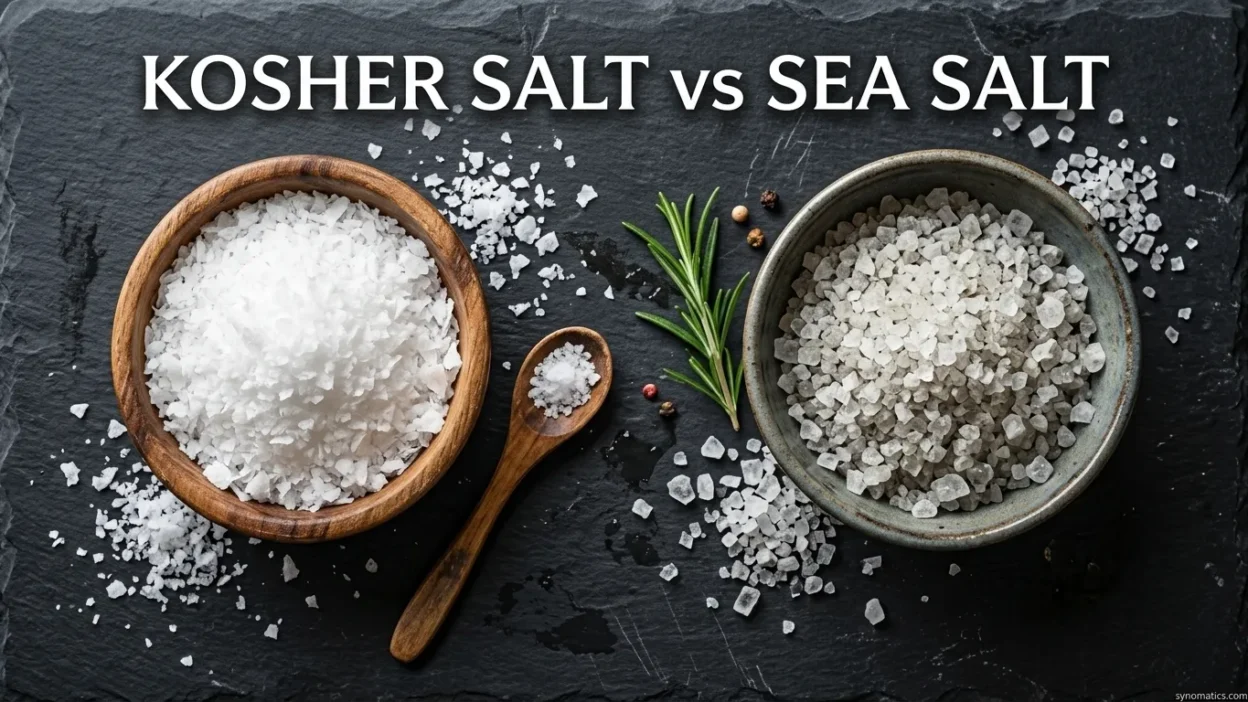
Kosher salt vs sea salt is a common comparison for home cooks, beginner chefs, and anyone who wants to understand different types of salt. Both are used to season food, improve flavor, and enhance the taste of everyday meals. However, they differ in how they are produced, their crystal shapes, their texture, and how easily they dissolve. These differences can affect the amount of salt you need in a recipe.
Kosher salt usually has larger, coarser crystals and is popular for seasoning meat, cooking vegetables, and preparing everyday meals. Sea salt is made by evaporating seawater and comes in several forms, including fine, coarse, and flaky crystals. Its texture and flavor can vary depending on how it is processed and where it comes from.
Although both types mainly contain sodium chloride, they are not always interchangeable in equal amounts by volume. Understanding their differences helps you choose the right salt for cooking, baking, finishing dishes, and seasoning food without making it too salty.
Quick Answer: Kosher Salt vs Sea Salt
Kosher salt typically has coarse, easy-to-pinch crystals and is commonly used for everyday cooking and seasoning meat. Sea salt is produced by evaporating seawater and is available in different crystal sizes and textures. Both provide saltiness, but their weight per teaspoon can differ. Choose based on crystal size, recipe requirements, and intended use.
Why Do People Confuse Kosher Salt and Sea Salt?
People often confuse kosher salt and sea salt because both are used in cooking and can look similar. Their crystals may be white, coarse, and irregular, especially when comparing coarse kosher salt with coarse sea salt.
Another reason is that both are primarily made of sodium chloride, the chemical compound responsible for their salty taste. Their main differences usually come from production methods, crystal structure, processing, and added ingredients.
The word kosher can also be confusing. Kosher salt is named for its traditional use in koshering meat, a process that helps remove surface blood according to Jewish dietary practices. Sea salt, by contrast, is named after its source: seawater.
What Is Kosher Salt?
Kosher salt is a type of culinary salt commonly recognized by its relatively large crystals. Many varieties have a coarse, flaky, or irregular texture that makes them easy to pick up between your fingers.
It is widely used in professional kitchens and home cooking because cooks can distribute it across food with good control. Its larger crystals can also make it convenient for seasoning meat, poultry, fish, and vegetables.
Key Characteristics of Kosher Salt
- Texture: Usually coarse, with relatively large crystals.
- Taste: Clean, salty flavor without a distinctive mineral taste in most standard products.
- Production: Commonly produced from salt brine through evaporation and crystal processing.
- Uses: Seasoning meat, cooking vegetables, preparing soups, and general food preparation.
- Ingredients: Many brands contain only salt, but some include anti-caking agents.
- Kosher status: The name refers to a traditional culinary use; certification and product ingredients should be checked when religious dietary requirements matter.
Kosher salt is not necessarily healthier than sea salt. Both can contribute significant amounts of sodium to your diet.
What Is Sea Salt?
Sea salt is produced by evaporating seawater, leaving behind salt crystals. Depending on the production method and the amount of processing, it can have fine grains, coarse crystals, or delicate flakes.
Some sea salts retain small amounts of naturally occurring minerals, but these amounts vary. Most sea salt is still predominantly sodium chloride, so it should not automatically be considered a major source of minerals.
Key Characteristics of Sea Salt
- Texture: Available in fine, coarse, and flaky forms.
- Taste: Primarily salty; some varieties may have subtle differences related to their mineral content and processing.
- Production: Obtained by evaporating seawater.
- Uses: Everyday cooking, seasoning, baking, and finishing dishes.
- Appearance: Usually white, although some varieties have gray, pink, or other natural colors.
- Ingredients: Often contains only salt, but labels should be checked for additives or other ingredients.
Fine sea salt dissolves quickly, making it useful for evenly seasoning liquids and mixing into recipes. Flaky sea salt is often sprinkled over finished dishes to add a delicate crunch.
Kosher Salt vs Sea Salt: Comparison Table
| Feature | Kosher Salt | Sea Salt |
|---|---|---|
| Source | Commonly made from salt brine | Produced from seawater |
| Crystal size | Usually coarse or flaky | Fine, coarse, or flaky |
| Main ingredient | Sodium chloride | Sodium chloride |
| Flavor | Generally clean and salty | Salty, sometimes with subtle mineral differences |
| Best-known use | Everyday cooking and seasoning meat | Cooking and finishing dishes |
| Dissolving speed | Depends on crystal size | Depends on crystal size |
| Sodium per teaspoon | Varies by crystal density | Varies by crystal density |
| Mineral content | Usually mostly sodium chloride | May retain small amounts of other minerals |
| Recipe substitution | Possible with measurement adjustments | Possible with measurement adjustments |
| Cost | Varies by brand and package | Varies by type, origin, and brand |
The most important difference for practical cooking is often crystal size and density rather than the name on the package.
When Should You Use Kosher Salt or Sea Salt?
Both types can work in many recipes, but certain forms are more convenient for particular tasks.
When to Use Kosher Salt
Choose kosher salt when you want a reliable, easy-to-handle salt for everyday cooking.
- Seasoning meat: Its larger crystals are easy to distribute over chicken, beef, or lamb.
- Cooking vegetables: It works well in roasted vegetables, stir-fries, and sautéed dishes.
- Preparing soups: It can season broths and stews when added gradually.
- Grilling: Its texture makes it convenient for seasoning meat before grilling.
- General cooking: It is a useful everyday option when a recipe specifically calls for kosher salt.
When to Use Sea Salt
Choose sea salt based on its texture and the result you want.
- Finishing food: Flaky sea salt adds a light crunch to steaks, salads, and roasted vegetables.
- Baking: Fine sea salt can blend evenly into dough and batter.
- Seasoning salads: Small amounts of flaky salt can provide a pleasant finishing texture.
- Cooking pasta: Fine or coarse sea salt can season the cooking water.
- Special dishes: Certain sea salts offer distinctive textures or subtle flavor differences that complement specific foods.
Neither type is universally better. For most everyday cooking, both can do the job well when you account for crystal size and quantity.
12 Practical Examples of Kosher Salt vs Sea Salt
These examples show how the two salts can be used in ordinary cooking.
- Seasoning chicken: Kosher salt is convenient because its crystals are easy to sprinkle evenly over the surface.
- Grilling steak: Kosher salt works well before cooking, while flaky sea salt can be added after cooking for a crunchy finish.
- Roasting potatoes: Either salt can season potatoes before they go into the oven.
- Making soup: Kosher salt or fine sea salt can be stirred into the broth and adjusted to taste.
- Cooking pasta: Both types can season pasta water, although fine salt dissolves more quickly.
- Baking bread: Fine sea salt or finely ground kosher salt can distribute evenly through the dough.
- Making cookies: Use the salt specified in the recipe, especially if the recipe depends on a precise measurement.
- Preparing scrambled eggs: A small amount of either salt can improve flavor.
- Finishing a salad: Flaky sea salt can add a light crunch to fresh vegetables.
- Seasoning roasted vegetables: Kosher salt is useful before roasting, while finishing salt can be sprinkled on just before serving.
- Making homemade sauces: Either type works when fully dissolved and measured appropriately.
- Preparing a salt crust: Coarse salt can help create a crust around foods such as baked fish, depending on the recipe.
These examples demonstrate that the best choice often depends on the dish, the crystal size, and whether you want the salt to dissolve or remain noticeable.
Common Mistakes When Comparing Kosher Salt and Sea Salt
1. Assuming One Teaspoon Always Equals Another
Different salts have different crystal sizes and densities. A teaspoon of fine sea salt may contain more salt by weight than a teaspoon of a light, flaky kosher salt.
Better approach: Follow the recipe’s specified salt type or measure by weight when precision matters.
2. Thinking All Sea Salt Is Coarse
Sea salt is available in fine grains, coarse crystals, and delicate flakes. The word sea identifies its source, not a specific grain size.
Better approach: Check the package for grain size before using it.
3. Assuming Kosher Salt Is Always Certified Kosher
The term refers to a traditional use in preparing meat. If religious dietary compliance is important, look for appropriate kosher certification and verify the ingredients.
Better approach: Check the label rather than relying on the product name alone.
4. Believing Sea Salt Is Automatically Healthier
Sea salt may contain trace minerals, but it is still primarily sodium chloride. These trace amounts do not make it a reliable mineral supplement.
Better approach: Focus on total sodium intake rather than choosing salt based on marketing claims.
5. Substituting Salts Without Adjusting the Amount
Replacing coarse kosher salt with fine sea salt in equal spoon measurements can make a dish too salty.
Better approach: Start with a smaller amount, taste the food, and add more if needed.
What Is an Easy Memory Trick for Kosher Salt vs Sea Salt?
Use this simple memory trick:
- Kosher salt = Cooking control. Remember its coarse crystals and how easily they can be pinched and sprinkled.
- Sea salt = Seawater source. Remember that it comes from evaporated seawater and can have many different textures.
Another helpful way to remember the difference is to focus on the words themselves. Kosher refers to a traditional use, while sea tells you where the salt comes from.
Is Kosher Salt Different in American and British English?
The terms are generally understood in both American and British English, but culinary preferences and product availability can differ.
In American recipes, kosher salt is a common ingredient, especially in recipes written by professional chefs and food publications. American brands may have different crystal shapes and densities, so the amount needed can vary by brand.
In British English, recipes may more commonly refer to table salt, sea salt, or flaky sea salt, depending on the dish and the writer. Kosher salt is available in the UK, but it may be less familiar to some home cooks.
The word salt has the same basic meaning in both varieties of English. The main difference is often the cooking tradition and the salt products commonly stocked in shops, rather than a difference in the English language itself.
Similar Words and Related Salt Terms
Understanding related terms can help you choose the correct product.
- Table salt: A finely granulated salt commonly used at the table and in cooking. It may contain iodine and anti-caking agents.
- Flaky salt: Salt with thin, delicate crystals, often used to finish food.
- Coarse salt: Salt with relatively large crystals. It describes texture rather than source.
- Fine salt: Salt with small grains that dissolve and distribute easily.
- Iodized salt: Salt with added iodine, a nutrient needed for normal thyroid function.
- Rock salt: Salt obtained from underground deposits, usually mined from natural salt formations.
- Fleur de sel: A delicate sea salt traditionally collected from the surface of salt ponds under suitable conditions.
- Himalayan pink salt: A rock salt known for its pink color, mainly composed of sodium chloride.
- Finishing salt: Salt added near the end of cooking or just before serving to provide flavor or texture.
These terms are not interchangeable. Some describe a salt’s source, others describe its texture, and others refer to its intended use.
FAQs:
1. Can I Substitute Kosher Salt for Sea Salt?
Yes. Kosher salt can usually replace sea salt in many recipes, and sea salt can replace kosher salt in many dishes. However, crystal size affects how much fits into a teaspoon. Adjust the amount or measure by weight for better accuracy.
2. Which Is Saltier, Kosher Salt or Sea Salt?
Neither is inherently always saltier. Both mainly contain sodium chloride. However, fine-grained salt can pack more tightly into a teaspoon than coarse, light crystals, making the same volume potentially saltier.
3. Is Kosher Salt Healthier Than Sea Salt?
No clear health advantage comes from choosing one over the other. Both can provide substantial sodium. Their health effects depend mainly on how much you consume and your overall dietary needs.
4. Why Do Chefs Prefer Kosher Salt?
Many chefs like kosher salt because its coarse crystals are easy to pinch, distribute, and control by hand. It is especially convenient for seasoning meat and other ingredients during cooking.
5. Can I Use Sea Salt Instead of Kosher Salt for Baking?
Yes, particularly if the sea salt is fine enough to distribute evenly. However, check the recipe’s measurements and adjust for crystal size. Baking can require more precise measurements than many everyday savory dishes.
6. Does Sea Salt Taste Different From Kosher Salt?
Both taste salty because their main component is sodium chloride. Some sea salts have subtle mineral or texture differences, but the difference may be slight. Crystal size and how the salt is used can affect the overall eating experience.
7. Which Salt Is Best for Steak?
Kosher salt is a practical choice for seasoning steak before cooking because it is easy to distribute. Flaky sea salt can also work well as a finishing salt after cooking. Either option can produce excellent results when used appropriately.
8. Does Kosher Salt Contain Less Sodium Than Sea Salt?
A teaspoon of some kosher salts contains less sodium than a teaspoon of fine sea salt because the crystals occupy more space. However, equal weights of ordinary salts contain broadly similar amounts of sodium. Check the product label for exact nutritional information.
Remember This
- Kosher salt is commonly used for everyday cooking and seasoning meat.
- Sea salt is made by evaporating seawater and comes in several textures.
- Both salts are primarily sodium chloride.
- Crystal size affects how much salt fits into a teaspoon.
- Fine salt dissolves quickly, while coarse and flaky salts offer different textures.
- Either salt can work in many recipes when you adjust the amount appropriately.
Conclusion
The difference between kosher salt and sea salt comes down mainly to their source, processing, crystal size, and practical use. Kosher salt is a convenient option for everyday cooking, while sea salt offers a wide range of textures for cooking and finishing dishes. Neither type is automatically better for every recipe.
When choosing between kosher salt vs sea salt, consider what you are preparing and how you want the salt to behave. Use the recipe’s recommended type when possible, measure carefully, and taste as you cook. These simple habits will help you season food more confidently and achieve consistent results.