
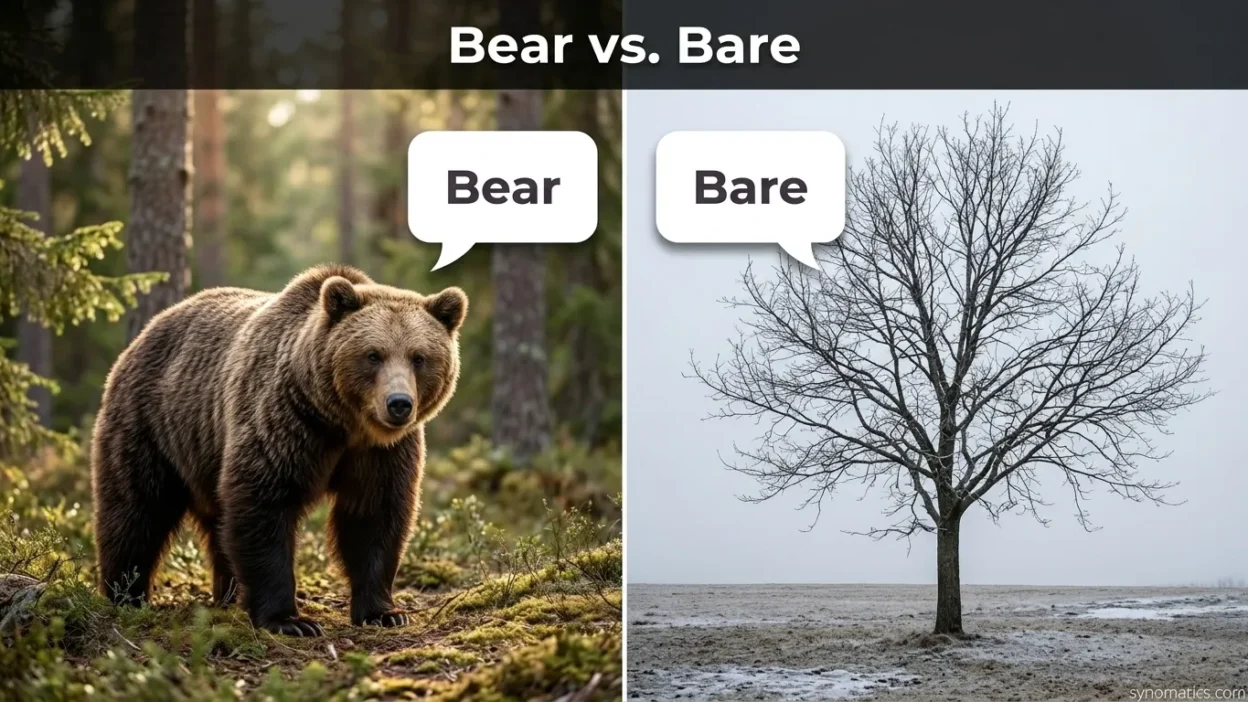
Have you ever wondered whether to write bear or bare? These two English words sound exactly the same, but they have different meanings and uses. Bear can refer to a large wild animal, mean to tolerate something difficult, or describe carrying a responsibility. Bare, on the other hand, means uncovered, exposed, or without the usual covering or decoration. Understanding the difference between these words can help you avoid spelling mistakes and communicate more clearly.
The confusion between bear and bare is common because they are homophones, meaning they have the same pronunciation but different spellings and meanings. For example, you might write, “I cannot bear the noise,” when you mean you cannot tolerate it. However, if you write, “She walked on the bare floor,” you mean the floor was uncovered. Although the words sound alike, they are not interchangeable. In this guide, you will learn the meaning of each word, discover when to use bear or bare, explore practical examples, and find simple memory tricks to remember the difference.
Quick Answer: Bear vs. Bare
Bear can mean a large mammal, to tolerate something, to carry a burden, or to support a responsibility. Bare means uncovered, exposed, or without something that usually covers or decorates a surface. Both words sound alike, but their meanings differ. Use bear for animals or enduring something and bare for things that are uncovered.
Why Do People Confuse Bear and Bare?
People often confuse bear and bare because they have the same pronunciation. When spoken aloud, there is no difference between the two words in standard English pronunciation.
However, their meanings and grammatical uses are different.
- Bear: Usually a noun referring to an animal or a verb meaning to tolerate, carry, or support something.
- Bare: Usually an adjective meaning uncovered or exposed. It can also be a verb meaning to uncover or reveal something.
For example:
- “I cannot bear this heat.” Here, bear means tolerate.
- “He walked with bare feet.” Here, bare means uncovered.
The key to choosing the correct word is understanding what you want to express in the sentence.
What Does Bear Mean?
The word bear has several meanings depending on the context. It can be a noun or a verb.
1. Bear as a Noun
As a noun, bear refers to a large, powerful mammal with thick fur. Bears live in different parts of the world and include species such as polar bears, brown bears, and black bears.
Examples:
- We saw a brown bear in the forest.
- The polar bear lives in Arctic regions.
- A bear was searching for food near the river.
In these sentences, bear refers to the animal.
2. Bear as a Verb
As a verb, bear can mean to tolerate, endure, carry, support, or accept something.
Examples:
- I cannot bear the pain anymore.
- She had to bear the responsibility for the mistake.
- This bridge can bear a heavy load.
- He could barely bear the thought of leaving his family.
In each example, bear describes an action or condition rather than an animal.
3. Common Expressions With Bear
Bear appears in several common English expressions.
- Bear in mind: Remember or consider something.
- Bear the burden: Accept or carry a difficult responsibility.
- Bear witness: Give evidence about something.
- Bear the cost: Pay for something or accept its financial burden.
- Cannot bear: Find something too unpleasant or difficult to tolerate.
Examples:
- Bear in mind that the deadline is tomorrow.
- She had to bear the burden of caring for her family.
- The documents bear witness to the agreement.
- I cannot bear the sound of loud chewing.
These expressions are common in everyday conversation, writing, and formal English.
What Does Bare Mean?
The word bare generally means uncovered, exposed, empty, or lacking something that is normally present. It can function as an adjective or a verb.
1. Bare as an Adjective
As an adjective, bare describes something that has no covering, clothing, decoration, or other expected feature.
Examples:
- He walked across the room with bare feet.
- The walls were bare and needed decoration.
- She sat on the bare ground.
- The tree’s branches were bare in winter.
In these examples, bare describes something that is uncovered or lacks its usual covering.
2. Bare as a Verb
As a verb, bare means to uncover or reveal something that was previously hidden.
Examples:
- The dog bared its teeth.
- He bared his arm to show the injury.
- The investigation bared the truth about the incident.
The verb bare is often used when something hidden or covered becomes visible.
3. Common Expressions With Bare
Several familiar expressions use bare.
- Bare feet: Feet without shoes or socks.
- Bare hands: Hands without gloves or protective coverings.
- Bare minimum: The smallest amount necessary.
- Bare necessities: The essential things needed to live or function.
- Lay bare: Reveal something openly or completely.
Examples:
- You need only the bare minimum to complete the task.
- They traveled with only the bare necessities.
- The report laid bare the problems within the organization.
These expressions highlight the idea of having less than usual or revealing something clearly.
Bear vs. Bare: Comparison Table
| Feature | Bear | Bare |
|---|---|---|
| Main meaning | An animal; to tolerate, carry, or support | Uncovered, exposed, or to uncover |
| Part of speech | Noun or verb | Adjective or verb |
| Example | I cannot bear the noise. | He has bare feet. |
| Common phrase | Bear in mind | Bare minimum |
| Related idea | Endurance or carrying | Exposure or absence of covering |
| Pronunciation | /ber/ | /ber/ |
The easiest distinction is that bear often relates to enduring or carrying something, while bare relates to being uncovered or exposed.
When Should You Use Bear or Bare?
Choose the word that matches the meaning of your sentence rather than its pronunciation.
Use Bear When You Mean Tolerate
Use bear when someone experiences something unpleasant or difficult without giving up.
Examples:
- I cannot bear this headache.
- She could not bear the thought of losing her pet.
- He had to bear the disappointment.
If you can replace the word with tolerate or endure, bear is usually the correct choice.
Use Bear When You Mean Carry or Support
Use bear when something carries weight, responsibility, or a burden.
Examples:
- The table can bear the weight of several books.
- Parents often bear many responsibilities.
- The company agreed to bear the expenses.
Use Bare When Something Is Uncovered
Use bare to describe something without a covering or something that is exposed.
Examples:
- The child walked with bare feet.
- The room had bare walls.
- Snow covered the ground, but the tree branches remained bare.
Use Bare When You Mean Reveal
Use bare as a verb when something is uncovered or revealed.
Examples:
- The dog bared its teeth.
- She bared her soul in the letter.
- The investigation bared the truth.
A helpful test is to ask whether the sentence refers to enduring something or leaving something uncovered. The first idea usually calls for bear, while the second calls for bare.
15 Examples of Bear vs. Bare in Sentences
The following examples show how both words work in everyday English.
Examples Using Bear
- I cannot bear the heat today.
Here, bear means tolerate. - The little boy was afraid of the bear.
Here, bear refers to the animal. - She had to bear the responsibility for her actions.
Here, bear means accept a responsibility. - This shelf can bear the weight of the books.
Here, bear means support. - Please bear in mind that the shop closes early.
Here, bear in mind means remember. - He could not bear to watch the sad movie.
Here, bear means endure an unpleasant experience. - The company will bear the travel expenses.
Here, bear means cover or accept the cost. - The witness agreed to bear testimony in court.
Here, bear means give or provide testimony.
Examples Using Bare
- She walked across the beach with bare feet.
Here, bare means uncovered. - The apartment had bare walls.
Here, bare means undecorated. - The tree’s branches were bare in winter.
Here, bare means without leaves. - The dog bared its teeth at the stranger.
Here, bared means exposed or showed. - We bought only the bare necessities for the trip.
Here, bare refers to essential items. - The report laid bare the truth.
Here, bare means revealed. - He stood barefoot on the cold floor.
Here, bare appears in barefoot, meaning without shoes or socks.
These examples demonstrate why context matters. The correct spelling depends on the intended meaning, not how the word sounds.
Common Mistakes With Bear and Bare
Even experienced English speakers sometimes mix up these words. Here are some common errors and their corrections.
Mistake 1: Writing Bare Instead of Bear
Incorrect: I cannot bare the noise.
Correct: I cannot bear the noise.
Why? The sentence means that the speaker cannot tolerate the noise. The correct word is bear.
Mistake 2: Writing Bear Instead of Bare
Incorrect: She walked with bear feet.
Correct: She walked with bare feet.
Why? The sentence describes feet without shoes or socks. The correct word is bare.
Mistake 3: Confusing Bear With Bare Minimum
Incorrect: We need the bear minimum.
Correct: We need the bare minimum.
Why? The expression means the smallest amount necessary.
Mistake 4: Confusing Bare With Bear Responsibility
Incorrect: He must bare the responsibility.
Correct: He must bear the responsibility.
Why? The verb means to accept or carry a responsibility.
Mistake 5: Confusing Bear and Bared
Incorrect: The dog bare its teeth.
Correct: The dog bared its teeth.
Why? Bared is the past tense of the verb bare, meaning uncovered or exposed.
Remember that bear, bears, bore, and borne are forms of the verb bear. Meanwhile, bare, bares, and bared are forms of the verb bare.
What Is an Easy Memory Trick for Bear vs. Bare?
A simple memory trick can help you remember the difference.
Bear = endure or carry. Bare = uncovered.
Think of these two sentences:
- Bear the burden: Imagine carrying a heavy bag.
- Bare feet: Imagine walking without shoes.
You can also connect bare with barely covered. Both ideas suggest that something is missing or reduced.
For bear, remember the animal. Picture a bear carrying a heavy log. Although this image is just a memory aid, it can help you associate the word with carrying.
Try asking yourself these questions before writing:
- Does the sentence mean tolerate, carry, or support? Choose bear.
- Does it mean uncovered, exposed, or revealed? Choose bare.
This quick check can prevent most common mistakes.
Is Bear or Bare Different in American and British English?
No. Bear and bare have the same meanings and spellings in standard American and British English. Both varieties pronounce the words alike, and neither variety uses a different spelling to distinguish their meanings.
For example, these sentences are correct in both varieties:
- I cannot bear the pain.
- She walked with bare feet.
- The dog bared its teeth.
The distinction is based on meaning, not regional spelling conventions.
Some accents may pronounce certain vowel sounds differently, but bear and bare remain homophones in standard American and British English.
What Are Some Similar Words to Bear and Bare?
Learning related words can make the distinction easier to understand.
Words Related to Bear
Depending on the context, synonyms for the verb bear include:
- Endure: Continue through a difficult experience.
- Tolerate: Accept something unpleasant without strong objection.
- Withstand: Resist or remain strong against pressure.
- Carry: Transport or hold something.
- Support: Hold up or provide assistance.
- Shoulder: Accept or take responsibility for a burden.
Example: “She had to bear the pressure” can be rewritten as “She had to endure the pressure.”
These words are not interchangeable in every sentence, so choose a synonym that fits the context.
Words Related to Bare
Words similar to bare include:
- Uncovered: Not covered by anything.
- Exposed: Open to view or contact.
- Naked: Without clothing or a covering.
- Empty: Containing nothing or very little.
- Undecorated: Without decorative features.
- Reveal: Make something known or visible; a related verb sense.
Example: “The walls were bare” can be rewritten as “The walls were undecorated.”
Keep in mind that bare and naked may have different connotations depending on the subject and situation.
FAQs:
1. Is it bear or bare with pain?
The correct word is bear. When you mean to tolerate or endure pain, use bear.
Example: “I can barely bear the pain.”
In this sentence, barely means hardly or only just, while bear means endure.
2. Is it bare minimum or bear minimum?
The correct expression is bare minimum. It refers to the smallest amount needed or required to do something.
Example: “You need the bare minimum of equipment to get started.”
3. Are bear and bare pronounced the same?
Yes. In standard American and British English, bear and bare are homophones. They sound alike but have different spellings and meanings.
4. What does bear mean in everyday English?
In everyday English, bear can mean tolerate, carry, support, or accept a responsibility. It can also refer to a large mammal.
Example: “I cannot bear this noise” means “I cannot tolerate this noise.”
5. What does bare mean in a sentence?
Bare usually means uncovered, exposed, empty, or without decoration. It can also mean to uncover or reveal something when used as a verb.
Example: “The room had bare walls.”
6. Is it bear responsibility or bare responsibility?
The correct phrase is bear responsibility. It means to accept or be accountable for a duty, action, or outcome.
Example: “Everyone must bear responsibility for their decisions.”
7. What is the difference between bear, bore, and borne?
These are forms of the verb bear. Bear is the base form, bore is the simple past tense, and borne is a past participle used in certain constructions.
Examples:
- I cannot bear the pressure.
- She bore the burden alone.
- The cost was borne by the company.
The word born is also related to bear and is generally used for birth, as in “She was born in June.”
8. Can bare be used as a verb?
Yes. As a verb, bare means to uncover or expose something.
Example: “The dog bared its teeth.”
The word bared is the past tense and past participle of bare.
Remember This
- Bear = an animal, tolerate, carry, or support.
- Bare = uncovered, exposed, or reveal.
- Bear the burden = accept a responsibility.
- Bare feet = feet without shoes or socks.
- Bare minimum = the smallest amount necessary.
- Bear in mind = remember.
If you remember only one rule, remember this: You bear something difficult, but something uncovered is bare.
Conclusion
The words bear and bare are easy to confuse because they sound exactly alike. However, they serve different purposes in English. Bear can refer to an animal or describe the act of tolerating, carrying, or supporting something. Bare describes something uncovered or exposed and can also mean to reveal something that was hidden.
To choose the correct word, focus on the meaning of your sentence. If you are talking about enduring pain, accepting responsibility, or carrying a burden, use bear. If you are describing uncovered feet, empty walls, or something revealed, use bare. With regular practice and the examples in this guide, you can use both words confidently in speaking and writing.