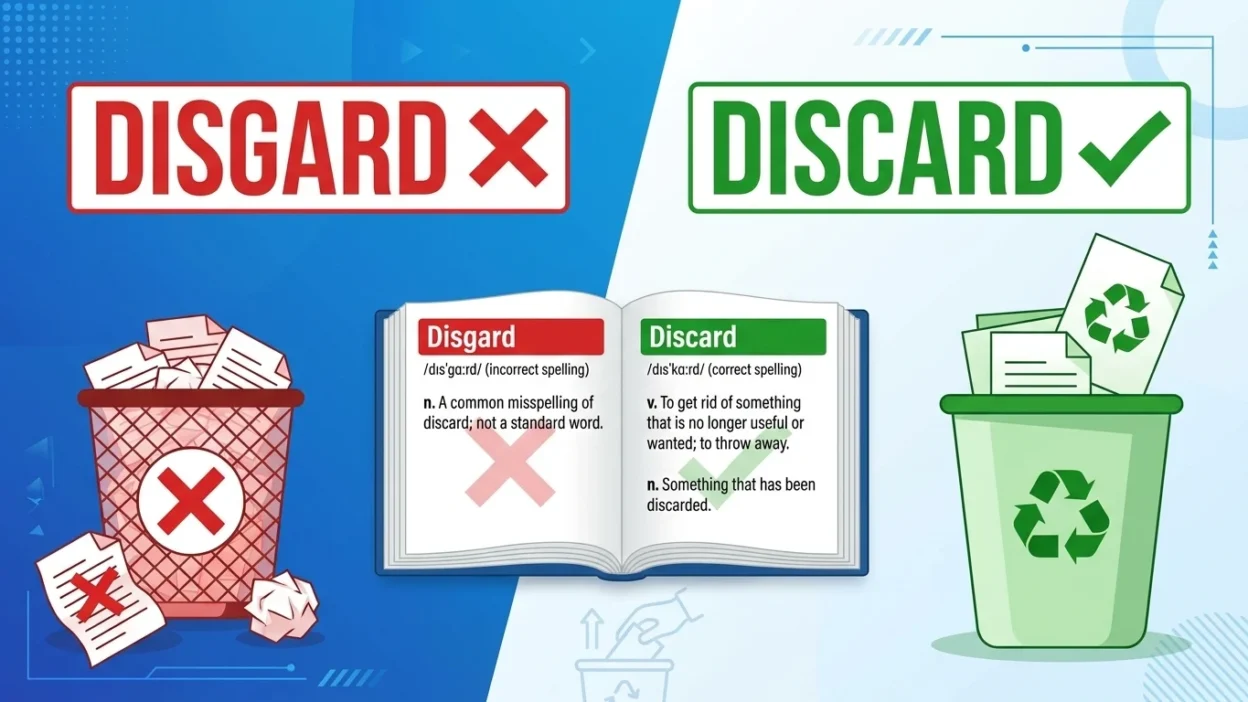
If you are confused about discard vs disgard, the correct spelling is discard. Disgard is a misspelling and is not the standard spelling of the word in modern English. The verb discard means to throw something away, get rid of something unwanted, or stop using something that is no longer useful. For example, “Please discard the empty bottle.” Learning the correct spelling helps students, ESL learners, and general readers communicate clearly and avoid common writing mistakes.
The confusion between these two spellings often happens because the letters c and g can sound similar in certain words or accents. However, only discard is correct when you want to express the idea of removing or rejecting something. This word is useful in everyday conversations, academic writing, workplace communication, and digital contexts. In this guide, you will learn the meaning of discard, understand why disgard is incorrect, explore practical examples, and discover an easy memory trick to remember the correct spelling.
Quick Answer
Discard is the correct spelling, while disgard is incorrect. The word discard means to throw something away, remove something unwanted, or stop using something. For example, “Discard the damaged papers.” Always use discard in standard English writing.
Why Do People Confuse Discard and Disgard?
People sometimes confuse discard and disgard because the words look similar and have nearly identical letter patterns. The main difference is the letter c in discard and g in disgard.
When people write quickly or rely mainly on pronunciation, they may choose the wrong consonant. However, the correct spelling is always discard when referring to throwing away, rejecting, or removing something.
- Incorrect: disgard
- Correct: discard
For example:
- Incorrect: Please disgard the old documents.
- Correct: Please discard the old documents.
Therefore, remembering the letter c is essential when spelling this word correctly.
What Does “Discard” Mean?
Discard is a verb that means to throw something away, get rid of something unwanted, or stop using something because it is no longer needed or useful.
It can refer to physical objects, ideas, plans, information, or items in a game.
For example:
- She decided to discard her old shoes.
- The editor discarded the unnecessary paragraph.
- The player had to discard a card.
Simple Definition of Discard
Discard = to throw away, reject, or stop using something.
Discard as a Noun
In certain contexts, discard can also be a noun. It refers to something that has been discarded or to the act of discarding.
For example, in card games, a discard is a card that a player gets rid of.
What Does “Disgard” Mean?
Disgard is a misspelling of discard in standard modern English. It is not the correct spelling when you mean to throw away, reject, or remove something.
For example:
- Incorrect: He decided to disgard the broken chair.
- Correct: He decided to discard the broken chair.
If you encounter disgard in an essay, email, report, or other piece of writing, replace it with discard when that is the intended meaning.
Is “Disgard” a Word?
Disgard is not the standard spelling of the English word discard. For ordinary modern English writing, use discard instead.
Discard vs Disgard: Comparison Table
| Word | Correct spelling? | Meaning | Example |
|---|---|---|---|
| discard | Yes | To throw away, reject, or stop using something | Please discard the empty box. |
| disgard | No | Misspelling of discard | Incorrect: Please disgard the empty box. |
The difference is simple: discard is correct, while disgard is a spelling mistake.
When Should You Use Each?
When to Use “Discard”
Use discard when you want to describe throwing something away, removing something unwanted, or rejecting an idea or plan.
Examples:
- Physical objects: Discard the damaged package.
- Ideas: We should discard the outdated theory.
- Documents: Please discard the duplicate copy.
- Games: You must discard one card.
- Plans: The team decided to discard its original proposal.
When to Use “Disgard”
In standard English, do not use disgard when you mean discard. It is a misspelling and should be corrected.
12 Examples of Discard in a Sentence
- Please discard the empty bottle in the recycling bin.
- She decided to discard her old notebook.
- The company will discard outdated records according to its retention policy.
- You should discard any food that shows signs of spoilage.
- The editor chose to discard the unnecessary paragraph.
- He had to discard one card during the game.
- The scientist decided to discard the unreliable results.
- Please discard the damaged packaging carefully.
- The team agreed to discard its original plan.
- Do not discard important documents without checking them.
- The designer decided to discard the first version of the logo.
- She learned to discard negative assumptions and consider the evidence.
These examples show that discard can describe getting rid of physical items as well as rejecting ideas, plans, or information.
Common Mistakes With Discard and Disgard
Mistake 1: Replacing C With G
The most common mistake is writing disgard instead of discard.
- Incorrect: Disgard the broken item.
- Correct: Discard the broken item.
Always remember the c in the correct spelling.
Mistake 2: Confusing Discard With Disregard
Although they look similar, discard and disregard have different meanings.
- Discard: To throw away or get rid of something.
- Disregard: To ignore something or treat it as unimportant.
Examples:
- Please discard the damaged paper.
- Please disregard the previous email.
The first sentence means to get rid of the paper. The second means to ignore the email.
Mistake 3: Using Discard When Ignore Is Better
Discard can sometimes describe rejecting an idea, but it does not always mean the same thing as ignore.
For example:
- Discard the proposal means reject or abandon it.
- Ignore the proposal means pay no attention to it.
Choose the word that expresses your intended meaning.
Mistake 4: Forgetting Related Forms
The standard forms of the verb include:
- Present: discard
- Past tense: discarded
- Present participle: discarding
- Third-person singular: discards
Examples:
- She discards unnecessary papers.
- He discarded the old plan.
- They are discarding damaged materials.
Memory Trick: How to Remember Discard
Use this simple memory trick:
DISCARD has a C, like “clean out.”
Think of cleaning out a cupboard and discarding things you no longer need.
Remember the spelling:
D-I-S-C-A-R-D
The word contains C, not G.
You can also connect discard with card. In many card games, players discard cards they no longer want.
This association can help you remember the correct spelling.
American vs British English
There is no standard American-versus-British spelling difference between discard and disgard.
Both American English and British English use discard.
- American English: Discard the old papers.
- British English: Discard the old papers.
Disgard is not the standard spelling in either variety. The meaning and spelling of discard remain the same across both forms of English.
Similar Words to Discard
Several words have meanings similar to discard, but each is best suited to a particular context.
Throw Away
Throw away means to get rid of something, especially a physical object.
Example: Please throw away the empty bottle.
Dispose Of
Dispose of means to get rid of something, often in a proper or organized way.
Example: Dispose of the chemical waste safely.
Reject
Reject means to refuse to accept something.
Example: The committee rejected the proposal.
Abandon
Abandon means to give up an idea, plan, activity, or undertaking.
Example: They abandoned the project because of the high cost.
Eliminate
Eliminate means to remove or get rid of something.
Example: The team worked to eliminate unnecessary steps.
Dismiss
Dismiss can mean to reject an idea or treat it as unworthy of consideration.
Example: She dismissed the suggestion without discussing it.
Although these words are related, they are not always interchangeable with discard.
Final Verdict
When choosing between discard vs disgard, the correct spelling is discard.
Discard means to throw away, get rid of, or reject something. In contrast, disgard is a misspelling and should not be used in standard English writing.
Remember the correct spelling: D-I-S-C-A-R-D. Whether you are writing about unwanted objects, outdated ideas, rejected plans, or cards in a game, discard is the word to use.
Frequently Asked Questions
Is it discard or disgard?
Discard is correct. Disgard is a misspelling in standard modern English.
What does discard mean?
Discard means to throw something away, get rid of something unwanted, or reject an idea or plan.
Is disgard a real English word?
Disgard is not the standard spelling of discard. Use discard in ordinary English writing.
What is the past tense of discard?
The past tense is discarded.
Example: She discarded the old papers yesterday.
What is the difference between discard and disregard?
Discard means to get rid of something, while disregard means to ignore something or treat it as unimportant.
What are some synonyms for discard?
Common alternatives include throw away, dispose of, reject, abandon, eliminate, and get rid of. The best choice depends on the context.
Is discard spelled the same in American and British English?
Yes. Discard is spelled the same in both American and British English.
How can I remember the spelling of discard?
Remember that discard contains the letter C, not G. You can also associate it with card games, where players discard unwanted cards.
Remember This
Discard is correct.
Disgard is incorrect.
Remember the spelling: D-I-S-C-A-R-D.
Discard = throw away, remove, or reject.
Conclusion
The difference between discard vs disgard is straightforward once you remember the correct spelling. Discard is the standard English word for throwing something away, removing something unwanted, or rejecting an idea. Disgard is a misspelling and should be avoided in everyday and formal writing.
To remember the correct form, focus on the letter c in discard. Also, distinguish it from disregard, which means to ignore something. With these simple tips and examples, you can use discard confidently in schoolwork, professional communication, and daily conversations.