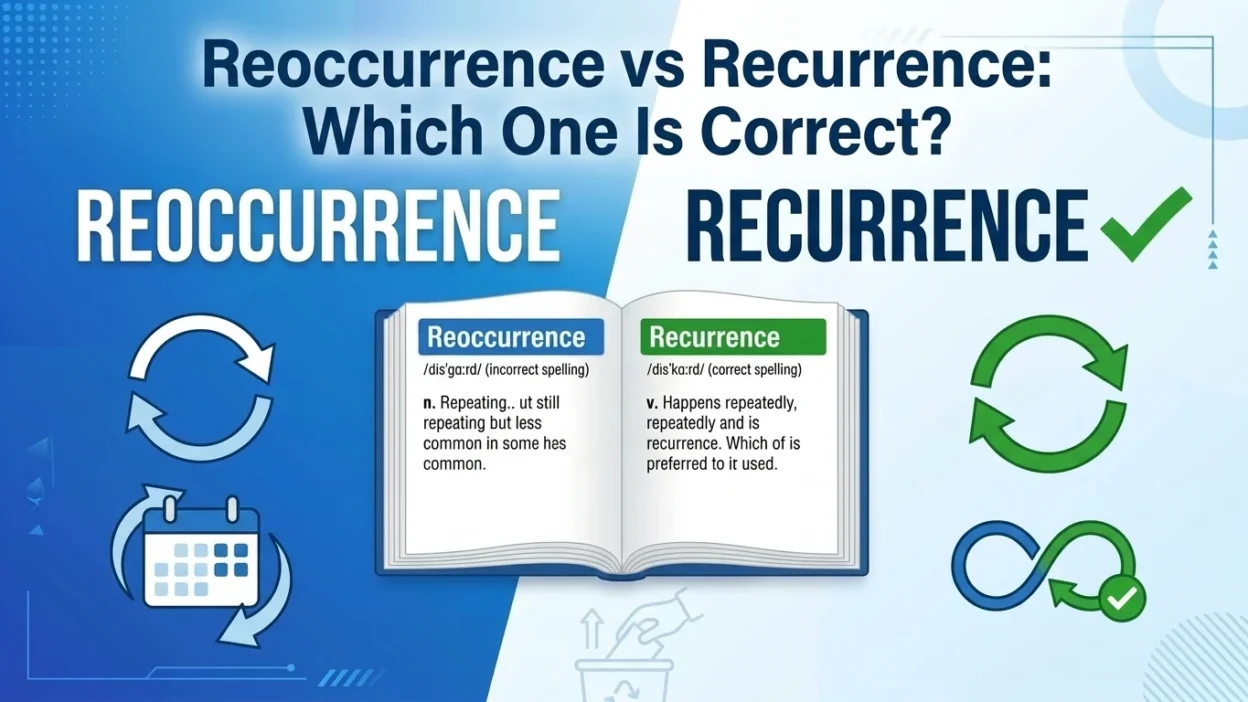
Have you ever wondered whether to write reoccurrence or recurrence? Both words are correct English spellings, and both describe something that happens again. However, they differ slightly in how they are formed and used. Understanding this difference can help you choose the right word for essays, emails, reports, and everyday writing.
Although recurrence is the more common and widely preferred choice, reoccurrence is also acceptable when you want to emphasize that something happens again. For example, a doctor might discuss the recurrence of an illness, while a writer might use reoccurrence to highlight an event happening once more. In many situations, the two words have similar meanings and can be used interchangeably. Nevertheless, the best choice depends on the sentence, context, and style of writing. By learning their meanings, examples, and common usage patterns, you can avoid spelling confusion and communicate more clearly.
Quick Answer: Reoccurrence or Recurrence?
Both reoccurrence and recurrence are correct spellings. They refer to something happening again or returning after a period of time. However, recurrence is generally more common and is often preferred in formal, academic, and medical writing. Use reoccurrence when you want to emphasize that an event or situation happens again.
Why Do People Confuse Reoccurrence and Recurrence?
People often confuse these words because they share the same basic meaning and have similar spellings. Both describe the return or repetition of an event, problem, condition, or situation.
The confusion also comes from the prefix re-, which means “again.” Since reoccurrence visibly includes this prefix, some writers assume it is the only correct spelling for something that happens again. However, recurrence is an established English word with the same general meaning.
Here are the main reasons for the confusion:
- Similar meanings: Both words describe something happening again.
- Similar spelling: Both contain the word element related to “occurring.”
- Different word formation: Reoccurrence visibly adds re- to occurrence, while recurrence comes from a different established form.
- Usage preferences: Recurrence is more common in many formal contexts, particularly medicine and academic writing.
Therefore, neither spelling is automatically wrong. The key is understanding the context and choosing the word that sounds natural in your sentence.
First Word: Reoccurrence
Reoccurrence is a noun that means the act of happening again or the return of an event, condition, or situation. It is formed from re- and occurrence, making the idea of happening again especially noticeable.
Meaning of Reoccurrence
Use reoccurrence when referring to an event, problem, or situation that happens again after it has happened before.
For example:
- The team introduced new rules to prevent the reoccurrence of the mistake.
- Regular maintenance can reduce the reoccurrence of technical problems.
- The reoccurrence of heavy rain caused delays.
- She wanted to avoid the reoccurrence of the same misunderstanding.
In each example, something has happened before and happens again.
When Should You Use Reoccurrence?
You can use reoccurrence when you want to emphasize the repetition of an event or situation. It may be suitable in general writing, workplace communication, reports, and discussions about recurring problems.
However, it is often helpful to choose recurrence instead when that word is the more established or natural choice in your field.
Example: The manager created a checklist to prevent the reoccurrence of errors.
Here, reoccurrence highlights the possibility of the same errors happening again.
Second Word: Recurrence
Recurrence is a noun that means the return or repetition of something after it has happened or appeared before. It is widely used in everyday English and formal writing, especially when discussing patterns, repeated events, and medical conditions.
Meaning of Recurrence
Use recurrence to describe the return of a condition, event, problem, or pattern.
For example:
- The doctor monitored the patient for a recurrence of the infection.
- The recurrence of the same issue frustrated the staff.
- Seasonal changes explain the recurrence of certain weather patterns.
- The company developed a plan to prevent recurrence of the problem.
In these sentences, recurrence describes something returning or happening again.
When Should You Use Recurrence?
Choose recurrence when you need a clear, widely accepted word for the return of something. It is especially useful in:
- Medical writing: recurrence of cancer, symptoms, or infection.
- Academic writing: recurrence of a pattern or theme.
- Business writing: recurrence of errors or operational problems.
- Everyday communication: recurrence of an event or situation.
For example, “The treatment reduced the risk of recurrence” is a natural and common way to describe the return of a medical condition.
Reoccurrence vs Recurrence: Comparison Table
| Feature | Reoccurrence | Recurrence |
|---|---|---|
| Part of speech | Noun | Noun |
| Meaning | Something happening again | Something returning or happening again |
| Correct spelling? | Yes | Yes |
| General usage | Correct but less common | More common and widely preferred |
| Formal writing | Acceptable in suitable contexts | Often the preferred choice |
| Medical writing | Possible, depending on context | Commonly used |
| Example | Reoccurrence of an error | Recurrence of a disease |
| Best general choice | When emphasis on happening again is useful | When a familiar, widely accepted term is needed |
The main difference is usage rather than meaning. Both words are correct, but recurrence is usually the safer choice when you are unsure which one to use.
When to Use Reoccurrence vs Recurrence
Choosing between these words becomes easier when you consider your audience, purpose, and writing context.
Use Reoccurrence When Emphasizing That Something Happens Again
Reoccurrence can work well when the sentence focuses on a repeated event or a problem happening another time.
Examples:
- The new procedure helped prevent the reoccurrence of mistakes.
- The software update reduced the reoccurrence of crashes.
- The school introduced a policy to prevent the reoccurrence of bullying.
Although these sentences could also use recurrence, reoccurrence clearly communicates the idea of something happening again.
Use Recurrence in Formal and Technical Writing
Recurrence is often the more natural option in formal, scientific, medical, and academic contexts.
Examples:
- The patient returned for an examination after the recurrence of symptoms.
- Researchers studied the recurrence of the same pattern.
- The company investigated the recurrence of equipment failures.
In these examples, recurrence fits naturally with the surrounding language.
Use Recurrence When You Are Unsure
If both words seem suitable, choose recurrence. It is the more common option and works in a wide range of contexts.
For example:
- Preferred: The team worked to prevent the recurrence of the issue.
- Also correct: The team worked to prevent the reoccurrence of the issue.
The first sentence is generally the more straightforward choice.
Reoccurrence vs Recurrence: 12 Example Sentences
These examples show how both words can be used in natural English.
- Reoccurrence: The company updated its procedures to prevent the reoccurrence of the error.
- Recurrence: The company updated its procedures to prevent the recurrence of the error.
- Reoccurrence: Regular inspections helped reduce the reoccurrence of equipment problems.
- Recurrence: The recurrence of the problem delayed the project.
- Reoccurrence: The teacher explained how to avoid the reoccurrence of common grammar mistakes.
- Recurrence: The recurrence of the same spelling mistake surprised the student.
- Reoccurrence: The software patch reduced the reoccurrence of unexpected crashes.
- Recurrence: The doctor discussed the risk of recurrence after treatment.
- Reoccurrence: The team developed a plan to prevent the reoccurrence of misunderstandings.
- Recurrence: Researchers examined the recurrence of a particular pattern in the data.
- Reoccurrence: The town prepared for the possible reoccurrence of flooding.
- Recurrence: The recurrence of heavy snowfall affected local transportation.
Notice that several sentences work with either noun. The choice often depends on customary usage and the style of the writing rather than a major difference in meaning.
Common Mistakes With Reoccurrence and Recurrence
Even experienced writers can become unsure about these words. Avoid the following mistakes to make your writing more accurate.
Mistake 1: Assuming Reoccurrence Is Incorrect
Incorrect belief: “Reoccurrence is not a real word.”
Correction: Both reoccurrence and recurrence are correct English words. However, recurrence is more widely used.
Mistake 2: Assuming the Words Always Have Different Meanings
Some writers believe reoccurrence refers to an event happening again, while recurrence refers only to something returning after a long time.
In actual usage, their meanings overlap considerably. Neither word has a strict time-based distinction.
Mistake 3: Using an Unnecessary Word in Formal Writing
Although reoccurrence is correct, recurrence may sound more natural in medical reports, research papers, and professional documents.
For example:
- Less conventional in medical writing: The reoccurrence of the disease was monitored.
- More conventional: The recurrence of the disease was monitored.
Mistake 4: Confusing Recurrence With Occurrence
Occurrence means an event or instance of something happening. Recurrence means something happening again or returning.
- Occurrence: The occurrence of a rare event surprised everyone.
- Recurrence: The recurrence of the event surprised everyone again.
The difference is important because recurrence specifically involves repetition or return.
Memory Trick: How to Remember Recurrence vs Reoccurrence
Use this simple memory trick:
- Occurrence = something happens.
- Recurrence = something happens again or returns.
- Reoccurrence = another accepted way to describe something happening again.
If you are writing a formal report and cannot decide, remember this practical rule: Choose recurrence for the more common, widely preferred option.
For example, “recurrence of symptoms” is a familiar phrase in medical writing, while “reoccurrence of a mistake” is also understandable and correct.
American vs British English: Is There a Difference?
There is no major American-versus-British spelling difference between reoccurrence and recurrence. Both forms are recognized in standard English, and neither is exclusively American or British.
The choice is mainly about frequency, context, and style rather than regional spelling rules.
| Context | Preferred guidance |
|---|---|
| American English | Recurrence is generally the more common choice. |
| British English | Recurrence is also widely used and generally preferred. |
| Academic writing | Follow the terminology and style used in your field. |
| Medical writing | Recurrence is the familiar standard term in many contexts. |
| Everyday writing | Either can be correct when used naturally. |
Therefore, you do not need to change the spelling simply because you are writing for an American or British audience.
Similar Words Related to Reoccurrence and Recurrence
Several English words express the idea of something happening again. However, each has a slightly different use.
1. Occurrence
Meaning: An event or instance of something happening.
Example: The occurrence of errors decreased after the training session.
Use occurrence when you are describing an event, not necessarily its repetition.
2. Repetition
Meaning: The act of doing or saying something again.
Example: Repetition helped the students remember the new vocabulary.
Use repetition when the focus is on repeating an action, word, sound, or process.
3. Return
Meaning: Coming back or appearing again.
Example: The return of warm weather brought more visitors to the park.
Use return when something comes back after being absent.
4. Resurgence
Meaning: A renewed increase or revival after a period of decline or inactivity.
Example: The city experienced a resurgence in tourism.
Use resurgence when something becomes active or popular again, often with increased strength.
5. Revival
Meaning: The restoration or return of something that was inactive, weak, or forgotten.
Example: The festival helped bring about a revival of local traditions.
Use revival when something is restored or brought back to life, popularity, or activity.
6. Repetition of an Event
Meaning: An event happening more than once.
Example: The repetition of the same mistake showed that more training was needed.
This phrase can replace recurrence when you want to emphasize the repeated action itself.
Final Verdict: Reoccurrence or Recurrence?
Both reoccurrence and recurrence are correct. They share the meaning of something happening again or returning after it has happened before. The main difference is that recurrence is more common and is often preferred in formal, academic, medical, and professional writing.
Use reoccurrence when it fits your sentence, but choose recurrence when you want the more familiar and widely accepted option. If you remember that both spellings are valid while recurrence is generally more common, you can make the right choice with confidence.
Frequently Asked Questions
1. Is reoccurrence a correct word?
Yes, reoccurrence is a correct English word. It is a noun that describes something happening again. However, recurrence is generally more common and may be preferred in formal or technical writing.
2. Is recurrence or reoccurrence more common?
Recurrence is generally more common. It is widely used in everyday, academic, professional, and medical contexts. When you are unsure which word to choose, recurrence is usually the safer option.
3. Do recurrence and reoccurrence mean the same thing?
They have very similar meanings. Both refer to something happening again or returning. In many sentences, either word is grammatically acceptable, although one may sound more natural depending on the context.
4. What is the difference between occurrence and recurrence?
Occurrence refers to an event or instance of something happening. Recurrence refers to something happening again or returning after it has happened before. For example, an occurrence is an event, while a recurrence is a repeated or returning event.
5. Should I use recurrence in medical writing?
In most cases, yes. Recurrence is a familiar term in medicine, especially when discussing the return of a disease, cancer, infection, or symptoms after improvement or treatment. Follow the terminology used by your medical or academic style guide.
6. Is reoccurrence one word or two?
Reoccurrence is one word. It is spelled without a space or hyphen. Similarly, recurrence is also a single word.
7. Is there a difference between recurrence and repetition?
Yes. Recurrence usually refers to the return of an event, condition, or pattern. Repetition focuses on doing, saying, or experiencing something again. Their meanings can overlap, but they are not always interchangeable.
Remember This
- Both spellings are correct: reoccurrence and recurrence.
- Recurrence is more common: It is generally the preferred choice in formal and technical writing.
- Both describe something happening again: Their meanings overlap significantly.
- No major regional difference: Both forms are used in American and British English.
- When in doubt, choose recurrence: It is the more familiar and widely accepted option.
Conclusion
Understanding reoccurrence vs recurrence is simple once you know that both words are correct. They describe something happening again or returning after an earlier event. Although their meanings are very similar, recurrence is the more common choice in many forms of writing, especially in medical, academic, and professional contexts.
Ultimately, choose the word that best fits your sentence and audience. When you need a clear, familiar term, use recurrence. When reoccurrence fits your intended meaning and style, it is also acceptable. Knowing this distinction will help you write more naturally and avoid unnecessary spelling confusion.