The word poor describes something that is having little of what is needed or expected. It can refer to a person who may lack needed food and shelter, or a situation that may fall below a certain standard.
Learning synonyms for poor helps explain different meanings clearly because poor can describe financial condition, performance, or quality. For example, poor performance may happen when someone does not try enough, while empty pockets and empty efforts can also show different meanings of the word.
The meaning of poor changes depending on the context. It can be the opposite of rich or wealthy when talking about money, material things, and resources. However, a person can have less money but still have strong knowledge, good friends, and kindness.
In this guide, understanding synonyms for poor creates a better comparison between different positive and negative meanings. These words help writers choose the right expression when discussing quality, ability, or different situations.
Just like grades and studying can show academic results, the word can describe many areas of life beyond financial status. Choosing accurate words improves communication and helps explain ideas with more clarity.
What Does “Poor” Mean?
The word poor means having little of something needed or having a lower level of quality. It can describe a person with limited money, a weak result, or something that does not meet expectations.
Examples:
- He comes from a poor family.
- The team showed poor performance.
- The product has poor quality.
The meaning depends on the context. Poor does not always refer to money; it can also describe skills, results, conditions, or experiences.
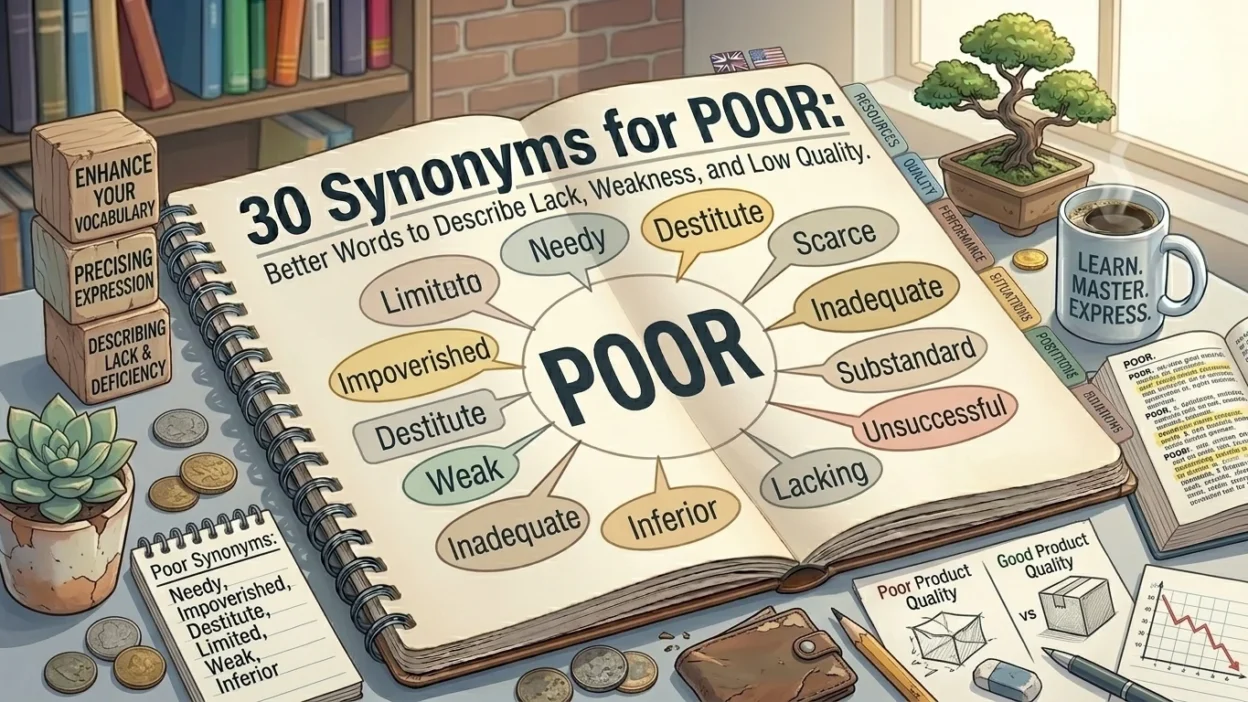
30 Synonyms for Poor
1. Needy
Meaning: Lacking basic needs such as money, food, or support.
Example Sentence: The charity helps needy families.
Best Usage Context: Financial situations and social support.
2. Impoverished
Meaning: Extremely poor with very few resources.
Example Sentence: The organization supports impoverished communities.
Best Usage Context: Formal writing about poverty.
3. Destitute
Meaning: Having no money or basic resources.
Example Sentence: The program provides help for destitute people.
Best Usage Context: Serious financial conditions.
4. Underprivileged
Meaning: Having fewer opportunities or advantages.
Example Sentence: The school supports underprivileged children.
Best Usage Context: Social and educational contexts.
5. Penniless
Meaning: Having no money.
Example Sentence: He was penniless after losing his job.
Best Usage Context: Informal descriptions of money problems.
6. Broke
Meaning: Having little or no money.
Example Sentence: I cannot buy it because I am broke.
Best Usage Context: Casual conversations.
7. Needy
Meaning: Requiring help or support.
Example Sentence: Many needy people received assistance.
Best Usage Context: Charity and support.
8. Low-quality
Meaning: Not good in standard or performance.
Example Sentence: The product received complaints because of low-quality materials.
Best Usage Context: Products and services.
9. Inferior
Meaning: Lower in quality compared to others.
Example Sentence: The material was inferior to the original one.
Best Usage Context: Comparisons.
10. Weak
Meaning: Not strong or effective.
Example Sentence: The company had weak sales this year.
Best Usage Context: Performance and ability.
11. Unsatisfactory
Meaning: Not good enough or acceptable.
Example Sentence: His results were unsatisfactory.
Best Usage Context: Formal evaluations.
12. Inadequate
Meaning: Not enough or not suitable.
Example Sentence: The resources were inadequate for the project.
Best Usage Context: Formal and professional writing.
13. Deficient
Meaning: Missing something necessary.
Example Sentence: The diet was deficient in important nutrients.
Best Usage Context: Health, skills, and resources.
14. Lacking
Meaning: Not having enough of something.
Example Sentence: The report was lacking important details.
Best Usage Context: General descriptions.
15. Scarce
Meaning: Available in very small amounts.
Example Sentence: Water became scarce during the drought.
Best Usage Context: Resources and availability.
16. Limited
Meaning: Restricted or not enough.
Example Sentence: They have limited experience.
Best Usage Context: Skills and opportunities.
17. Unsuccessful
Meaning: Not achieving the desired result.
Example Sentence: The attempt was unsuccessful.
Best Usage Context: Results and achievements.
18. Failed
Meaning: Not successful.
Example Sentence: The project failed because of poor planning.
Best Usage Context: Actions and outcomes.
19. Weakness
Meaning: A lack of strength or ability.
Example Sentence: Communication was his main weakness.
Best Usage Context: Skills and personal qualities.
20. Defective
Meaning: Having a problem or fault.
Example Sentence: The machine was defective.
Best Usage Context: Products and objects.
21. Substandard
Meaning: Below the expected quality.
Example Sentence: The service was substandard.
Best Usage Context: Professional reviews.
22. Inferior
Meaning: Lower in value or quality.
Example Sentence: This version is inferior to the updated model.
Best Usage Context: Comparisons.
23. Unfortunate
Meaning: Experiencing bad circumstances.
Example Sentence: It was an unfortunate situation.
Best Usage Context: Events and situations.
24. Miserable
Meaning: Very unhappy or uncomfortable.
Example Sentence: They lived in miserable conditions.
Best Usage Context: Emotional or living conditions.
25. Disappointing
Meaning: Not meeting expectations.
Example Sentence: The performance was disappointing.
Best Usage Context: Results and experiences.
26. Unsatisfactory
Meaning: Below an acceptable level.
Example Sentence: The service quality was unsatisfactory.
Best Usage Context: Reviews and assessments.
27. Unsuccessful
Meaning: Without achievement or positive results.
Example Sentence: The business became unsuccessful.
Best Usage Context: Success and failure.
28. Inadequate
Meaning: Not sufficient for a purpose.
Example Sentence: The preparation was inadequate.
Best Usage Context: Formal explanations.
29. Fragile
Meaning: Weak or easily damaged.
Example Sentence: The economy was fragile.
Best Usage Context: Systems and conditions.
30. Unfortunate
Meaning: Showing bad luck or difficulty.
Example Sentence: They faced unfortunate circumstances.
Best Usage Context: Situations and experiences.
Comparison Table: When to Use Different Synonyms for Poor
| Synonym | Meaning Focus | Best Use |
| Needy | Lack of money/resources | People and charity |
| Destitute | Extreme poverty | Serious conditions |
| Inferior | Low quality | Comparisons |
| Weak | Lack of strength | Ability and performance |
| Inadequate | Not enough | Formal writing |
| Scarce | Limited supply | Resources |
| Disappointing | Poor results | Experiences |
| Defective | Problems | Products |
How to Choose the Right Synonym for Poor
For Financial Problems
Use:
- Needy
- Destitute
- Penniless
- Broke
These words describe lack of money or resources.
For Low Quality or Performance
Use:
- Inferior
- Weak
- Defective
- Substandard
These words describe something that does not meet expectations.
For Limited Resources
Use:
- Scarce
- Limited
- Inadequate
- Lacking
These words focus on shortage or missing things.
For Negative Results
Use:
- Unsuccessful
- Disappointing
- Unsatisfactory
- Failed
These describe outcomes that are not good enough.
Why Learning Synonyms for Poor Matters
Understanding different alternatives helps you avoid repetition and improve vocabulary. A writer can describe financial struggles, weak performance, or low quality more clearly by choosing the correct word.
For ESL learners and content creators, learning these differences makes communication more accurate and effective.
Conclusion
Learning synonyms for poor helps you express different meanings related to money, quality, ability, and situations. Words like needy, inferior, inadequate, and unsuccessful create more specific descriptions than using poor repeatedly.
A strong vocabulary allows you to choose the right word for every context and make your writing clearer.