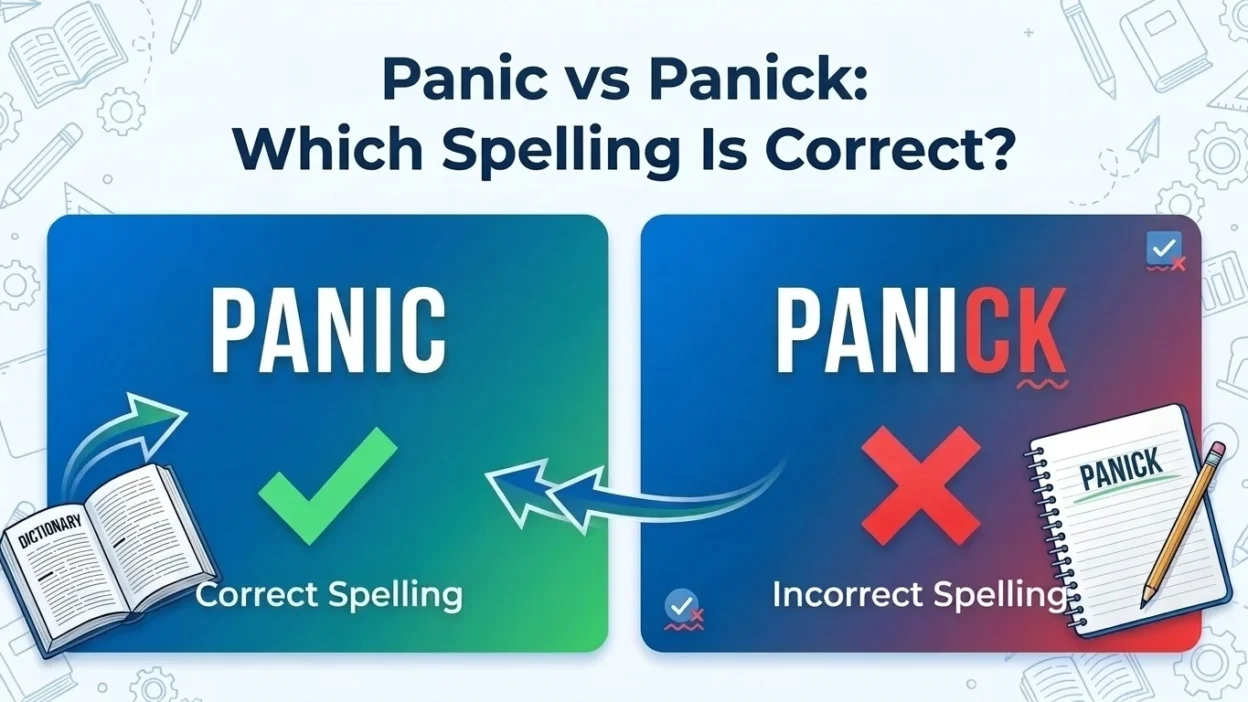
If you are wondering whether panic or panick is correct, the standard English spelling is panic. Panick is a misspelling. The word panic can be a noun meaning a sudden feeling of extreme fear or anxiety, or a verb meaning to become extremely frightened or worried. For example, “She began to panic when she could not find her keys.”
The confusion usually happens when people try to form the past tense or present participle of panic. Unlike some verbs that simply add -ed or -ing, panic changes its spelling before these endings: panic → panicked and panic → panicking. The k is added before -ed or -ing to keep the hard /k/ sound. Understanding this spelling pattern can help students, ESL learners, and writers use the word correctly in everyday and formal writing.
Quick Answer
Panic is the correct spelling, while panick is incorrect. The word panic is used as both a noun and a verb. When adding -ed or -ing, it becomes panicked and panicking. For example, “He began to panic,” but “He panicked when he heard the alarm.”
Why Do People Confuse It?
People may confuse panic and panick because the word ends with a c that sounds like k. When spelling the word based on pronunciation, it can seem reasonable to add another k.
However, the base word is simply:
panic ✅
Not:
panick ❌
The confusion becomes more understandable when forming related words. Before -ed and -ing, the spelling changes:
- panic → panicked
- panic → panicking
The letter k is added in these forms to preserve the hard k sound before a vowel-ending suffix.
First Word: Panic
Panic is the correct English spelling.
As a noun, panic means a sudden and powerful feeling of fear or worry.
The news caused widespread panic.
As a verb, panic means to suddenly become very frightened or worried and have difficulty thinking calmly.
Try not to panic during the emergency.
The word can describe an individual’s reaction or a broader reaction among a group of people.
Panic as a Noun
Examples include:
- a moment of panic
- sudden panic
- widespread panic
- panic attack
- panic button
- panic buying
Panic as a Verb
Examples include:
- panic quickly
- panic easily
- panic over something
- panic when something happens
For example:
Don’t panic if you make a small mistake.
Second Word: Panick
Panick is an incorrect spelling of panic.
The extra k does not belong in the base word.
Incorrect:
Don’t panick when something goes wrong.
Correct:
Don’t panic when something goes wrong.
However, the letter k does appear when forming some grammatical forms of the word:
- panic → panicked
- panic → panicking
Therefore, it is important to distinguish the base word panic from its inflected forms.
Panic vs Panick: Comparison Table
| Word | Correct? | Meaning | Example |
|---|---|---|---|
| panic | ✅ Yes | A sudden feeling of fear; or to become very frightened | Try not to panic. |
| panick | ❌ No | Incorrect spelling of panic | Try not to panick. |
The key point is simple: panic is the correct base word, while panick is not.
When to Use Each
When to Use “Panic”
Use panic when you are referring to a sudden feeling of extreme fear or worry, or when describing the action of becoming frightened or anxious.
For example:
There was panic after the alarm sounded.
Or:
She started to panic when she realized she was lost.
When to Use “Panick”
Do not use panick as the base spelling of the word.
If you want the verb in a sentence such as “Do not ___,” use:
Do not panic.
If you need the past tense, use:
He panicked.
If you need the present participle, use:
She is panicking.
10+ Examples of Panic
- Try not to panic when things go wrong.
- She began to panic when she lost her phone.
- The sudden noise caused panic among the crowd.
- He panicked when he could not find his passport.
- The passengers started to panic after the announcement.
- There was widespread panic after the unexpected news.
- She is panicking because she cannot find her wallet.
- Don’t panic; we still have plenty of time.
- The driver began to panic when the car stopped.
- His calm response helped prevent panic.
- The children panicked when they could not see their parents.
- She tried to remain calm instead of giving in to panic.
These examples show how panic can function as both a noun and a verb, while panicked and panicking are the appropriate forms when the grammar requires them.
Common Mistakes
One common mistake is adding k to the base word:
Incorrect:
Don’t panick.
Correct:
Don’t panic.
Another common mistake is forming the past tense incorrectly:
Incorrect:
She paniced when she heard the noise.
Correct:
She panicked when she heard the noise.
The same pattern appears with the -ing form:
Incorrect:
He is panicing.
Correct:
He is panicking.
The spelling changes because the k helps preserve the hard /k/ sound before e or i.
Memory Trick
Remember this simple rule:
Panic has C, but panicked and panicking get K.
Think of the pattern:
panic → panicked → panicking
The base word ends in c, but the k appears when adding -ed or -ing.
You can also remember:
C in panic, K in panicked.
This makes it easier to avoid writing panick as the base word.
American vs British English
The spelling of panic is the same in American and British English.
Both use:
panic ✅
panick ❌
The related forms are also spelled the same:
- panicked
- panicking
Pronunciation can vary slightly between English accents, but these spelling forms remain standard in both varieties.
Similar Words
Several words are related to panic, but they have slightly different meanings.
Fear
Fear is the feeling caused by danger, threat, or uncertainty.
She felt fear when she heard the strange noise.
Anxiety
Anxiety refers to worry, nervousness, or unease, often about something uncertain.
He felt anxiety before the interview.
Alarm
Alarm can mean sudden fear or concern caused by a perceived danger.
The announcement caused alarm among residents.
Fright
Fright means sudden fear or shock.
The loud sound gave her a fright.
Dread
Dread describes strong fear or worry about something expected or anticipated.
He felt dread before opening the letter.
Distress
Distress refers to serious emotional upset or suffering.
The situation caused considerable distress.
These words can overlap with panic, but they are not exact substitutes in every sentence.
Final Verdict
The correct spelling is panic.
Panick is a misspelling and should not be used as the standard form of the word. Remember that panic can be both a noun and a verb.
The spelling changes when you add certain endings:
panic → panicked
panic → panicking
So, write:
Don’t panic.
Not:
Don’t panick.
Frequently Asked Questions
Is it panic or panick?
The correct spelling is panic. Panick is a misspelling.
Is panick a real word?
No. Panick is not the standard English spelling. The correct base word is panic.
Why does panicked have a k?
The k is added to preserve the hard /k/ sound before the -ed ending. Therefore, panic becomes panicked.
Is it panicking or panicing?
The correct spelling is panicking, with a k before -ing.
What is the past tense of panic?
The past tense is panicked.
She panicked when she missed the train.
What is the meaning of panic?
Panic can mean a sudden feeling of extreme fear or worry. As a verb, it means to become extremely frightened or worried.
Is panic spelled differently in British English?
No. Panic has the same spelling in American and British English.
How do you remember the spelling of panic?
Remember: panic has a c, but its -ed and -ing forms use k: panicked and panicking.
Remember This
Panic = correct ✅
Panick = incorrect ❌
Remember the three forms:
Panic → Panicked → Panicking
The base word ends in c, while k is added before -ed and -ing.
So:
Don’t panic.
Not:
Don’t panick.
Conclusion
The difference between panic vs panick is simple: panic is the correct English spelling, while panick is incorrect. Panic can work as a noun describing a sudden feeling of fear, or as a verb meaning to become very frightened or worried.
When you change panic into related forms, remember the spelling pattern panic → panicked → panicking. The added k helps preserve the hard /k/ sound. By remembering this pattern, you can avoid common spelling mistakes and use the word confidently in everyday, academic, and professional writing.