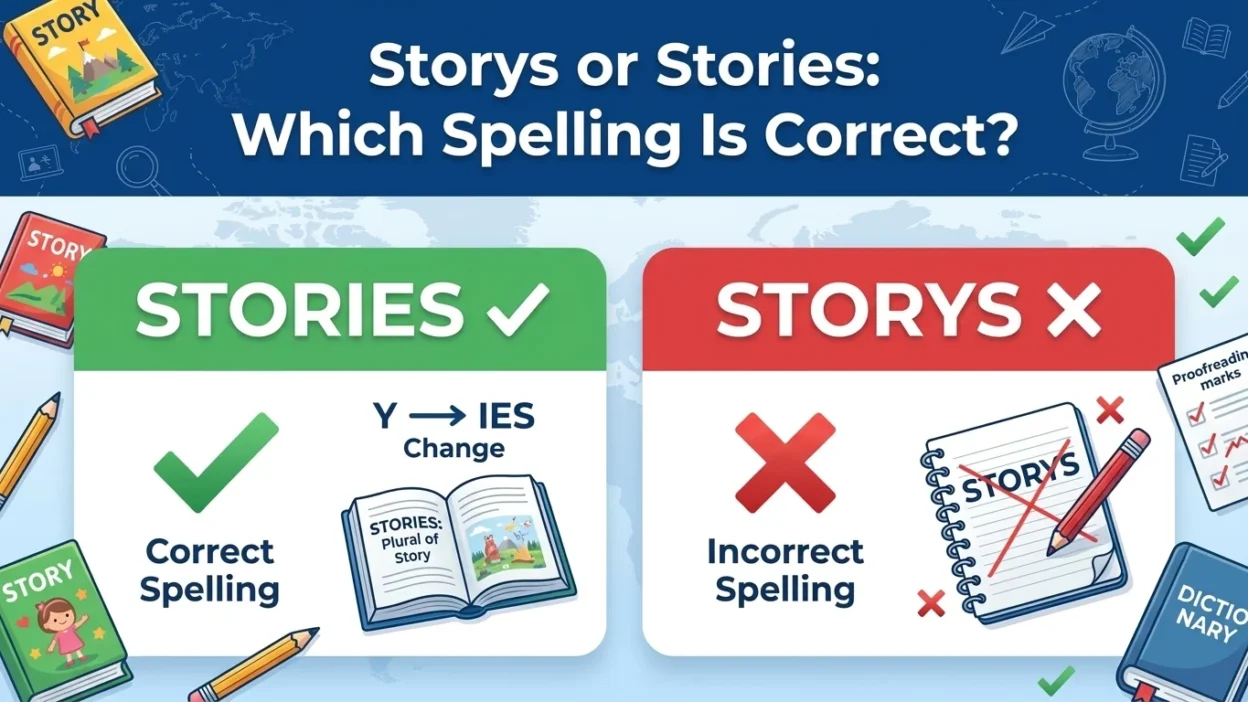
If you are wondering whether storys or stories is correct, the standard English spelling is stories. Storys is incorrect. Stories is the plural form of story, meaning more than one narrative, account, or sequence of events. For example, “She enjoys reading short stories before bed.”
This spelling can be confusing because story ends in -y, and many English nouns form plurals simply by adding -s. However, when a noun ends in a consonant followed by y, the y usually changes to ie before the plural s is added. Therefore, story becomes stories, not storys. Learning this spelling pattern can help students, ESL learners, writers, and general readers use plural nouns correctly in essays, emails, articles, and everyday conversations.
Quick Answer
Stories is the correct plural spelling of story, while storys is incorrect. Because story ends in a consonant followed by y, the y changes to ie before adding s. Therefore, the correct form is story → stories. For example, “I read three stories.”
Why Do People Confuse It?
People often confuse storys and stories because the most common way to make an English noun plural is to add -s.
For example:
- book → books
- car → cars
- table → tables
This may make storys seem logical. However, nouns ending in a consonant + y generally follow a different plural spelling pattern.
The y changes to ie, and then s is added:
story → stories
The same pattern appears in words such as:
- city → cities
- baby → babies
- family → families
- country → countries
- library → libraries
Therefore, remembering the -ies pattern makes the spelling of stories much easier.
First Word: Storys
Storys is an incorrect spelling.
It is formed by simply adding -s to story, but standard English changes the final y to ie when forming the plural.
Incorrect:
I read several storys yesterday.
Correct:
I read several stories yesterday.
You should avoid storys in academic writing, professional communication, articles, and other forms of standard English.
Second Word: Stories
Stories is the correct plural form of story.
A story can be a narrative about real or fictional events. It can also refer to an account of something that happened.
When there is more than one story, the plural form is stories.
Examples include:
- short stories
- children’s stories
- true stories
- success stories
- personal stories
- bedtime stories
- funny stories
- fictional stories
The spelling changes like this:
story → stories
Storys vs Stories: Comparison Table
| Word | Correct? | Meaning | Example |
|---|---|---|---|
| storys | ❌ No | Incorrect plural spelling of story | I read three storys. |
| stories | ✅ Yes | Plural of story | I read three stories. |
The key difference is the ending. Stories changes y to ie before adding s.
When to Use Each
When to Use “Storys”
You should not use storys in standard English.
If you mean more than one story, always use stories.
When to Use “Stories”
Use stories when referring to two or more narratives, accounts, or descriptions of events.
Common expressions include:
- interesting stories
- funny stories
- true stories
- fictional stories
- personal stories
- success stories
- short stories
- bedtime stories
- children’s stories
- inspiring stories
For example:
The book contains several interesting stories.
10+ Examples of Stories
- She enjoys reading stories before bed.
- The children listened to several stories.
- He writes short stories in his free time.
- The book contains ten different stories.
- We shared funny stories about our childhood.
- These stories teach valuable lessons.
- She loves listening to true stories.
- The website publishes inspiring stories every week.
- The teacher asked students to write their own stories.
- I heard several interesting stories during the trip.
- These stories are based on real events.
- The collection includes traditional stories from different cultures.
Each example uses stories because the sentence refers to more than one story.
Common Mistakes
The most common mistake is adding -s directly to story.
Incorrect:
She writes short storys.
Correct:
She writes short stories.
Another common mistake is forgetting the spelling pattern for nouns ending in consonant + y.
Remember:
story → stories
The same rule applies to:
- city → cities
- company → companies
- family → families
- country → countries
- party → parties
However, this rule does not apply to every word ending in y. When the letter before y is a vowel, the word usually keeps the y and simply takes -s.
For example:
- boy → boys
- toy → toys
- key → keys
- day → days
Memory Trick
A simple way to remember the spelling is:
One story, many stories.
Think of the ending as:
Y → IES
So:
STORY → STORIES
You can also remember:
Stories have “ies.”
Whenever you need the plural of story, change the final y to ie, then add s.
American vs British English
There is no spelling difference between American and British English for stories.
Both varieties use:
stories ✅
And both consider:
storys ❌
an incorrect plural spelling.
The word story can have slightly different meanings in different contexts. For example, in British English, storey is commonly used for a level of a building, while American English generally uses story for this meaning. However, the plural of the narrative noun story is stories in both varieties.
Similar Words
Several words can be related to stories, depending on the context.
Tales
Tales are stories, often referring to traditional, imaginative, or entertaining narratives.
She enjoys reading fairy tales.
Narratives
Narratives are accounts or descriptions of events, either real or fictional.
The book contains several personal narratives.
Accounts
Accounts are descriptions or reports of events or experiences.
He gave detailed accounts of his travels.
Anecdotes
Anecdotes are short and interesting stories about real events or people.
She shared several funny anecdotes.
Reports
Reports provide information about events, situations, or findings.
The newspapers published reports about the incident.
These words can overlap with stories, but their meanings and uses are not always identical.
Final Verdict
The correct spelling is stories.
Storys is incorrect because the plural of story changes the final y to ie before adding s:
story → stories
For example:
Correct: I read three stories.
Incorrect: I read three storys.
The easiest way to remember the spelling is to focus on the -ies ending in stories.
Frequently Asked Questions
Is it storys or stories?
The correct spelling is stories. Storys is incorrect.
What is the plural of story?
The plural of story is stories.
one story → two stories
Why does story become stories?
Because story ends in a consonant followed by y. When forming the plural, the y changes to ie, followed by s.
Is storys a real word?
No. Storys is not the standard plural spelling of story. The correct form is stories.
How do you spell stories correctly?
The correct spelling is s-t-o-r-i-e-s: stories.
Is stories spelled the same in British and American English?
Yes. Stories is spelled the same way in both British and American English.
What is the difference between story and stories?
Story refers to one narrative or account, while stories refers to more than one.
What are similar words to stories?
Depending on the context, similar words include tales, narratives, accounts, anecdotes, and reports.
Remember This
Stories = correct ✅
Storys = incorrect ❌
Remember the simple pattern:
STORY → STORIES
The final y changes to ie, and then s is added.
So write:
She reads many stories.
Not:
She reads many storys.
Conclusion
The difference between storys or stories is a simple plural spelling issue. Stories is the correct plural form of story, while storys is a misspelling. When a noun such as story ends in a consonant followed by y, the y changes to ie before the plural s is added.
This same spelling pattern appears in words such as city → cities, family → families, and country → countries. However, remember that words ending in a vowel + y, such as boy and toy, usually keep the y and simply add -s. With practice, recognizing these patterns becomes much easier.