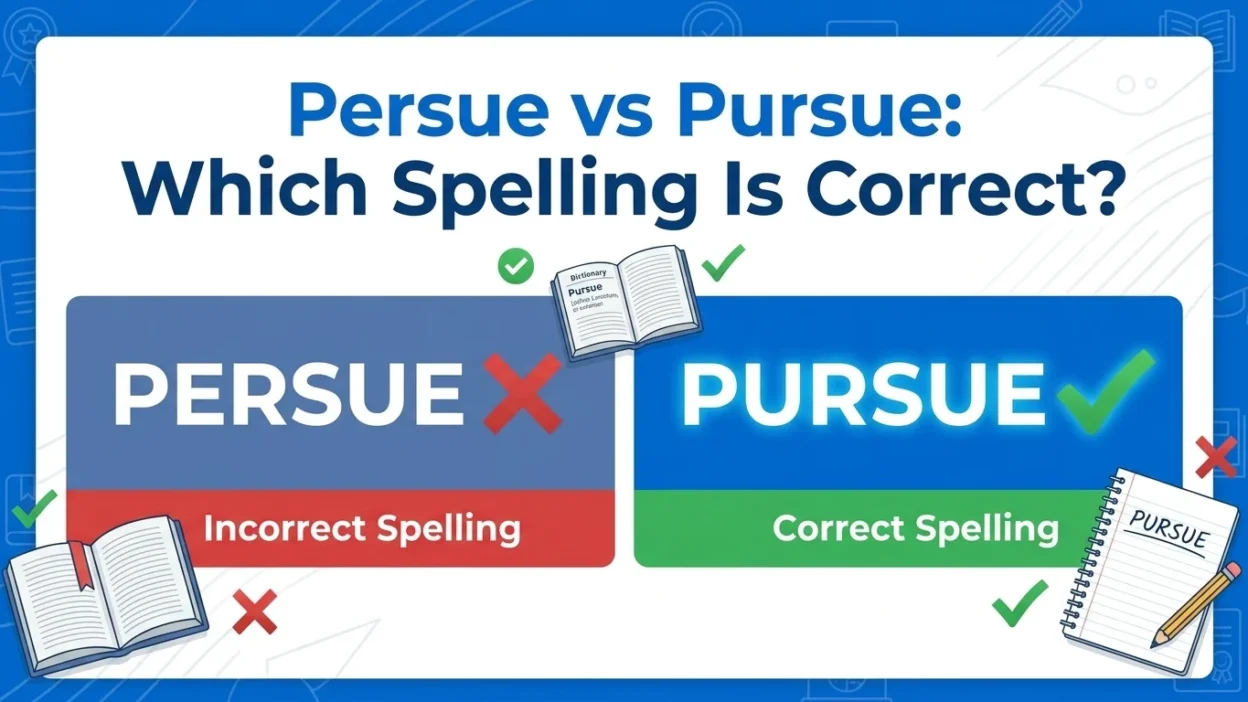
If you are wondering whether persue or pursue is correct, the answer is simple: pursue is the correct spelling. Persue is a common spelling mistake and is not the standard English word. The verb pursue means to follow, chase, continue, or work toward something, such as a goal, career, interest, or opportunity.
Because the two spellings look and sound similar, it is easy to confuse them, especially when writing quickly or learning English. However, using the correct spelling is important in school assignments, professional writing, emails, and everyday communication. In this guide, you will learn why this mistake happens, what pursue means, how to use it correctly, and how to remember its spelling. You will also see practical examples and answers to common questions about persue vs pursue.
Quick Answer
Pursue is the correct English spelling, while persue is a misspelling. Use pursue when you mean to follow, chase, continue, or work toward something. For example, “She plans to pursue a career in medicine.” Remember: the correct spelling contains pur, not per.
Why Do People Confuse Persue and Pursue?
People often confuse persue and pursue because they are visually similar and have a similar pronunciation. When writing from memory, it can be tempting to spell the word with per, especially because many familiar English words begin with “per.”
However, the correct spelling is pursue, with pur after the initial p.
Another reason for the confusion is that the word contains an unusual letter combination. The sequence -rsue may not look natural to beginners, so writers sometimes change it to the more familiar-looking persue.
Therefore, if you are unsure, remember that pursue is the only standard spelling of this word.
First Word: Persue
Persue is an incorrect spelling of pursue.
It is not the standard English spelling and should not be used in formal or careful writing. For example, writing “I want to persue my dreams” is incorrect.
Instead, write:
I want to pursue my dreams.
Although persue may appear in informal writing, online posts, or user-generated content, its appearance does not make it a correct spelling.
Second Word: Pursue
Pursue is the correct spelling.
It is a verb with several related meanings. Most commonly, it means to follow or chase something, or to continue trying to achieve something.
For example:
- The police pursued the suspect.
- She decided to pursue her dream.
- He wants to pursue a career in teaching.
- They pursued a new business opportunity.
The meaning depends on the context. You can pursue a person, pursue an opportunity, pursue a goal, pursue an interest, or pursue a course of action.
What Does Pursue Mean?
Pursue can mean:
- to follow or chase someone or something
- to try to achieve a goal
- to continue doing something
- to seek an opportunity
- to develop an interest or career
For example, “He pursued his education” means that he continued working toward his educational goals.
Persue vs Pursue: Comparison Table
| Word | Correct? | Meaning | Example |
|---|---|---|---|
| persue | ❌ No | Misspelling of pursue | I want to persue my goals. |
| pursue | ✅ Yes | To follow, chase, seek, or work toward something | I want to pursue my goals. |
The key difference is spelling. Persue is incorrect, while pursue is the correct English word.
When to Use Each
When to Use “Persue”
In standard English, you should not use “persue.”
If you see this spelling while proofreading, editing, or checking an assignment, replace it with pursue when that is the intended word.
When to Use “Pursue”
Use pursue when you mean to follow, chase, seek, or work toward something.
Common combinations include:
- pursue a goal
- pursue a dream
- pursue a career
- pursue an education
- pursue an opportunity
- pursue an interest
- pursue a degree
- pursue a relationship
- pursue a plan
- pursue a case
10+ Examples of Pursue in Sentences
- She wants to pursue a career in medicine.
- He decided to pursue his dream of becoming a writer.
- The athlete continued to pursue excellence.
- They are planning to pursue a new business opportunity.
- She chose to pursue higher education abroad.
- The detective continued to pursue the case.
- He worked hard to pursue his long-term goals.
- The company decided to pursue a different strategy.
- She hopes to pursue her interest in photography.
- The dog began to pursue the ball.
- He wants to pursue a degree in engineering.
- They decided to pursue legal action.
Notice that pursue can describe both physical action and the effort to achieve something. You can pursue a person, but you can also pursue an abstract goal such as success, knowledge, or happiness.
Common Mistakes
The most common mistake is replacing pur with per.
Incorrect:
I want to persue my dreams.
Correct:
I want to pursue my dreams.
Another common mistake is assuming that persue is an alternative spelling. It is not a standard variant of pursue.
Also, do not confuse pursue with related words such as purpose or persuade. These words have different meanings and spellings.
For example:
- Pursue = follow or work toward something
- Persuade = convince someone
- Purpose = the reason for doing something
Memory Trick: Remember “PUR” in Pursue
A simple way to remember the spelling is:
Pursue = PUR + SUE
Think:
PURsue your goals.
You can also remember the phrase:
“Pursue your purpose.”
Both words begin with pur, which can help you remember the correct spelling.
Therefore, whenever you are choosing between persue and pursue, look for pur. If you see per, check the spelling again.
American vs British English
There is no spelling difference between American and British English for pursue.
Both varieties use:
pursue ✅
And both consider:
persue ❌
an incorrect spelling of the word.
The pronunciation and meaning may be encountered in different accents, but the standard written spelling remains pursue in both American and British English.
Similar Words
Several words are related to pursue, although they are not always exact replacements.
Follow
Follow means to go after someone or something or to come after it.
The child followed his father home.
Chase
Chase usually suggests actively trying to catch someone or something.
The dog chased the ball.
Seek
Seek means to try to find, obtain, or achieve something.
She is seeking a better opportunity.
Aim for
Aim for means to try to achieve a particular result.
He is aiming for a higher score.
Work toward
Work toward emphasizes making continued effort to reach a goal.
They are working toward financial independence.
Continue
Continue focuses on carrying on with an activity rather than stopping.
She continued her studies after graduation.
Thus, pursue can overlap with several of these words, but the best replacement depends on the exact context.
Final Verdict
The correct spelling is pursue.
Persue is a misspelling and should be avoided in standard English. Use pursue when you mean to follow, chase, seek, or work toward something.
For example:
Correct: She plans to pursue her goals.
Incorrect: She plans to persue her goals.
The easiest way to remember the difference is to focus on PUR in pursue.
Frequently Asked Questions
Is “persue” a correct word?
No. Persue is a misspelling of pursue. The standard English spelling is pursue.
Is it “persue” or “pursue”?
It is pursue. Use this spelling when you mean to follow, chase, seek, or work toward something.
What is the meaning of pursue?
Pursue means to follow or chase something, or to make an effort to achieve or obtain something. For example, “She wants to pursue a career in science.”
How do you spell pursue correctly?
The correct spelling is p-u-r-s-u-e: pursue.
Why is “persue” wrong?
Persue is not the standard spelling of the English verb pursue. The correct form contains pur after the first letter.
Is pursue used in American English?
Yes. Pursue is the standard spelling in American English.
Is pursue used in British English?
Yes. Pursue is also the standard spelling in British English. There is no British-American spelling difference for this word.
What is an example of pursue?
A simple example is: “She decided to pursue her dream of becoming a teacher.” Here, pursue means to work toward achieving her dream.
Remember This
Pursue = correct ✅
Persue = incorrect ❌
When you mean follow, chase, seek, or work toward, use pursue.
A quick memory tip is:
PUR + SUE = PURSUE
So, do not write persue your goals. Instead, write pursue your goals.
Conclusion
The difference between persue vs pursue is straightforward once you remember the correct spelling. Pursue is the standard English word, while persue is a common misspelling. The verb pursue can mean to follow or chase something, but it can also describe working toward a goal, career, dream, opportunity, or interest.
Therefore, whenever you are writing about achieving something or following something, choose pursue. Remember the PUR at the beginning, check your spelling carefully, and you will avoid one of the common spelling mistakes associated with this word.