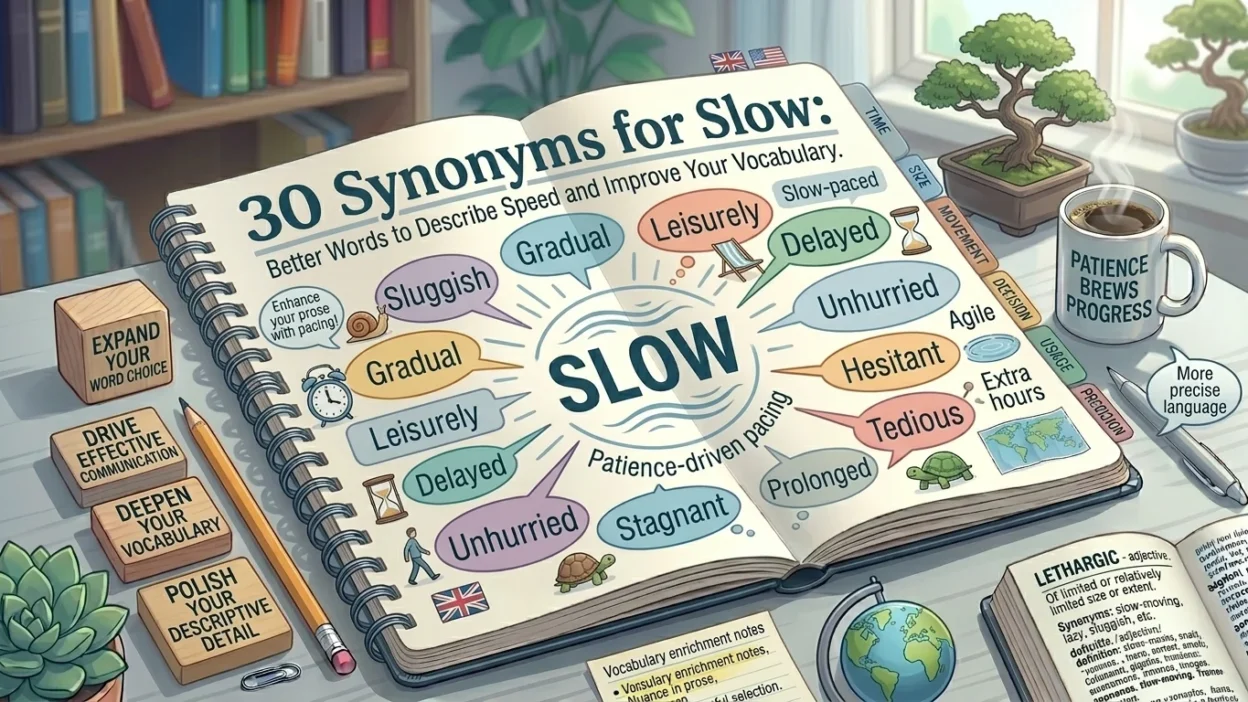
The word slow is a common English word used to describe low speed, delayed actions, gradual progress, or a lack of quick movement. It can describe people, objects, processes, learning, or changes over time.
While “slow” is simple and useful, using it repeatedly can make your writing less interesting. Learning different synonyms for slow helps students, ESL learners, writers, and content creators express ideas more accurately.
In this guide, you will learn the meaning of “slow,” discover 30 useful alternatives, understand their differences, and learn when to use each word naturally.
What Does “Slow” Mean?
The word slow means moving, happening, or developing at a low speed. It can describe physical movement, progress, reactions, or time.
Examples:
- The car is slow.
- The internet connection is slow.
- The project is moving slowly.
Although “slow” is easy to use, choosing a more specific synonym can make your writing clearer and more professional.
30 Synonyms for Slow
1. Sluggish
Meaning: Moving or working slowly with little energy.
Example Sentence: The old computer became sluggish.
Best Usage Context: Technology and performance.
2. Slow-paced
Meaning: Happening at a relaxed speed.
Example Sentence: The movie has a slow-paced story.
Best Usage Context: Activities and lifestyles.
3. Gradual
Meaning: Happening slowly over time.
Example Sentence: She noticed gradual improvement in her skills.
Best Usage Context: Progress and changes.
4. Leisurely
Meaning: Slow and relaxed.
Example Sentence: They enjoyed a leisurely walk.
Best Usage Context: Relaxed activities.
5. Delayed
Meaning: Happening later than expected.
Example Sentence: The flight was delayed because of weather.
Best Usage Context: Events and schedules.
6. Unhurried
Meaning: Calm and without rushing.
Example Sentence: He took an unhurried approach to the task.
Best Usage Context: Calm actions.
7. Steady
Meaning: Moving slowly but consistently.
Example Sentence: The company showed steady growth.
Best Usage Context: Progress and development.
8. Sluggishly
Meaning: In a slow and weak way.
Example Sentence: The website loaded sluggishly.
Best Usage Context: Performance issues.
9. Gradually
Meaning: Slowly over a period of time.
Example Sentence: The weather gradually became warmer.
Best Usage Context: Changes and improvement.
10. Late
Meaning: Not happening at the expected time.
Example Sentence: He arrived late to the meeting.
Best Usage Context: Time situations.
11. Leisurely-paced
Meaning: Moving at a comfortable speed.
Example Sentence: They followed a leisurely-paced schedule.
Best Usage Context: Travel and relaxation.
12. Moderate
Meaning: Not fast or extreme.
Example Sentence: The company experienced moderate growth.
Best Usage Context: Balanced progress.
13. Cautious
Meaning: Slow because of careful thinking.
Example Sentence: She took a cautious approach before deciding.
Best Usage Context: Decisions and actions.
14. Hesitant
Meaning: Slow because of uncertainty.
Example Sentence: He was hesitant to answer.
Best Usage Context: People and choices.
15. Dragging
Meaning: Taking too much time.
Example Sentence: The meeting was dragging on.
Best Usage Context: Tasks and events.
16. Lethargic
Meaning: Slow because of tiredness or low energy.
Example Sentence: He felt lethargic after a long day.
Best Usage Context: People and feelings.
17. Idle
Meaning: Not active or moving.
Example Sentence: The machine remained idle for hours.
Best Usage Context: Work and machines.
18. Inactive
Meaning: Not moving or operating.
Example Sentence: The account has been inactive for months.
Best Usage Context: Systems and activities.
19. Stagnant
Meaning: Not developing or improving.
Example Sentence: The business entered a stagnant period.
Best Usage Context: Growth and progress.
20. Wearisome
Meaning: Slow and tiring.
Example Sentence: The process became wearisome.
Best Usage Context: Long tasks.
21. Lingering
Meaning: Lasting longer than expected.
Example Sentence: A lingering problem affected the team.
Best Usage Context: Problems and feelings.
22. Tedious
Meaning: Slow and boring.
Example Sentence: The paperwork was tedious.
Best Usage Context: Tasks and processes.
23. Time-consuming
Meaning: Taking a lot of time.
Example Sentence: Editing videos can be time-consuming.
Best Usage Context: Work and activities.
24. Behind
Meaning: Late or slower than expected.
Example Sentence: The project is behind schedule.
Best Usage Context: Deadlines.
25. Weak
Meaning: Slow because of low power or ability.
Example Sentence: The weak signal made the connection slow.
Best Usage Context: Performance.
26. Dull
Meaning: Slow and lacking energy.
Example Sentence: The presentation felt dull.
Best Usage Context: Experiences and events.
27. Plodding
Meaning: Moving slowly and heavily.
Example Sentence: The story had a plodding pace.
Best Usage Context: Writing and movement.
28. Inactive
Meaning: Not operating or progressing.
Example Sentence: The project remained inactive for weeks.
Best Usage Context: Systems and plans.
29. Prolonged
Meaning: Continuing for a long time.
Example Sentence: The discussion became prolonged.
Best Usage Context: Events and situations.
30. Gradual-moving
Meaning: Developing slowly.
Example Sentence: The gradual-moving process required patience.
Best Usage Context: Long-term progress.
Comparison Table: When to Use Different Synonyms for Slow
| Synonym | Tone | Best Used For |
|---|---|---|
| Sluggish | Negative | Poor performance |
| Gradual | Neutral | Progress |
| Leisurely | Positive | Relaxed activities |
| Delayed | Formal | Timing issues |
| Steady | Positive | Growth |
| Hesitant | Emotional | Decisions |
| Stagnant | Negative | Lack of progress |
| Tedious | Negative | Boring tasks |
| Prolonged | Formal | Long situations |
| Cautious | Neutral | Careful actions |
How to Choose the Right Synonym for Slow
For Physical Movement
Use:
- Sluggish
- Leisurely
- Slow-paced
- Plodding
These describe speed and motion.
For Progress and Development
Use:
- Gradual
- Steady
- Moderate
- Stagnant
These describe growth and change.
For Delays and Time Problems
Use:
- Delayed
- Late
- Behind
- Prolonged
These describe timing issues.
For People and Actions
Use:
- Hesitant
- Cautious
- Lethargic
- Unhurried
These describe behavior and decisions.
Common Mistakes When Using Synonyms for Slow
Using Negative Words for Neutral Situations
Example:
“The project has gradual progress.”
This is neutral.
“The project has sluggish progress.”
This sounds negative.
Confusing Slow With Bad
Slow does not always mean poor quality. Sometimes slow means careful or steady.
Example:
“She made a cautious decision.”
This shows care, not weakness.
Using Formal Words in Casual Speech
Words like “prolonged” and “stagnant” may sound too formal in everyday conversation.
Why Learn Synonyms for Slow?
Learning alternatives helps you:
- Improve vocabulary
- Avoid repetition
- Describe situations accurately
- Write better essays and content
- Communicate more clearly
A wider vocabulary helps you express different meanings instead of using one simple word.
Conclusion
Learning synonyms for slow helps you describe speed, progress, and actions with more accuracy. Words like sluggish, gradual, delayed, steady, leisurely, cautious, and prolonged allow you to express different types of slowness.
The right synonym depends on your meaning, tone, and situation. By practicing these words, students, ESL learners, writers, and content creators can improve their English skills and create more effective writing.