
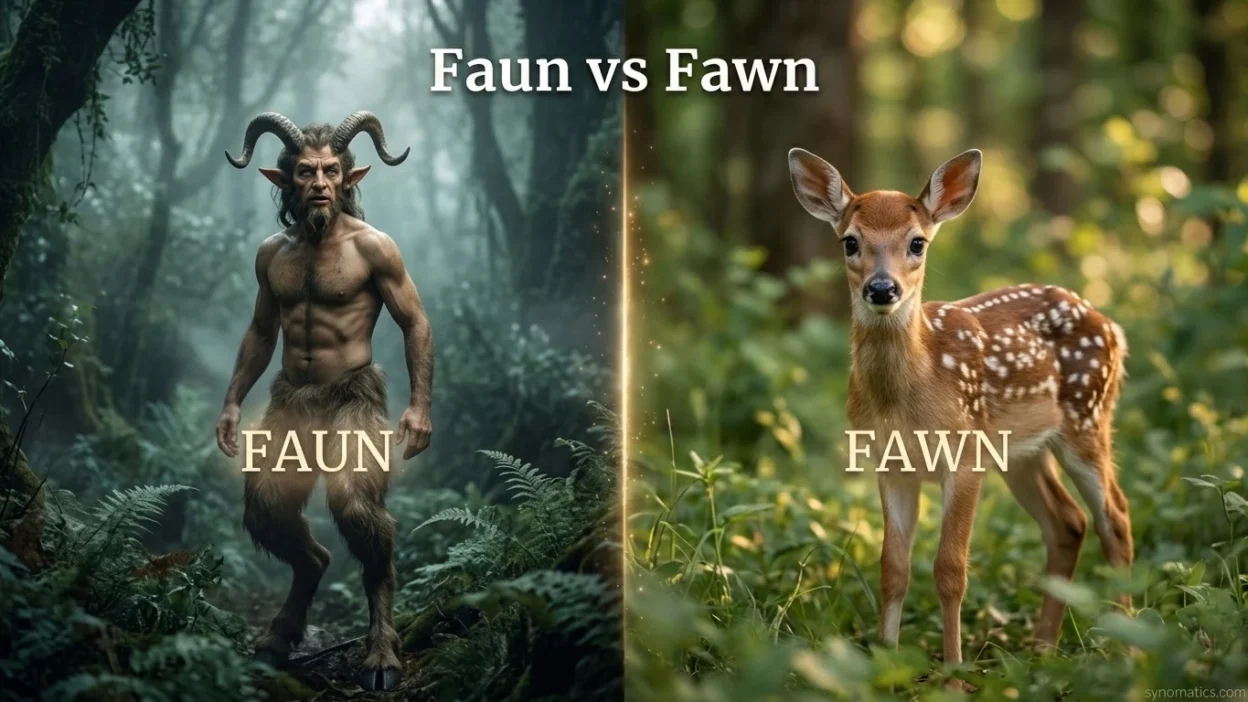
The words faun vs fawn may look almost identical, but they have completely different meanings. A faun is a mythical creature from ancient Roman mythology, usually depicted with human features and the legs, ears, or horns of a goat. A fawn, on the other hand, is a young deer. Understanding the difference between these two words helps you choose the correct spelling when writing about mythology, wildlife, or nature.
Although both words are pronounced similarly in many English accents, their meanings and uses are easy to distinguish once you learn their definitions. A faun belongs to the world of myths and legends, while a fawn is a real animal found in nature. The words can also appear in different contexts, such as fantasy stories, wildlife documentaries, children’s books, and descriptive writing. This guide explains the meaning of each word, shows how to use them in sentences, and provides simple memory tricks to help you remember the difference.
Quick Answer
Faun refers to a mythical creature from Roman mythology that is part human and part goat. Fawn means a young deer. Although the words look and sound similar, they describe different things. Use faun when discussing mythology and fawn when referring to a baby deer or the light brown color associated with deer.
Why Do People Confuse Faun and Fawn?
People often confuse faun and fawn because they differ by only one letter. In many English accents, they are pronounced exactly the same, making them homophones.
Both words are also associated with nature in different ways. A faun is traditionally connected with forests, animals, and the countryside through mythology. A fawn is a real woodland animal, usually recognized by its small body and spotted coat.
Here are the main reasons for the confusion:
- Similar spelling: Both words contain four letters and have a similar appearance.
- Similar pronunciation: In many accents, faun and fawn sound identical.
- Nature-related meanings: Both words can appear in descriptions of forests, wildlife, and outdoor settings.
- Different origins: One comes from mythology, while the other refers to a young deer.
The easiest solution is to remember that a faun is a mythical being, while a fawn is a young animal.
What Does Faun Mean?
A faun is a mythical creature from ancient Roman mythology. Fauns are commonly depicted as beings with a human upper body and goat-like features, such as pointed ears, horns, or goat legs.
Fauns are associated with forests, fields, nature, and rural life. They are often portrayed as playful or mischievous creatures in mythology, fantasy literature, paintings, and films.
Examples of Faun in Sentences
- The faun played a flute beneath an ancient tree.
- The fantasy novel featured a friendly faun who guided travelers through the forest.
- The artist painted a faun surrounded by woodland animals.
- In the story, a mysterious faun lived near a magical spring.
- The children discovered a statue of a faun in the garden.
Is a Faun a Real Animal?
No. A faun is a mythical creature rather than a real animal. It belongs to ancient Roman mythology and is often compared with the Greek satyr, although traditional depictions and characteristics can differ.
The word faun is especially useful when discussing mythology, fantasy stories, classical art, or imaginary woodland creatures.
What Does Fawn Mean?
A fawn is a young deer. The word commonly refers to a baby deer during its early stage of life, particularly when it has the spotted coat associated with many deer species.
Fawns are usually small and delicate. Their coats may feature white spots that help them blend into their surroundings. Adult deer often leave their young hidden in vegetation while they forage nearby.
The word fawn can also refer to a pale yellowish-brown color. In addition, to fawn is a verb meaning to behave in an excessively flattering or submissive way toward someone, usually to gain approval or favor.
Examples of Fawn in Sentences
- A fawn rested quietly in the tall grass.
- We spotted a young fawn near the edge of the forest.
- The mother deer returned to feed her fawn.
- The fawn’s spotted coat helped it blend into the woodland.
- She chose a fawn-colored jacket for the autumn season.
What Does Fawn Mean as a Verb?
As a verb, fawn means to flatter someone excessively or behave in an overly eager, submissive way.
For example:
- He continued to fawn over his manager to gain approval.
- The celebrity was surrounded by people who constantly fawned over her.
This meaning is different from the animal-related meaning, but the spelling remains the same.
Faun vs Fawn: Comparison Table
| Feature | Faun | Fawn |
|---|---|---|
| Main meaning | A mythical creature | A young deer |
| Origin | Roman mythology | The English word for a young deer |
| Real or mythical? | Mythical | Real animal |
| Pronunciation | /fɔːn/ in many dictionaries | /fɔːn/ in many dictionaries |
| Common contexts | Mythology, fantasy, art | Wildlife, nature, animal descriptions |
| Other meanings | Primarily a mythological being | A pale brown color; to flatter excessively |
| Example | The faun played a flute. | The fawn followed its mother. |
The key difference is meaning, not pronunciation. A faun belongs to mythology, while a fawn is a young deer.
When Should You Use Faun or Fawn?
Choose the word according to what you want to describe.
Use Faun When Talking About Mythology
Use faun when referring to a mythical creature with human and goat-like features.
Examples:
- The faun appeared in the ancient legend.
- A faun guarded the entrance to the enchanted forest.
- The museum displayed a Roman sculpture of a faun.
Use Fawn When Talking About a Young Deer
Use fawn when describing a baby deer or a young deer in its early stages.
Examples:
- The fawn stood beside its mother.
- A fawn crossed the path in front of us.
- The wildlife photographer captured a picture of a sleeping fawn.
Use Fawn for Color or Behavior
The word fawn can also describe a pale brown shade or excessive flattery.
Examples:
- The living room had fawn-colored walls.
- You do not need to fawn over someone to earn respect.
Quick rule: If the subject is a mythical creature, write faun. If it is a young deer, a color, or the act of flattering someone excessively, write fawn.
Faun vs Fawn: 12 Example Sentences
These examples show how the two words work in everyday and descriptive writing.
- Faun: The faun danced beside the river in the ancient story.
- Fawn: A little fawn rested under a tree.
- Faun: The artist created a wooden statue of a faun.
- Fawn: We saw a fawn moving through the meadow.
- Faun: The children read a fantasy tale about a friendly faun.
- Fawn: The mother deer watched over her fawn.
- Faun: A faun appeared in the painting of a magical forest.
- Fawn: The young fawn had white spots on its back.
- Faun: The mythical faun played music for the woodland spirits.
- Fawn: The fawn hid among the tall plants.
- Fawn: She painted the bedroom walls a soft fawn color.
- Fawn: He tried to fawn over his supervisor to get a promotion.
Notice that the correct word depends on the context. Even when the words sound the same, their meanings are not interchangeable.
Common Mistakes When Using Faun and Fawn
Writers sometimes choose the wrong spelling because the two words sound alike. The following mistakes are easy to avoid.
Mistake 1: Using Faun for a Baby Deer
Incorrect: The faun followed its mother through the field.
Correct: The fawn followed its mother through the field.
A young deer is a fawn, not a faun.
Mistake 2: Using Fawn for a Mythical Creature
Incorrect: The fawn played a magical flute in the legend.
Correct: The faun played a magical flute in the legend.
When describing the mythical human-goat creature, use faun.
Mistake 3: Assuming Both Words Have the Same Meaning
Although their pronunciation may be identical, their definitions are different. Similar sounds do not make two words interchangeable.
Mistake 4: Forgetting the Other Meanings of Fawn
The word fawn does not always refer to a deer. It can also describe a pale brown color or excessive flattery.
For example, “She wore a fawn coat” describes a color, while “He tends to fawn over wealthy people” describes behavior.
Memory Trick: How to Remember Faun vs Fawn
Use these simple associations to remember which spelling is correct.
- Faun = Fantasy: Both words begin with the letter F, and a faun is a fantasy creature from mythology.
- Fawn = Forest baby deer: Think of a young deer hiding in the forest.
- Fawn = Flattering: Remember that fawn over someone means to flatter that person excessively.
You can also remember this sentence:
“A faun belongs in a fantasy, while a fawn belongs with deer.”
This short phrase connects each spelling to its most common meaning and makes the distinction easier to remember.
American vs British English: Faun and Fawn
There is no major difference between American and British English in the spelling or core meanings of faun and fawn.
Both varieties use faun for the mythical creature and fawn for a young deer. The word fawn can also describe a light brown color or excessive flattery in both varieties.
Pronunciation may vary slightly by accent, but the words are homophones in many American and British accents.
Examples:
- American English: We saw a fawn near the woods.
- British English: We saw a fawn near the woodland.
- American English: The faun appeared in the fantasy movie.
- British English: The faun appeared in the fantasy film.
The wording in these examples reflects different common vocabulary choices, not a difference in the meaning or spelling of the two words.
Similar Words to Faun and Fawn
Learning related words can help you understand the difference more clearly.
Words Related to Faun
- Satyr: A creature from Greek mythology often depicted with human and goat-like features.
- Mythical creature: An imaginary being found in myths, legends, and folklore.
- Centaur: A creature from Greek mythology with a human upper body and a horse’s body.
- Nymph: A female nature spirit in Greek mythology.
These terms are associated with mythology, but each describes a different type of being.
Words Related to Fawn
- Deer: A hoofed mammal; a fawn is a young deer.
- Calf: A young animal of several species, including cattle and some deer species.
- Doe: An adult female deer.
- Buck: An adult male deer in many deer species.
- Fawn-colored: A pale yellowish-brown color.
Remember that calf, doe, and buck refer to different animal ages or sexes, depending on the species, while fawn specifically emphasizes a young deer.
FAQs:
1. What is the main difference between faun and fawn?
A faun is a mythical creature from Roman mythology, while a fawn is a young deer. The words are pronounced alike in many English accents, but they have different meanings and spellings.
2. Are faun and fawn homophones?
Yes. Faun and fawn are homophones in many English accents because they have the same pronunciation but different spellings and meanings.
3. Is a faun a real animal?
No. A faun is a mythical creature associated with Roman mythology. It is traditionally depicted with human and goat-like features.
4. Is a fawn a baby deer?
Yes. A fawn is a young deer. The term is commonly used for a young deer with a spotted coat.
5. Does fawn have more than one meaning?
Yes. Fawn can mean a young deer, a pale yellowish-brown color, or the act of flattering someone excessively when used as a verb.
6. How do you pronounce faun and fawn?
In many English accents, both words are pronounced /fɔːn/. Their pronunciation can vary by accent, but they are commonly homophones.
7. Is faun or fawn correct in a fantasy story?
Both can be correct, depending on the subject. Use faun for a mythical human-goat creature and fawn for a young deer that appears in the story.
Remember This
- Faun: A mythical creature from Roman mythology.
- Fawn: A young deer.
- Fawn: Also a pale brown color.
- To fawn: To flatter someone excessively.
- Easy memory trick: Faun = fantasy; fawn = young deer.
Conclusion
Understanding the difference between faun and fawn is simple once you connect each spelling to its meaning. A faun is a mythical creature associated with Roman mythology, while a fawn is a young deer. Both words may sound the same, but they are used in different contexts.
When writing about mythology, fantasy, or imaginary woodland beings, choose faun. When discussing wildlife, young deer, pale brown colors, or excessive flattery, choose fawn. Remembering these distinctions will help you avoid common spelling mistakes and communicate your ideas more clearly.